donny1963
No longer a newbie, moving up!
- Joined
- Dec 15, 2015
- Messages
- 371
- Reaction score
- 28
- Can others edit my Photos
- Photos NOT OK to edit
Here is something i wanted to point out, that many of you may not know Specially if you use a light meter..
Ok so you got this lens you paid $1,500.00 for it, and lets say for argument sake, a Sony Stm F2.8
Then you have another lens The sony 70-200 Gmaster F2,8 And so you would think you would get the same exposure using them at F2.8 on the same camera same settings Right?
Wrong!!!
First off let me say Not all lenses that are F2.8 or any other Aperture are really what they say.
It may say your lens is a F2.8 but that doesn't always mean your getting F2.8..
The real Spec (number) that you want to Look at for true accurate F-Stops is the T-stops spec
The difference between the F-stops number and the T-stops Number is basically this..
The F-stops is how much light that is allowed into the lens, the T-Stop number is what your actually getting in light out the end of the lens into the sensor, this makes a huge difference
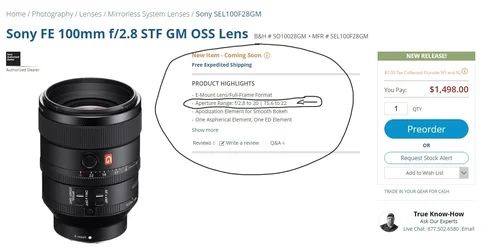
So for example the 2 lenses i mention the Sony STM f2.8 is Rated at T-stops 5.6 which is what your getting for light on the sensor, The sony Gmaster F2.8 is rated at T-stops 2.9 which is what you would think F.29 to be..
so the Gmaster is the same F2.8 rating as the STN 2.8 only the STN your only getting F5.6 when it comes down to actual light hitting your sensor, so it's really a 5.6 not a 2.8.
and you will notice, if your the type who uses an external light meter and shoot with them 2 F-2.8 lenses , your going to get a darker picture using the STM, because your light meter doesn't know your T-stops on your lens, so you would have to make adjustments..
So basically T-stops spec is what you really want to look for, if your really Expecting a lens to deliver the light you want to your sensor.. Now some manufactures are honest Like Sony on the STM they say F2.8 T-5.6, so far they are the only ones who have the balls to actually be honest and print that on their lens..
You need to dig further with other manufactures like Sigma , Tamron, Nikon, Canon , none of them will print the Actual T-stops on the lens. You can still find out by checking the specs and looking to what the T-stops are, but they don't make it so obvious,
and you have to dig to find this out..
And you should check this out because you might find out your precious F2.8 lens is not really delivering you F2.8 performance to your sensor and only getting 1/4 the light you though you would be getting..
So remember T-stops is what really counts, Not F-stops..
And some of the reasons for this is that the light that comes into a lens could be getting degraded when going through elements in your lens and gets degraded to less light once it hits your sensor..
This is not just the only reason they are others, but it's mostly because of the design of the lens and what it is TRULY able to deliver when it comes down to actual light at your sensor..
And a long time ago this was discovered when moving making, when they changed their lenses with the same F-stops but notice different results in exposure, so this is why, In photography lenses they label it F2.8 in cinematography, they label the lens T 2.8
and the reason that being is they wanted to know the actual light they are getting, to avoid exposure changes all of a sudden during the movie when they changed lenses..
This is why Photo Camera's lens manufacture's should change it to T-stops to avoid being misled.
Which is what is happening in many cases.
I bet some of you here thought your lens would be a F2.8 but in truth when it comes to real specs, your shooting with a
F5.6 Lens..
So F-stops means how much background Blur,
T-stops means how much light at you sensor..
you can check your lens at SDP.IO/DXOmark
website you can find the true specs of your lens..
This is something you all should check into, for instance i rented a mitakon f0.95 lens to check it out, and you think it would be a killer in low light shooting right? but i found out it wasn't better then a 50 MM F1.4 lens, and so the reason was the mitakon f0.95 is really only delivering T 1.4
So if you want to avoid being misled or let down from something like this start checking the lens T-Stops Not the F-stops , it makes all the difference in the world..
Donny
Ok so you got this lens you paid $1,500.00 for it, and lets say for argument sake, a Sony Stm F2.8
Then you have another lens The sony 70-200 Gmaster F2,8 And so you would think you would get the same exposure using them at F2.8 on the same camera same settings Right?
Wrong!!!
First off let me say Not all lenses that are F2.8 or any other Aperture are really what they say.
It may say your lens is a F2.8 but that doesn't always mean your getting F2.8..
The real Spec (number) that you want to Look at for true accurate F-Stops is the T-stops spec
The difference between the F-stops number and the T-stops Number is basically this..
The F-stops is how much light that is allowed into the lens, the T-Stop number is what your actually getting in light out the end of the lens into the sensor, this makes a huge difference
So for example the 2 lenses i mention the Sony STM f2.8 is Rated at T-stops 5.6 which is what your getting for light on the sensor, The sony Gmaster F2.8 is rated at T-stops 2.9 which is what you would think F.29 to be..
so the Gmaster is the same F2.8 rating as the STN 2.8 only the STN your only getting F5.6 when it comes down to actual light hitting your sensor, so it's really a 5.6 not a 2.8.
and you will notice, if your the type who uses an external light meter and shoot with them 2 F-2.8 lenses , your going to get a darker picture using the STM, because your light meter doesn't know your T-stops on your lens, so you would have to make adjustments..
So basically T-stops spec is what you really want to look for, if your really Expecting a lens to deliver the light you want to your sensor.. Now some manufactures are honest Like Sony on the STM they say F2.8 T-5.6, so far they are the only ones who have the balls to actually be honest and print that on their lens..
You need to dig further with other manufactures like Sigma , Tamron, Nikon, Canon , none of them will print the Actual T-stops on the lens. You can still find out by checking the specs and looking to what the T-stops are, but they don't make it so obvious,
and you have to dig to find this out..
And you should check this out because you might find out your precious F2.8 lens is not really delivering you F2.8 performance to your sensor and only getting 1/4 the light you though you would be getting..
So remember T-stops is what really counts, Not F-stops..
And some of the reasons for this is that the light that comes into a lens could be getting degraded when going through elements in your lens and gets degraded to less light once it hits your sensor..
This is not just the only reason they are others, but it's mostly because of the design of the lens and what it is TRULY able to deliver when it comes down to actual light at your sensor..
And a long time ago this was discovered when moving making, when they changed their lenses with the same F-stops but notice different results in exposure, so this is why, In photography lenses they label it F2.8 in cinematography, they label the lens T 2.8
and the reason that being is they wanted to know the actual light they are getting, to avoid exposure changes all of a sudden during the movie when they changed lenses..
This is why Photo Camera's lens manufacture's should change it to T-stops to avoid being misled.
Which is what is happening in many cases.
I bet some of you here thought your lens would be a F2.8 but in truth when it comes to real specs, your shooting with a
F5.6 Lens..
So F-stops means how much background Blur,
T-stops means how much light at you sensor..
you can check your lens at SDP.IO/DXOmark
website you can find the true specs of your lens..
This is something you all should check into, for instance i rented a mitakon f0.95 lens to check it out, and you think it would be a killer in low light shooting right? but i found out it wasn't better then a 50 MM F1.4 lens, and so the reason was the mitakon f0.95 is really only delivering T 1.4
So if you want to avoid being misled or let down from something like this start checking the lens T-Stops Not the F-stops , it makes all the difference in the world..
Donny
Last edited: