Gavjenks
TPF Noob!
- Joined
- May 9, 2013
- Messages
- 2,976
- Reaction score
- 588
- Location
- Iowa City, IA
- Can others edit my Photos
- Photos OK to edit
I'm having trouble figuring out a basic approach for how to do this in software (I can write my own image programs, but I don't get the algorithm yet).
The basic idea is this:
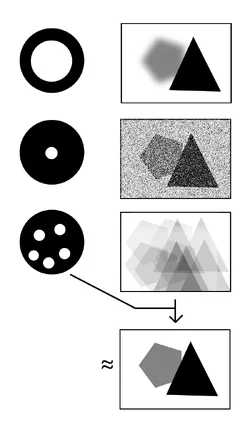
Large aperture = shallow depth of field, but low ISOs can be used to make non-noisy images in low light
Small single aperture = deep depth of field, but high ISOs are needed, making it hard to use in low light.
Multiple small apertures = overlapping deep depth of field images, and oevrall fast shutter speed and low ISO from total large amount of light. With proper software, and a known location of where each aperture hole was relative to the optical axis, these multiple overlapping images can be resolved back into a single image (more or less). The result is a usually slightly flawed, but overall pretty high quality and sharp single deep depth of field image taken with low ISO / high shutter speed even in low light.
Any help with what sort of algorithm might be involved in decoding that overlapping image would be appreciated. In case anybody has experience with this. I could probably muddle through myself if I have to, but it would take a lot longer.
There are various websites that look at this, but they all talk about it at ridiculously confusing high theoretical math levels, not practical implementation levels, so it would be nicer if I could talk to a real person with experience.
The basic idea is this:
Large aperture = shallow depth of field, but low ISOs can be used to make non-noisy images in low light
Small single aperture = deep depth of field, but high ISOs are needed, making it hard to use in low light.
Multiple small apertures = overlapping deep depth of field images, and oevrall fast shutter speed and low ISO from total large amount of light. With proper software, and a known location of where each aperture hole was relative to the optical axis, these multiple overlapping images can be resolved back into a single image (more or less). The result is a usually slightly flawed, but overall pretty high quality and sharp single deep depth of field image taken with low ISO / high shutter speed even in low light.
Any help with what sort of algorithm might be involved in decoding that overlapping image would be appreciated. In case anybody has experience with this. I could probably muddle through myself if I have to, but it would take a lot longer.
There are various websites that look at this, but they all talk about it at ridiculously confusing high theoretical math levels, not practical implementation levels, so it would be nicer if I could talk to a real person with experience.





![[No title]](/data/xfmg/thumbnail/32/32177-3a3d923fa1584c6ef7d6602aaa24fbc6.jpg?1734161047)
![[No title]](/data/xfmg/thumbnail/32/32175-dfc7c053c145a53c7f2585ca44f122d4.jpg?1734161047)
![[No title]](/data/xfmg/thumbnail/32/32174-b57e340fadfeea99045595146efd64b1.jpg?1734161047)