What's new

Film vs digital - resolution

k.udhay

TPF Noob!
Joined
Mar 6, 2013
Messages
130
Reaction score
9
Location
India
Can others edit my Photos
Photos OK to edit
Hi,

When I magnify a digital photo, I always see that there is a distortion in the image quality. Is it the same thing with film-captured photos as well? Say for example, my digital cam has taken a photo set for a resolution of A4 size. When I take a print to a size of A3, I start getting some bad feeling about the photo. Is it the same case had I used a film camera also? Thanks.
 
It will depend somewhat. Upscaling in general is going to reduce the quality of the final image, however you also have to remember a few key points.

1) If you're printing larger you can record larger; DSLR cameras are typically either 35mm or a 1.5 or 1.6 crop of 35mm in the size of their sensor. There are larger medium and large format sensors, but the prices on those cameras are very high at present - film can go larger and indeed potentially much larger for less in cost, though of course you need to source a supply of large enough quality film and a camera.

2) If you simply increase the size to fit and don't preform any adjustments you will have less quality. There are various upscaling methods you can use and software packages (Genuine Fractles is a popular software option for increasing the size of digital images).

3) Typically a larger picture is also one viewed from a greater distance - go up and look at a billboard picture and you'll see that, up close, its often made up very large coloured dots. It's made to be viewed at a distance not far off.
 
I'm not sure that you can really compare because each is a different medium; I don't know that either is better so much as different.

With film it can make a difference what size film you're using; with 120 the negative is larger than 35mm so you don't have to enlarge it as much to go from the negative to a large print. With 35mm a 5x7 is comparable in proportion but once you go to an 8x10 you're losing part of the image; I usually get 8x12 color enlargements done and crop them myself, and have done my own B&W enlargements adjusting the framing when making the print.

I think it depends more on the quality of the original image how good the quality will be as it's enlarged; a well exposed, sharply focused photo seems to produce a better enlargement.
 
Wow, some really good information here.

Overread and Vintagesnaps, I have a question for you.

With the sensor resolutions shooting up sky high on dSLR's, is it possible to get the same enlargement out of a 35mm enlarger... and maintain the same amount of quality. This is an area I have absolutely ZERO experience in. So sorry if that was a stupid question. I've never even seen a photograph be enlarged.
 
They are different. I have some old negs from the 1980's, grain is brutal on them, wish some of them were digital. I had someone buy a few prints and they wanted to know why they were so grainy, because his digital images aren't. Trying to explain an image shot on 1600asa film at night to someone that has no clue is pointless, they just don't understand. It's easier to just say, "it's because it's film"
 
It's easier to just say, "it's because it's film"
Except that's not an exact answer. That's a mighty high asa any way you cut it!

Note of caution: don't let this thread turn into film v digital, I beg you all. Thankee!
 
I have seen some VERY interesting comparisons posted on-line; one in which film's resolving ability was shown to be amazingly high. I'm not even sure what the OP's question is. For example, "a distortion in the image quality" in digital images. Not...sure...what...that...means...

There was a UK photographer that showed the resolving abilities of various film formats, 35mm, 120 roll in various capture sizes, and also large format sheet film...the sheet film had huge equivalent megapixel image count.
 
Basically, yes, they're just different. Film and digital both can capture "everything" the lens gives it a lot of the time, but not all of time, and certainly not under strict testing conditions. Very large prints will look quite different, with people often preferring the way film looks when over-enlarged.

In more detail:

Current sensor resolutions in DSLRs are such that you are.. often?.. not really limited by the sensor. In general unsharpness introduced by camera shake, lens properties, and so on will be a larger factor in image quality than the sensor resolution. If you use quite good lenses, good technique, and set things up to fairly close to the best possible settings you can wind up putting an image ON to the sensor that has interestingly more information in it than the sensor can capture. In normal use, usually/frequently/sometimes this will NOT be the case, though.

Modern film is also pretty darn good, probably about the same area. The films that could reliably outperform then lenses they were stuck behind are either discontinued or hard to get, but most of the films we have today will outperform the rest of the camera "much of the time" and under certain circumstances, well, they won't.

So at that level it doesn't really matter. Film, digital, the image being put ONTO it isn't all that great to start with when you go way way way in to the pixels or grains. The results will look a bit different, but the math says that your final results will have about the same information in them. Generally speaking, in ordinary usage, film or digital will give you "about the same" sizes of enlargements before the wheels fall off and it starts to look over-enlarged.

The look of film, especially at higher enlargements, is quite different. Film and digital will fail quite differently when you enter the land of over-enlargement. Without some special handling, digital will simply look increasingly unsharp, whereas film will start to reveal film grain and start to look "chunky" in a particular way that depends, to a degree, on what kind of film you used. You'll have an impression of sharpness from film due to the sharp rendering of the film grain -- the image itself will be soft, but the grains are spiky and sharp.

This may or may not be pleasing and desireable.

Also, you can of course add a grain effect to a digital file and cause it to "fail" in roughly comparable ways when overenlarged.

 
Thanks Terri for helping to keep this on track! Scott I agree, sometimes it's not worth that much of an explanation... shooting sports I found people seem to think you're the information booth - just because I'd have a camera and a pass of some sort didn't mean I knew whatever it is they're asking about (I'd just send them to Will Call). So if they want to talk photography, you sometimes just grin and bear it. LOL

Aaron you might be sorry you asked but here you go - this is with B&W film - basically you have just a safe light on in the darkroom which is rather dim light. The enlarger has a negative carrier that you use to hold the negative, and there's a light on the enlarger that is projected thru your negative to frame the image onto the easel that will hold your paper. You raise and lower the carrier - the enlarger basically uses bellows - til you get the image in focus and whatever size you want. For a 4x6 the negative needs to be closer to the paper, to make an 8x10 you raise it to make the image larger as it gets farther away from the paper. You turn off the light, position the paper on the easel, set the timer for say 7 sec., then flip the switch to zap light thru the negative onto the paper for that amount of time. Then the paper goes into a tray of developer and you see your image start to emerge. Then it goes thru stop bath and fixer and water to rinse, then the print is squeegeed and dried.

And that should be more than anyone would want to know... As you move the negative away from the paper to make an image larger that's where you can lose sharpness and quality. I find it depends on the negative - if I shot outdoors in sunlight I usually have a better quality negative to work from than one I shot in a dim, mercury vapor-lit ice rink. From what I understand, with digital sensors as there are more megapixels it's possible to make a larger image or enlarge and crop and retain sharpness and quality.
 
I agree with you Amolitor, I find that if I'm shooting in the evening and losing light, as you said at some point the wheels fall off - the camera's recording light and you can reach a limit of no longer having enough light to produce an image (unless you set up a long exposure to keep recording whatever light is available).

I find that with film I get to the point I'm just going to get a dark image that isn't usable; with digital I get images that can still look OK on the viewscreen but seeing them larger the quality degrades with less and less light coming in to your camera. I think the light can make more of a difference that what you record it on.
 
It's easier to just say, "it's because it's film"
Except that's not an exact answer. That's a mighty high asa any way you cut it!

Note of caution: don't let this thread turn into film v digital, I beg you all. Thankee!

Most times it the only answer, people aren't really interested in knowing that it is film, only that it is doesn't look like their digital photos. It really doesn't, even high iso digital images don't look the same as grainy negs. They are similar, just not the same. Even 400 asa film with a perfect exposure looks more grainy than a 400 iso digital image. I don't mind, so long as I can get a good print out of it.
 
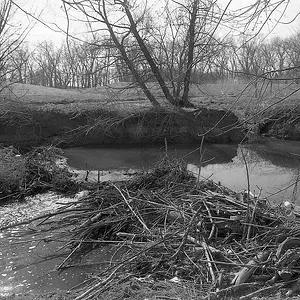
Here's an example of 120 FP4 developed in Rodinal

img250-XL.jpg


and a 100% crop

img250crop-XL.jpg
 
I love the shot. I found that a lot of my Dad's 2 1/4 negs from the early 60's were so grain smooth. It has been great working with them.
 
Basically, yes, they're just different. Film and digital both can capture "everything" the lens gives it a lot of the time, but not all of time, and certainly not under strict testing conditions. Very large prints will look quite different, with people often preferring the way film looks when over-enlarged.

In more detail:

Current sensor resolutions in DSLRs are such that you are.. often?.. not really limited by the sensor. In general unsharpness introduced by camera shake, lens properties, and so on will be a larger factor in image quality than the sensor resolution. If you use quite good lenses, good technique, and set things up to fairly close to the best possible settings you can wind up putting an image ON to the sensor that has interestingly more information in it than the sensor can capture. In normal use, usually/frequently/sometimes this will NOT be the case, though.

Modern film is also pretty darn good, probably about the same area. The films that could reliably outperform then lenses they were stuck behind are either discontinued or hard to get, but most of the films we have today will outperform the rest of the camera "much of the time" and under certain circumstances, well, they won't.

So at that level it doesn't really matter. Film, digital, the image being put ONTO it isn't all that great to start with when you go way way way in to the pixels or grains. The results will look a bit different, but the math says that your final results will have about the same information in them. Generally speaking, in ordinary usage, film or digital will give you "about the same" sizes of enlargements before the wheels fall off and it starts to look over-enlarged.

The look of film, especially at higher enlargements, is quite different. Film and digital will fail quite differently when you enter the land of over-enlargement. Without some special handling, digital will simply look increasingly unsharp, whereas film will start to reveal film grain and start to look "chunky" in a particular way that depends, to a degree, on what kind of film you used. You'll have an impression of sharpness from film due to the sharp rendering of the film grain -- the image itself will be soft, but the grains are spiky and sharp.

This may or may not be pleasing and desireable.

Also, you can of course add a grain effect to a digital file and cause it to "fail" in roughly comparable ways when overenlarged.

Thank you very much, amolitor... I was thinking that film-captured photos are infinitely sharp and the only reason people don't buy is it is costly compared to digital forms... But you explained me that there is some "chunky" disturbance on the quality as they are enlarged... May I ask you if there is a website url where such effect is shown? Thanks.
 
Here's an example of 120 FP4 developed in Rodinal


and a 100% crop

Thanks, Gary. So, film-shot photos do lose their sharpness after a limit of magnification...
 

Create an account or login to comment

You must be a member in order to leave a comment

Create account

Create an account on our community. It's easy!

Log in

Already have an account? Log in here.

New Topics

Back
Top Bottom