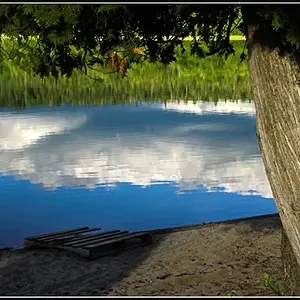
Landscapes are more often shot with a high focal ratio (e.g. f/22, f/16, or maybe f/11). We all want our "subject" in focus... but for a landscape the "subject" is often the entire scene. By using a high focal ratio (often on a wide angle lens) you get tremendous depth of field.
You may want to learn about "hyper-focal distance". The hyper-focal distance is the distance (for a given lens and f-stop combination) which achieves the maximum possible depth of field.
When you focus to a specific distance, the depth of field allows objects both nearer and farther to also be in acceptable focus (depending on your depth of field.) You might think you could just set a high depth of field, focus to infinity, and take the shot. But it turns out that while doing this would provide focus to some range in-front of your focus distance, you also get some range "behind" the focused distance -- and as you've focused to "infinity" there is nothing "behind" infinity. So the hyper-focal distance is a way to find the optimal focus distance by pulling the whole focus range closer to take advantage of the wasted focus "behind infinity".
Here's how we used to do it.
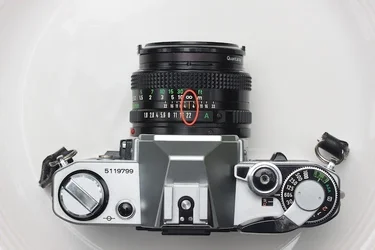
The first image shows the camera focused to infinity using f/22. If you look at the depth of field marks left and right of the focus indicator line, everything between the two "22" marks should be in focus. But since this lens is focused to infinity, we gain nothing from that end. Meanwhile the "22" mark on the left indicates everything from ... let's call that 12 feet ... to infinity will be in acceptable focus.
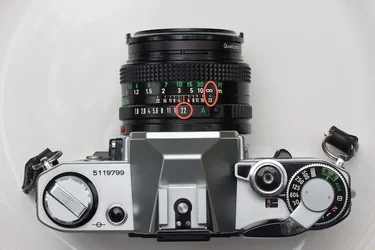
This next image shows the lens focused for "hyper-focal" distance. Since we are using f/22, rather than focusing to "infinity" as the focused distance... we rotate the focus ring so that "infinity" is aligned with the "22" depth of field mark on the far end of the range. This pulls our "near" end of the range down to about 6'.
This is a 50mm lens (on a 35mm film body). For landscapes, you may find you prefer shorter focal length (wide) lenses. If you need to "look around" to take in the image, chances are that a wide angle lens would do better. A side-effect of shorter focal length lenses is that the depth of field naturally gets even larger (assuming the focus distance and f-stop are the same).
As I mentioned above, the hyper-focal distance is the distance that achieves the maximum possible depth of field for a given camera, focal-length, and f-stop combination. So with this "full frame" (really 35mm film) camera, using a 50mm lens set to f/22, the "hyper focal distance" is 12'... (that's where the focused distance is set on the lens even though we did this by adjust the "infinity" mark to the "22" on the far end of the range.)
So that's the idea... but modern "zoom" lenses usually don't include depth of field marks anymore and prime lenses may have them... but they aren't as usable (modern lenses usually move the focus element faster with less physical rotation of the focus ring. That puts the depth of field marks so tightly together that they're harder to use.)
You can look up the depth of field and find the hyper focal distance of a camera/lens/f-stop combination using a website such as dofmaster.com
There are also apps you can download to a smartphone so you can look up the info while in the field and not connected to the internet. But I suspect you'll find you usually don't need to look it up very often. This is because the hyper-focal distance is associated with a lens & f-stop combination. Remember... assuming the same camera sensor size (e.g. suppose it's an APS-C crop-sensor camera), lens focal length (how many lenses do you own??) and f-stop combination (and you'll probably tend to shoot these using a consistent f-stop such as f/16 or f/22) there is ONE "hyper-focal" distance for that combination. Suppose you shoot landscapes with a 24mm lens at f/22... you'd need to know the one hyper-focal distance for that lens (which wouldn't be hard to remember). That's why I say you probably won't need to be looking this stuff up all the time (but it's nice to know how you figure out what the number is the first time you need it.)
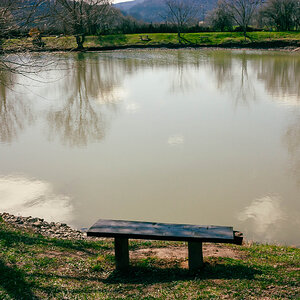
Landscapes often look better when there is something of foreground interest in the shot... knowing how to get the foreground sharp and still having a sharp impressive background is key.



![[No title]](/data/xfmg/thumbnail/32/32930-09414fc020c2a60a456ff59a05c5ef8f.jpg?1734162706)