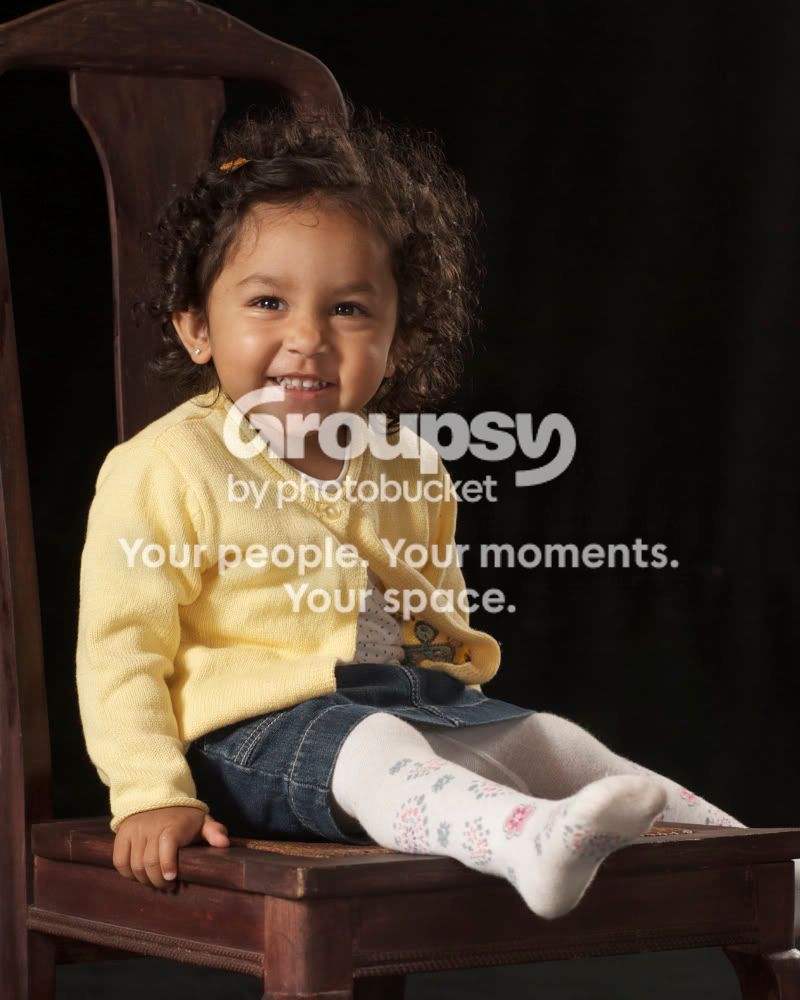
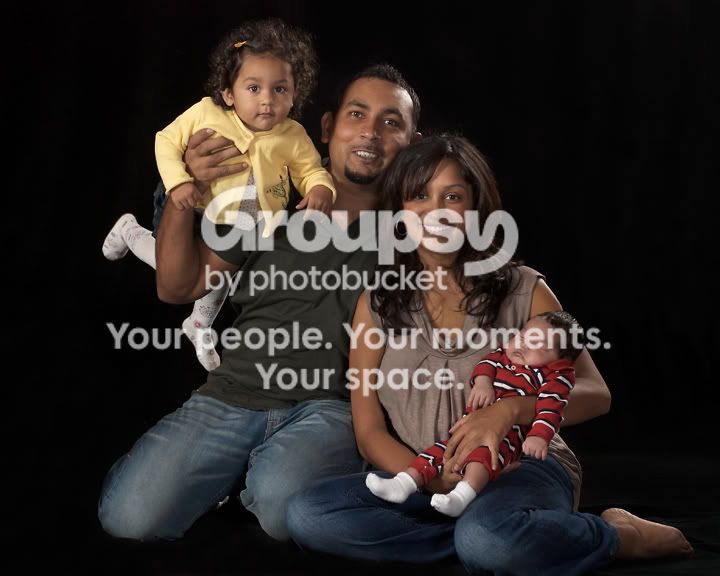
The hair light is in an umbrella? How odd--because in the family group shot, the hair light looks almost like a bare flash on the man's temple. One oddity of hair lighting is when you move it around and nearly parallel to the camera-to-subject axis, hair lighting becomes very strong--almost like an aberration in physics. I first read about that from a master lighting technician, Ellis Vener. I didn't believe it myself, but it is true; if you position a hair light behind a subject and aim it toward the camera at a steep angle, like 10 to 25 degrees, even a small amount of hair light will appear very,very bright--like 50 watt seconds hairlight and an 800 watt-second mainlight can produce the type of bright, specular, blown-out highlight like the father has on his temple in the family shot.
Bottom line--in the lighting setup shown, the hair light is far too hot,and as Henry stated, aiming it differently would be a good idea; he thought the hair light needed a small soft box; I looked at it and thought it needed to be shot through at least two layers of mylar diffusing material. IOW, your hairlight in the bottom scenario is far,far too hot,and looks so bright we both (I think) thought it was undiffused, bare flash--or at least in need of diffusion. Contrast that with the little girl in the top shot--that has soft, very subtle hair lighting--very subtle, but still a wee bit too strong. Again, perhaps you moved the hair light too far "around the back" in the family group, and that is causing the excessively hot, specularity on the man's head, and since you told us you used an umbrella for the hair light, the flash output is simply too high in relation to the main/fill ratio and the camera exposure; look at how the hairlight delineates the man's cheekbone. Too strong.
The hair light on the little girl I said was a bit too strong--I can see the shadow the hair light is causing on her curly hair,and it is illuminating a bit of her cheekline as well.
These results are reasonably good, but this is an example of why I personally suggest to beginners that actual studio lights, with modeling lights, will really,really help them position their lights so they have a WYSIWYG aid; speedlight lighting is all done by experience and is all done "blind". Even slight movements of the subject can change the lighting setup's results, which is one reason studio lights have modeling lamps--the photographer can literally "see" a problem before committing to the shutter.
If you want a nice,soft,even light that allows a lot of subject movement, you need to have a VERY large light source, like two 42x72 panels or two very large umbrellas positioned "not too close", to keep falloff fairly even over the shooting area. Using one main light of 40-60 inches will have a fairly notable amount of fall-off as the subject moves across the set or background; the closer the light to the subject, the MORE-pronounced the fall-off is.
I would be greatly tempted to add a 3rd flash on the black backdrop,and fire a little pop of flash thru a colored gel filter to juice up the background a bit, or just to provide a gradient fill type effect on the black backdrop, which will allow you to get a separation of dark-haired figures from the black backdrop, without the need to use too much hair light. Still, overall, you're doing okay,and your attitude about a potential reflector mis-alignment shows how open you are to suggestions AND clues me in that you're actually working hard and are analyzing things on your own. All great signs. And just coincidentally, reflector mis-alignment vis a vis the main light and reflector position is a really,really common mistake many people make.




![[No title]](/data/xfmg/thumbnail/31/31701-24a40368b575b319cb332e3114f39172.jpg?1734160369)