What's new

How do I stop blowing out the sky!?!

allison_dcp

TPF Noob!
Joined
Jun 14, 2012
Messages
274
Reaction score
25
Location
Ohio
Can others edit my Photos
Photos OK to edit
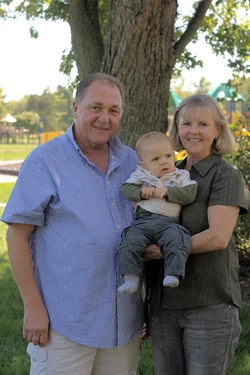
Took some photos today at our reunion with my Canon EOS 20D and 50mm lens. I am working on my exposure and was paying close attention to the meter on the camera and my settings, but still manage to blow out the sky!:grumpy: How can I avoid this?(f/5 1/250 and 200ISO) $deanwithlinda&rick.webp
 
Nd filter my friend.. graduated kind. ;)
 
Flash. This is why Natural light is HARDER THAN HELL and most "natural light" photographers are really just scared of flash. It should be the opposite-flash is MUCH easier and they should be terrified of natural light!
And don't place people in front of a tree trunk like that. It SOUNDS good when you do it, but trunks aren't pretty and they hurt your composition.
 
Bottom line is exposure. You're metering their face most likely and getting the proper exposer for them. The sky is much brighter. If you want a darker sky, you'll need a faster shutter. Now under exposed people. You could then add fill with a flash, sure. If you get a graduated ND filter, you can put the darker part of the filter in the sky framed above your subjects. Cheaper than buying a flash and less weight to carry around. Just an overall good option also.
 
Bottom line is exposure. You're metering their face most likely and getting the proper exposer for them. The sky is much brighter. If you want a darker sky, you'll need a faster shutter. Now under exposed people. You could then add fill with a flash, sure. If you get a graduated ND filter, you can put the darker part of the filter in the sky framed above your subjects. Cheaper than buying a flash and less weight to carry around. Just an overall good option also.

A GND might be useful in 1 of 10 shots.... too limiting in the framing.... and what if you have sky behind the people? GND on them might look a bit odd, don't you think? (wow.. how did they get that half tan so fast?)

Or if you use a Cokin type GND where you can slide it, than you have dark sky above people, and light sky behind them... doesn't look very natural!

With flash.. you can use aperture to control the exposure on the subject, and shutter speed to underexpose the sky.... works great!

 
Bottom line is exposure. You're metering their face most likely and getting the proper exposer for them. The sky is much brighter. If you want a darker sky, you'll need a faster shutter. Now under exposed people. You could then add fill with a flash, sure. If you get a graduated ND filter, you can put the darker part of the filter in the sky framed above your subjects. Cheaper than buying a flash and less weight to carry around. Just an overall good option also.
This makes complete sense!! Thanks! Oh and I did use a flash, but had it almost aimed straight up b/c of my lack of practice and time with the flash. Also I agree with the tree, uck, there were people everywhere. This was mainly a snapshot.
 
Think of it light this. There is a variation in light in any normal scene between the darkest points and the brightest points - this range is the dynamic range of the scene. Now your camera has a limited dynamic range, over that range it can record detail from the darkest to the brightest points and outside of that range it records either pure black (shadows) or pure white (brights).

In the scene you have above the camera simply can't record the whole dynamic range from the darks to the bright parts. Yes you could adjust the exposure to account for the sky, but he result would be that your darks would then be shifting into their limited point (they'd be going pure black). In addition you've the subject - that is the part that you really want exposed right and can't afford to have over or under exposed to any great degree.


So what can you do? Well you can add or remove light to the photo. Now you can't easily remove the sun from the sky, and if you can't compose without the sky being a part of the photo you've got only one choice - adding light to the shaded areas. Boosting the light there means that the whole dynamic range from the brightest to the darkest points has been reduced and as a result will be able to fit into the dynamic range of the camera.

Adding light can come in many forms from a simple reflector bouncing light onto the scene up to flashes and studio stobes. Learning how to use various different kinds for different effects is very important - it need not be overly complex, but learning it is important. Furthermore remember that just as you can add light you can also remove it - a black sheet can be used (out of scene) to block light or you can use a diffuse surface - in this shot you've already used a light blocker to soften the light - that being the shade cast by the tree itself.


Learning to control light is important and it releases you from a lot of limitations which will otherwise greatly reduce the quality and also greatly reduce the times that you can take photographs.
 
Bottom line is exposure. You're metering their face most likely and getting the proper exposer for them. The sky is much brighter. If you want a darker sky, you'll need a faster shutter. Now under exposed people. You could then add fill with a flash, sure. If you get a graduated ND filter, you can put the darker part of the filter in the sky framed above your subjects. Cheaper than buying a flash and less weight to carry around. Just an overall good option also.

A GND might be useful in 1 of 10 shots.... too limiting in the framing.... and what if you have sky behind the people? GND on them might look a bit odd, don't you think? (wow.. how did they get that half tan so fast?)

Or if you use a Cokin type GND where you can slide it, than you have dark sky above people, and light sky behind them... doesn't look very natural!

With flash.. you can use aperture to control the exposure on the subject, and shutter speed to underexpose the sky.... works great!

Yeah, and in this shot it would have worked flawlessly.
 
An ND filter would not have worked in this photo. An ND filter gives you a single sheet of dark glass which reduces light coming through- just like sunglasses. An ND filter is designed to block out the light over the whole of the cameras view and if you get a screw in kind that is what you get - a drop in the exposure over the whole image.

Now if you get a graduated ND screw in filter you get a line of difference through the middle - one half being more blocked out than the other (aimed at skylines where you've a clear line between a dark ground and bright sky).

Now if you get the square kind that go into a filter holder then with both kinds of ND filter you can vary the position of the filter in the scene. However for the photo above you've not got a clear area divide between the bright and the dark parts. The bright sky appears either side of the tree so you'd have to be very creative with a couple of ND filters to block out only the sky parts without catching the tree as well. IF you just blocked out all the light from the top half you'd have a very underexposed tree compared to the rest of the photo and that would seem odd indeed.

ND and ND graduated filters do have their place, but you've got to have a scene which benefits from them being used.
 
The ND grad filter is NOT the solution for this image or most high dynamic range portraiture. It's usefulness with landscapes is paramount.

In post, you can always try lightroom 4 highlights/shadows slider. Adobe has really figured out their algorithms to pull back highlights and lift shadows intelligently (to a certain limit).

But fill flash will save you a bunch of exposures. Learn it!
 
Bottom line is exposure. You're metering their face most likely and getting the proper exposer for them. The sky is much brighter. If you want a darker sky, you'll need a faster shutter. Now under exposed people. You could then add fill with a flash, sure. If you get a graduated ND filter, you can put the darker part of the filter in the sky framed above your subjects. Cheaper than buying a flash and less weight to carry around. Just an overall good option also.

A GND might be useful in 1 of 10 shots.... too limiting in the framing.... and what if you have sky behind the people? GND on them might look a bit odd, don't you think? (wow.. how did they get that half tan so fast?)

Or if you use a Cokin type GND where you can slide it, than you have dark sky above people, and light sky behind them... doesn't look very natural!

With flash.. you can use aperture to control the exposure on the subject, and shutter speed to underexpose the sky.... works great!

Yeah, and in this shot it would have worked flawlessly.

No.. I am afraid it wouldn't! It would have been light tree / dark tree... would not look natural! GND's are great for landscapes with unobstructed sky, or a fairly level horizon... and that is about it!
 
Bottom line is exposure. You're metering their face most likely and getting the proper exposer for them. The sky is much brighter. If you want a darker sky, you'll need a faster shutter. Now under exposed people. You could then add fill with a flash, sure. If you get a graduated ND filter, you can put the darker part of the filter in the sky framed above your subjects. Cheaper than buying a flash and less weight to carry around. Just an overall good option also.
This makes complete sense!! Thanks! Oh and I did use a flash, but had it almost aimed straight up b/c of my lack of practice and time with the flash. Also I agree with the tree, uck, there were people everywhere. This was mainly a snapshot.

if your flash was pointed mostly up.. you didn't use it! There is nothing above to bounce off of, right? It may have gone off, but it didn't add any light to the subjects....
 
A GND might be useful in 1 of 10 shots.... too limiting in the framing.... and what if you have sky behind the people? GND on them might look a bit odd, don't you think? (wow.. how did they get that half tan so fast?)

Or if you use a Cokin type GND where you can slide it, than you have dark sky above people, and light sky behind them... doesn't look very natural!

With flash.. you can use aperture to control the exposure on the subject, and shutter speed to underexpose the sky.... works great!

Yeah, and in this shot it would have worked flawlessly.

No.. I am afraid it wouldn't! It would have been light tree / dark tree... would not look natural! GND's are great for landscapes with unobstructed sky, or a fairly level horizon... and that is about it!
And would have affected the top of their heads.
 
OR, the OP could have saved everyone a lot of trouble by simply moving to her left a couple of feet, to put the tree trunk over to the left of the couple, and the bush behind them, and probably have blocked out a bunch of that overly bright sky.

This is as much a compositional problem as it is an exposure/light balance problem. I don't do a lot of this kind of photography, but when I do, I learned long ago to move myself side to side when I'm trying to place my subject, just as much as I would move the subject side to side to get proper placement. It's a common problem - and is related to the "stuff growing out of their head" problem - when we are looking at taking a picture like this, we naturally concentrate on the SUBJECT, and our brains just throw away the other information. Unfortunately, we need that stuff to take a good PHOTOGRAPH. So things like a bright sky, or the signpost growing out of someone's head, or other distracting background information, gets into the picture. The camera sees it, and our photograph sees it, but our brains did not, at the time of composition.
 

Create an account or login to comment

You must be a member in order to leave a comment

Create account

Create an account on our community. It's easy!

Log in

Already have an account? Log in here.

New Topics

Back
Top Bottom