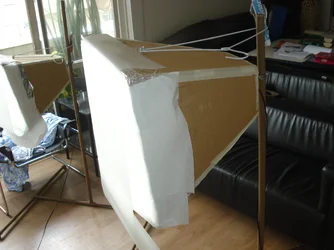
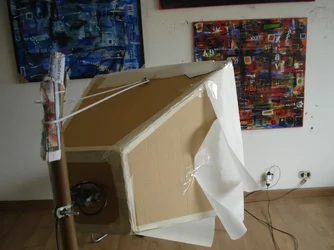
These lights appear to be too close to the position of the camera. Push them farther out to the side.
Imagine you take down the art and replace the art with a glass mirror. Would you be able to see the lights from the camera's point of view... as it's looking at the mirror? If the lights are close to the camera, the answer will be yes. But if the lights are off to he sides, then the answer will be no.
The acrylic paint is reflective surface and will behave "like a mirror" -- so treat it like a mirror and move the lights to a position where you wouldn't be able to see them.
There's also an issue with light "fall off". Each time the distance from a light source to the subject increases by the 1.4x (it's actually the square root of 2, which is about 1.4142... but "1.4" is close enough) the amount of light will be halved.
Suppose you have a painting which is 2' wide (left to right) and you've placed a light source 5' away from the "right edge" of the painting. This makes that edge 5' away... but the "left edge" is 7' away from that light. The light fall-off rule (which is really the "inverse-square law" -- see:
Inverse-square law - Wikipedia the free encyclopedia ) says that since 5 x 1.4 = 7 then that 7' distance will get precisely half as much light as the 5' distance and your image will have a noticeable drop off in lighting (the "fall off" problem.) But if you place ANOTHER light not he opposite side (and at the same distance) then it will provide supplemental light to the left and fall off to the right. This balance gives you even lighting across the image.
While this makes it sound like balancing the lights at equal distance from left to right should cancel out the fall off... not necessarily. Suppose you have a 9' wide piece of art and the lights are 5' away from the left and right edges respectively. Think about the math....
If the light is 5' away from the "right edge" then by the time you reach 5' in from the right (nearly the mid-point) the light fall-off is now down to 1/4 of the light. So you've got a bright outer edge but a dim center area. And unfortunately the light on the opposite side is ALSO unable to reach the mid-point. Increasing the power of the light won't help because the fall-off distribution is the same. If, however, the lights where moved back to about 20' (instead of 5) then the problem remedies itself.
Lastly... bumps and textures in the paint may be reflective EVEN with the lights far off to the side. But it turns out a circular polarizer is particularly good about handling reflections from light sources that originate from the side. If moving the lights to the side does not solve the reflection problem on it's own... invest in a circular polarizing filter (and preferably a good filter that doesn't create a color-cast).