What's new

Is it the lens, the settings, or me?

chris miss

TPF Noob!
Joined
Oct 18, 2008
Messages
62
Reaction score
0
Location
NE coast of Florida
Can others edit my Photos
Photos OK to edit
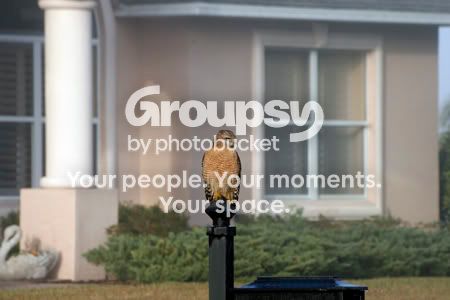
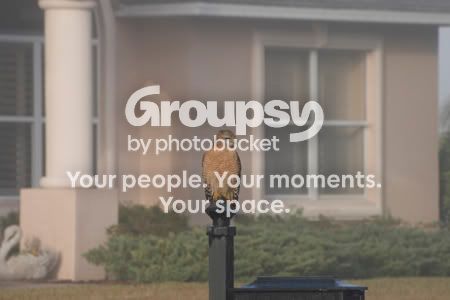
This morning I had a great opportunity to shoot a red shouldered hawk perched on my neighbor's mailbox. There was a little fog lingering, but none of the photos are as sharp as I had hoped. I inched closer and closer with each shot. These two are the closest I was able to get before he flew off. I must say, I get real nervous when I have an opportunity like this. I don't think much about settings, just getting something before the moment is gone.

I used my Sigma 70-300 f/4-5.6 APO DG Macro lens. I know it is soft at 300, so I set the focal length to 214 mm. I did use a tripod with a remote. I'm sure it's just inexperienced me, but would I have gotten better results with a different setting? I'm going to Merritt Island next week to try to get some more bird shots and could use a little advice. My lens choices are the Sigma, Canon 100 f/2.8 Macro USM, and a nifty-50.

Settings for this shot: f/8.0, 1/160, ISO 100
hawk2.jpg


Settings for this shot: f/5.0, 1/320, ISO 100

hawk1.jpg
 
Fog has a large influence on the image.
It has lowered contrast and can affect the focusing sensor.

I am not sure if you could have done better.
 
second shot settings look fine to me - fast shutter speed - good aperture for the subject (though you could probably have gone to f4 but then the lens is not capable of that aperture at that range). ISO is great, and in the second the shutter speed should be fine for handholding as well (at least according to the theory of 1/focal length for base shutter speeds to avoid image blur from handshake).

for the haze try editing the shot with levels - do an auto levels edit and then do some sharpening and the shot should gain some more punch that it is lacking.
The sigma is not the sharpest of lenses - a good lens for its price but its a very cheap lens - that said the APO edition should possibly be capable of slightly sharper shots than that - ambient lighting can be a big part in image sharpness at times as well.

if you want more editing advice have a look at this site here:
Ron Bigelow Articles
it might look a lot, but the articles are generally easy to understand and contain good information
 
lowering the fstop wouldve made the bird sharper against the background ( i think) and you would changethe shutter to compensate.

is f/5 as low as you can go? i would've zoomed alitle tighter and shot it that way making the bird "pop" alittle more
 
lowering the fstop wouldve made the bird sharper against the background ( i think) and you would changethe shutter to compensate.

is f/5 as low as you can go? i would've zoomed alitle tighter and shot it that way making the bird "pop" alittle more

Backwards. Lowering the F-Stop would shallow his depth of field. At that focal length. Increasing the aperture would make a larger contrast between the bird and the background. Higher F-stop=deeper field of depth.
 
I wouldn't hesitate one second to use that lens at 300mm as long as you can keep the aperture at f/8 or higher.

As far as the colors and fog, looks like it can easily be fixed with a levels or curves adjustment (as was already stated I think).

Before
hawk1.jpg


After
hawk1.jpg


Edit: I did nothing in the photo above except a levels and curve adjustment. Both the fog is gone and the colors more vibrant which seems to solve your problem.....next time shoot some at 300mm f/8 and a steady hand and see if the results are good enough for you....for me they were really good.
 
Last edited:
just to clarify:
higher f stop = smaller f number = smaller depth of field = more light getting into the lens
smaller f stop = bigger f number = large depth of field = less light getting into the lens

also note that focal length, distance to subject and subject size will also affect depth of field in a shot as well
 
I wouldn't hesitate one second to use that lens at 300mm as long as you can keep the aperture at f/8 or higher.

totally forgot about this - good point NateS!
most lenses are not their best when wide open (At the largest aperture/smallest f number) and stopping down (bigger f number) can improve sharpness in a shot. F8-f11 is generally the range where most lenses will give a good sharp shot, though it is limiting you in depth of field control I would say that (if conditions allow it) go for it!
 
Backwards. Lowering the F-Stop would shallow his depth of field. At that focal length. Increasing the aperture would make a larger contrast between the bird and the background. Higher F-stop=deeper field of depth.

No, more depth of field would have made the bird stand out less against the background and may have lowered its perceivable sharpness. Hence, the reason a lot of pro sports are shot at 400mm f/2.8, or 600 f/4.
 
just to clarify:
higher f stop = smaller f number = smaller depth of field = more light getting into the lens
smaller f stop = bigger f number = large depth of field = less light getting into the lens

also note that focal length, distance to subject and subject size will also affect depth of field in a shot as well

Bah, this is how kat's get confused. You are mixing vocabulary between aperture and F-Stop.

Back to basics. The F number means F-stop, or Fractal Stops. Hence the fact that the higher the F-Stop, the more fractals are stopped from coming into the lens. Therefore, when you raise the "f number," you are actually raising your f stop, and lowering the size of the aperture. Aperture and f-stops are NOT the same thing. F-stops are only the way you meter how small the aperture gets. When you lower the "f number," you are actually lowering your f stop, and raising the size of the aperture.

So:

1. HIGHER f stop = HIGHER f number = Deeper depth of field = Smaller Aperture Size=Less light getting into the lens
2. LOWER f stop = LOWER f number = Shallower depth of field = Larger Aperture Size = More light getting into the lens
 
just to clarify:
higher f stop = smaller f number = smaller depth of field = more light getting into the lens
smaller f stop = bigger f number = large depth of field = less light getting into the lens

also note that focal length, distance to subject and subject size will also affect depth of field in a shot as well

I always thought that

Higher F/stop = Higher F number = smaller aperture = less light getting into the lens

and

Lower F/stop = Lower F number = larger aperture = more light getting into the lens.

So you are saying that higher the term f stop is directly related to aperture and not the f number...I thought f stop meant number and when either was higher, the aperture was smaller (I do understand the aperture is and how it effects everything....etc....but guess I was confused as to the term f stop and what it was directly associated to)

Edit: I see that based on TheUndisputed's post (and who can dispute that...lol) that my thinking is correct. Anybody else want to chime in and confirm?
 
No, more depth of field would have made the bird stand out less against the background and may have lowered its perceivable sharpness. Hence, the reason a lot of pro sports are shot at 400mm f/2.8, or 600 f/4.

true - but you also have to factor in the lens used as well - a pro is using £/$1000s worth of lens for that f4 sharp shot - something like the sigma is going to be greatly challenged against that - hence using a sharper aperture and sacrifice the depth of feld control

as for fstops I am confused now -- I might have that term wrong
edit DRAT I am getting things backwards - sorry guys! (its late)
here what I meant to say:
larger aperture = smaller f number = smaller depth of field = more light getting into the lens
smaller aperture = bigger f number = large depth of field = less light getting into the lens
 
Thank you all for the replies. I will try shooting at the full 300 and set my aperture to f/8-11 when I'm at Merritt Island next week.

I did try to do a little PP on the first shot. I have Photoshop CS3 but haven't really played with it. I need to get the old tutorial disk out and work on that. Anyway, here's what I came up with, but I really didn't know what I was doing. Did I go overboard on the sharpening?

Sharpened image:
sharpened2430.jpg


Original image:
hawk2.jpg


And I'm going to have to change my signature to Christine. I'm a she!
 
sharpening looks ok to me - though it is tricky to tell with small images.
also I would say stick to f8 - f11 is more of a landscape aperture - and if your after animals your going to want your shutter speed as fast as you can get it. Using smaller apertures will mean less light - so slower speeds - unless you raise you ISO
 
so smaller f number will give the subject more focus against a blurring background and each time you go up (f/5, f/6 etc.) the background will come more into focus as long as you adjust your shutter accordingly

right???
 

Create an account or login to comment

You must be a member in order to leave a comment

Create account

Create an account on our community. It's easy!

Log in

Already have an account? Log in here.

New Topics

Back
Top Bottom