What's new

ISS Lunar Transit- first attempt

Peeb73 2

Semi-automatic Mediocrity Generator
Joined
Jul 16, 2015
Messages
4,311
Reaction score
5,160
Location
Oklahoma
Can others edit my Photos
Photos OK to edit
Armed with 700mm of glass, I got out this AM to try to capture the international space station transiting the mostly full moon. Odd results. At precisely the time my GPS apps said to shoot, I got this dark blur on the right hand side of the frame:
MJK_9747.webp


Why such a blur at 1/6000 shutter???

A minute or so later, I took aim at the station with a dark sky background and got this:
MJK_9782_DxO.webp


Any suggestions on how to better capture this beast the next time it passes in front of the moon?

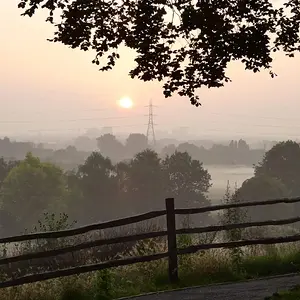
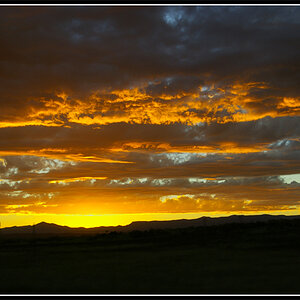
Oh well, at least it was a nice sunrise...

Dawn showers- East of Nature Conservancy Prairie Preserve- Osage County OK
by Peeb-OK, on Flickr
 
That`s a bad bit of sensor dust..lol
Nice shot and well spotted and taken.
 
Why such a blur at 1/6000 shutter???
Atmosphere movement & distortion at many different altitudes.
The best ISS in front of the moon images are made from choosing video frames that luckily recorded little atmosphere movement/distortion.
Lucky imaging - Wikipedia

If you shoot straight up the atmosphere is some 100 miles thick. And straight up you may only shoot up a single convection cell.
If you shoot 45° above the horizon the atmosphere is some 250 miles thick, and you're more likely to be shooting through many convection cells.
 
If the ISS is between you and the moon and the moon is almost full, it means everything including the sun is lined up just right. Based on the rough shape and orientation compared to your second shot, I'd guess you caught the shadow of the ISS passing across the moon causing at least a partial solar eclipse for any little green guys standing in the right spot on the moon.
 
I'd guess you caught the shadow of the ISS passing across the moon . . .
That's not possible.
ISS is in low Earth orbit and there is no way a shadow cast by ISS would be detectable on the surface of the moon - some 250,00 miles away from ISS.
Plus at full moon, for IIS to be between Earth and the moon it has to be on the side of Earth opposite the Sun.
Of course ISS is miniscule compared to the moon and even if ISS were in orbit around the moon it's shadow would be teeny, tiny and likely impossible to see on the moon's surface.

Right now here where I am in Iowa the moon is 96.3% illuminated, not quite full, but looks full.
The moon was full early yesterday evening.
en:start [Virtual Moon Atlas] Go to the Ephemeris after setting set your location (lat/long) to see what he moon would look like from wherever you're observing it from. Change the date and time to see the exact time frame when the moon would be 100% illuminated from there.
 
Last edited:
I'd guess you caught the shadow of the ISS passing across the moon . . .
That's not possible.
ISS is in low Earth orbit and there is no way a shadow cast by ISS would be detectable on the surface of the moon - some 250,00 miles away from ISS.
Plus at full moon, for IIS to be between Earth and the moon it has to be on the side of Earth opposite the Sun.
Of course ISS is miniscule compared to the moon and even if ISS were in orbit around the moon it's shadow would be teeny, tiny and likely impossible to see on the moon's surface.
............

Well, let's get technical here then.

It IS possible for the ISS to 'cast a shadow' on the moon, even when in earth orbit. All it would take is for the sun, moon and ISS to all line up. This can happen when the ISS is in view of both the sun and a near-full moon. Celestial mechanics have most likely made this happen many times over. Certainly not every time there's a full moon, but it can happen. Essentially, the ISS would be transiting the sun next to the earths' limb when viewed from the moon.

However, the ISS would not cast an umbral shadow on the moon, but purely a penumbral shadow. Same thing with the ISS is on the 'sun', or 'daylight' side of the earth. It does cast a penumbral shadow on the moon, and no doubt the exceedingly miniscule loss of light does exist. But even if a person on the earth knew the ISS was transiting the sun, the loss of light would again, be exceedingly miniscule.

While the loss of sunlight could be calculated mathematically, it would merely be an exercise to prove it could be done. Actually detecting the presence of the penumbra shadow is most likely out of the reach of current technology, let alone recording it with consumer electronics.
 

Create an account or login to comment

You must be a member in order to leave a comment

Create account

Create an account on our community. It's easy!

Log in

Already have an account? Log in here.

Back
Top Bottom