

Patrice
No longer a newbie, moving up!
I don't often post images but here is a photo taken with an older 50mm AFD lens with a D700. Soft reflected backlight, bounced flash, automatic white balance, f3.5 or so, camera in manual, SB600 flash in TTL from about 2.5 feet away. Nice 'bokeh' from an older lens often considered to be just so so. Dead cheap too, these days anyway. I've had this lens for nearly 15 years.
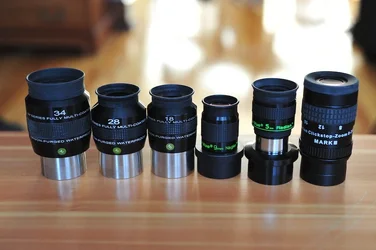
The photo is of a set of lenses of a different sort. They are all telescope eyepieces of high to middle quality. They render flat field images well corrected for CA and coma and meant to be used in reasonably fast telescopes. These are like the rear elements of camera lenses. They take the image projected by the telescope's objective lens set (achromatic doublets, ED doublets or apochromatic triplets and quadruplets) and deliver them to the observers eyes. The numbers printed on them are their focal length. As opposed to camera lenses, a bigger number means less magnification. Unlike camera lenses which are designed to illuminate a given sensor dimension, the diameter of the projected image of these lenses varies as a function of the objective lens' focal ratio. The distance from the lens' rear element to the focussed image (eye relief) varies with lens design as does the apparent field of view of the image delivered to the observer's eye, the field of view is also dependant on the design of the objective lens.
A good quality eyepiece can be as expensive as any prime for photography.
The photo is of a set of lenses of a different sort. They are all telescope eyepieces of high to middle quality. They render flat field images well corrected for CA and coma and meant to be used in reasonably fast telescopes. These are like the rear elements of camera lenses. They take the image projected by the telescope's objective lens set (achromatic doublets, ED doublets or apochromatic triplets and quadruplets) and deliver them to the observers eyes. The numbers printed on them are their focal length. As opposed to camera lenses, a bigger number means less magnification. Unlike camera lenses which are designed to illuminate a given sensor dimension, the diameter of the projected image of these lenses varies as a function of the objective lens' focal ratio. The distance from the lens' rear element to the focussed image (eye relief) varies with lens design as does the apparent field of view of the image delivered to the observer's eye, the field of view is also dependant on the design of the objective lens.
A good quality eyepiece can be as expensive as any prime for photography.
Last edited:










![[No title]](/data/xfmg/thumbnail/30/30870-c7febc7c14dc6447653c2ae2355ffc61.jpg?1734158850)