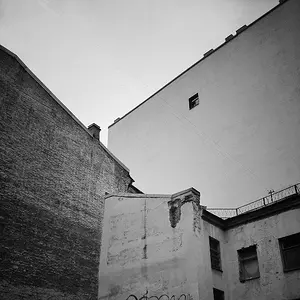
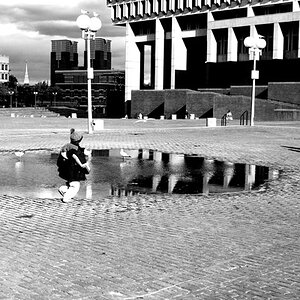
In the D700, and most Nikons, you can do multiple exposures, just like with film. So what I do is turn the multiple exposure on and set it to 10 images, don't forget to turn auto-gain on. hit OK, and rack off 10 images. The camera than stacks them all into one, even works with RAW!
That way, when i have to do alot of shadow recovery, i don't have any noise to deal with because i'm basically amplifying the signal by having the camera stack 10 exposures on top of eachother. Detail stays the same, noise gets averaged out.
Now there are by-products to this i've found. Usually it works awesome, but when you're getting such a true signal, you really start to see the limitations of these 14-bit bayer interpolated sensors. Color banding can become more obvious in open skies, and often times really tight details (especially in the red and blue channels) can start to look blocky. These are both things that noise or grain typically hide, but the latter has everything to do with red and blue pixels only making up 25% of the sensor each.
This is what makes the Sigma Foveon sensor so amazing, and medium format digital untouchable. The Foveon doesn't do any bayer interpolation, so each pixel contains R,G, and B values in them. Medium format can often do what's called Multi-Shot where the camera takes a R,G, B, and K picture, than interpolates so that the resulting pixels also have R, G, and B values in them and the file is 16-bit.
Bayer interpolations sucks. It was figured out in the mid 1970's and has just stuck with us because it's cheap n' easy.







![[No title]](/data/xfmg/thumbnail/32/32712-779fdbfe2a0a6166b7dfdd81426fd16a.jpg?1734162324)