What's new

looking for beginners critique

smokedoff

TPF Noob!
Joined
Jan 9, 2013
Messages
8
Reaction score
0
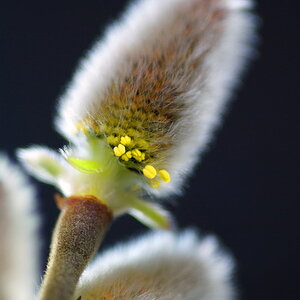
I had to 70-200 f/4 on my t3i the other day and snapped these. any critique good or bad is welcome. should have taken the hummingbird feeder out of the bad ground for the first two. no PP.


iso 800, f/6.3, 1250


iso 800, f/4, 2000


iso 200, f/4, 800

does the 1st one, at f/6.3 look sharper or more in focus because the lens is sharper at f/6.3 than f/4?
 
Most lenses perform best at about 2 stops from widest aperture ... so that can attribute to higher image quality.
Stopping down the lens also increased the Depth of Field ... thus increasing the range of acceptable sharpness.
 
What dxqcanada said...stopping the len s down increases Depth of Field, and that increases the zone of acceptable shaprness, especially on close-range shots!

On today's high-megapixel sensors, the ability of a lens to render fine, fine details is actually often limited by diffraction in the f/4 range, and a great lens (like say a 200 f/2 from Canon or Nikon) might actually be "sharper" at f/4 than at f/6.3, due to diffraction effects at f/4.8 or smaller sized lemns openings, at least on something like a flat resolution target, or a star target,etc..

In the real world, MANY photos look 'sharper', or 'clearer', or just better, when the lens is set in the f/6.3 to f/7.1 to f/8 range of apertures, because those smallish f/stop openings give more in-focus subject matter. Sharpness is a confusing term, hard to define, and it is part resolution ability, contrast, microcontrast, and also, the depth of field that the f/stop delivers. On close-range shots, LACK of in-focus stuff makes pictures appear "unsharp". Many,many times on very close-range shots, it is actuallty best to close the lens down to the f/13, f/16, or even into the f/22 range, to get more IN-FOCUS---even though those tiny apertures cause diffraction, diffraction is less-objectionable than showing stuff that is clearly OUT of the focus band of the depth of field!

I sold a camera a few years back: I took a bunch of studio-flash-lighted sales shots of the camera and lens: the best pictures were the ones shot at f/16....even though my Tamron 90mm AF-SP macro lens is "sharpest" at f/4.8 or so...test-chart sharpness is different from real-world scene sharpness!

 
I have found that a macro lens, either a 1:1 or 1:2 seems to work best for flowers. Tokina makes a reasonable priced 100 or 90mm that is exceptional from images I have seen. The advantage of the macro is the close focusing distance and the ability to shoot at f/2.8 for pleasant, creamy backgrounds. Isolation of the flower is challenging but usually produces more dramatic results. You can do it with your current lens but it requires a great deal of practice learning how the lens renders at different distances, focal lengths, and aperture settings. The macro simplifies this by it's ability to close focus. Other options may include closeup filters but I am not sure what Canon offers for that.
 
I would say you have a good basis here for learning about close-ups. Technically, it would be easy to find a number of faults but nothing major - nothing to be embarrassed about.

I would prefer the centre of the flower to be in focus, perhaps at the expense of the anthers, and the background could be tidier - the dead flower on the right is more intrusive than the hummingbird feeder.
 
The lighting is quite harsh. Flowers do better with defused light.


Sent from my iPhone using Tapatalk
 
Comments on anything are welcome. I have had the 50 1.8 on my camera as motivation to learn the camera and not constantly swapping lenses and getting lost in all that. But I saw some birds outside and tried to catch some shots so I put the 70-200 on. Headed back in this flower caught my eye so I snapped a few at different settings and while looking through them on the computer I saw a lot of differences and wanted some help on what I was looking at.

All replies make great sense to me. I'm tempted to stick with the same flower and try again with different light, settings, and getting rid of some distraction.

Thanks for the help!
 

Create an account or login to comment

You must be a member in order to leave a comment

Create account

Create an account on our community. It's easy!

Log in

Already have an account? Log in here.

Back
Top Bottom