What's new

Macro is hard!

DrunkenGiraffe

TPF Noob!
Joined
Jun 21, 2010
Messages
53
Reaction score
0
Location
Australia
Can others edit my Photos
Photos OK to edit
I just got a Tamron 90 macro :D Today was the first real chance I have had to play with it. So many are out off focus. I tried using both the auto and manual focus. I would love some tips on how to improve, it feels so much harder than using my normal telephoto! Here is a few that I got, I was using aperture priority
1.
f/22 1/60 sec ISO 640 (too slow shutter speed?)
DSC_5025asmall.jpg


2.f/22 1/250 sec ISO 640
DSC_5008bsmall.jpg


3. f/22 1/80 sec ISO 640
DSC_5023hsmall.jpg
 
C&C per req:
Overall a nice start. Macro is a very difficult aspect of photography to master. The DoF is very narrow (as little as 1mm) and you're so close to the subject that any movment can ruin the image.

As far as tips go, I would suggest getting a little further back from the subject to gain more DoF and definitely use a higher shutter speed. As well, consider lighting; look for subjects which are well lit naturally .

Just my $00.02 worth - your mileage may vary.

~John
 
In macro world, we always need to work with narrow depth of field (DoF). Some photographers use focus stacking to stack more than one photos to achieve deeper DoF. I have not try that yet myself.

What I did now is using a relative small aperture to increase the DoF. Usually I use f/11 to f/16. (I can go smaller, but image quality suffered due to diffraction) The issue is with a smaller aperture, light become an issue. So I use a external flash to light the subject. With the artificial light, I can set the shutter speed to 1/200 to 1/250.

As mentioned by Ron, I also use manual focus. For example, I turn the focus ring so that the lens is at 1:1 ratio. And then I will move my camera back and fro (hand held operation) and take the shot when the focus confirmation indicator signal me the subject is in focus. (sometimes, I will use a monopod to stabilize the image)

I took this photo with the method I mentioned above.
 
Imust say that yours are a lot better than my first attempts at macro. I think that lighting is important to up the shutter speed, a little.
Dao has it right, I think. I don't have a macro lens, but use a set of tubes with a 135mm lens. I typically use f11 (recommended by someone else) and I use flash gun on a bracket at the side of the camera, with a piece of plastic milk bottle to diffuse it.
Focussing is done by rocking on the balls of the feet, or gently swaying in the wind (:)).

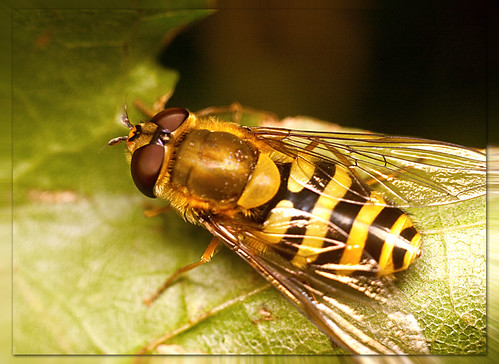
This is one of mine...done with the above set-up:


hoverfly resting framed by Bend The Light, on Flickr
 
Go manual or at least AP for your settings and then set you camera to manual focus. While in manual focus move you head (and camera) forward and back fractions of an inch while firing xx images. By moving your camera/head an inch or so forward and back you will run into several in focus shots.....delete the rest and be glad that you are not paying for film.

Generally dragon flies will stay still for minutes at a time giving you plenty of time to fire off 100's of shots. If you find that your subjects are moving look for ones that perch on top off a round or cone head type of perch....for some reason that gives them pleasure and they will stay there even if you fire a flash.

Also, keep away from the f22 or find a better background. All of the pics posted would of put the background more out focus (less distracting) if you didn't close down the ap so much.

Another thingy.... I can't figure out #3, the tail and the wire is in focus and while the head is in the same focal plane it is not in focus at all. Granted the heads can show up cloudy but something else is wrong....do you have **** on your glass or maybe an old filter?
 
I think the 3rd looks out of focus because of the natural bulge of the dragons eyes - I've noticed this with a few insects in that a shot that is in focus and sharp can look soft because the nearer parts of the eyes are out of the depth of field on the frame -and are thus soft.

Further I agree on avoiding f22, but for slightly different reasons - diffraction is something you'll need to take into consideration when choosing the aperture you want to work at. Simply put diffraction is the effect by which a shot will soften as you lower the aperture - no matter how well you take the shot. Thus even with a perfect shutter speed and low ISO a very small aperture shot will still be softer than ideal.
In general the best way to work out which aperture to use is to set the lens to the closest focusing distance - mount it on a tripod and take a series of shots from say f8 through to f22 and then compare the results on the computer to see the softening and make your own choice on where the limit is for yourself and your output/usage of the shots.
Generally speaking with 1.6/1.5 crop camera bodies f13 is the limit for most photographers with f16 occasionally used.

As for dragonflies staying still for minutes generally the only times of the day they will be like this with any certainty are early in the morning (when they are cold after the night and waiting for the sun to warm them) or in the evening as they "roost up" for the night. Come midday on a hot sunny day they'll be zipping here and there all day- though they are territorial and will often patrol a set area - perching on vantage points to survey their territory.
 

Create an account or login to comment

You must be a member in order to leave a comment

Create account

Create an account on our community. It's easy!

Log in

Already have an account? Log in here.

New Topics

Back
Top Bottom