What's new

My first attempt at a star trail shot..

Postman158

TPF Noob!
Joined
Apr 14, 2011
Messages
327
Reaction score
11
Location
Manteca, CA
And I think it was too bright where I was, even though I was out in the cuts.. haha. What did I do wrong, and what can I change? I tried to have part of a stagnant object in the picture, which was the leaves of that tree.

Shutter: 20 minutes
f/: 5.6
ISO: 100


IMG_0367 by Andrew Montero, on Flickr

Thanks
 
It's extremely difficult to have any kind of plant that close for night shots. Even the slightest breeze will blur it with a long exposure. It definately seems like there was still quite a bit of light pollution where you were. How far were you from the nearest city? How large is the city? Were you facing towards it?

I've personally found that it's usually best to be at least 30-40 miles from the nearest city of 30,000 even if you are shooting away from it. It's amazing how much light pollution travels. Where was the moon in relation to your shot? Even the moon will cause a great deal of pollution if it's near the frame.

Your settings appear to be pretty close to what I usually shoot at, depending on how bright the moon is. I prefer to have an aperture between f/5.6 and f/8 to help make the stars brighter than a smaller aperture would give.

Try finding something of more interest that is solid (generally not plants) in the foreground, and if possible position the North Star near one of the Rule of Thirds powerpoints. (that isn't a must, but it usually seems to work better)

Also, focus seems off. That can be one of the harder things to do when it's dark. Keep in mind that most lenses will focus beyond infinity to adjust for temperture variations, so just focusing as far over as it will go will rarely, if ever, work.

 
Wow, sounds good. I was only 10 miles or so from the city. My friends live out in the country part of town. As for the moon, it was super bright last night, but behind my camera. I tried to point it away from the moon.

And yes, focusing is a pain. How do you normally manage that?
 
I've only done star trails with 35mm negatives so my experience may not apply to digital.

I typically use a wide angle lens, like 20mm (full frame) and shoot at F8 with ISO 200 film. Time can range from 15~30min. It usually works alright and I can always save my image in photoshop.

There is really no formula to what setting it should be. It's trial and error. If you had to take a second shot right after the one you did, I'd change the aperture to F8 instead and keep the shutter the same. Again, the condition is always changing with time. In 20min, the moon would have shifted and creates a different lighting condition which you won't be able to pick up with human eye. So it's all just a guess.

Also, I always "anchor" my composition with the landscape. It gives the viewer the sense of scale and orientation, as well as context. Other wise, shooting pics of stars in Alaska is no different from shooting stars in Florida.
 
Focusing is difficult. I first take a short exposure at the highest ISO the camera will allow. That way you can check composition and focus without a waiting for half an hour. You can then lower your ISO to the lowest native setting and go from there. But really, it's just trial an error.

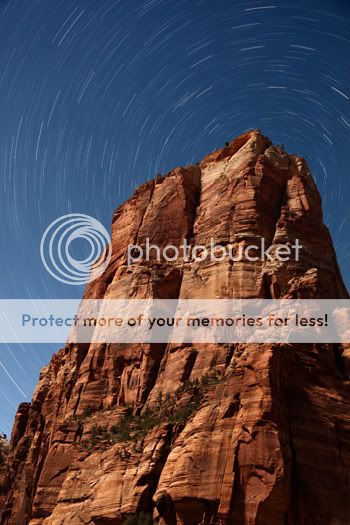
Molested Cow makes a good point about "anchoring" your composition to the area. Here's an example of one of mine that I tend to whore around the forum whenever questions like this come up. It's one in Zion N.P. in Southern Utah.

IMG_9800small.jpg
 

Create an account or login to comment

You must be a member in order to leave a comment

Create account

Create an account on our community. It's easy!

Log in

Already have an account? Log in here.

Back
Top Bottom