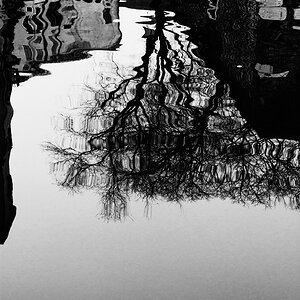
There is a lesson here. When you see something that catches your eye - it's because there's something there. However, the eye-brain connection is yours and to capture that "something" in a way that communicates it to other viewers takes some work. Probably the first thing to determine is what was it that was special - and this can be hard to do because much of our perception operates on a subconsious level. Once you've zoned in on what was special, then comes the photographic work of packaging it in a way that captures that "specialness" for viewers that have no connection to the scene or to your own experiences. There are a bunch of decisions to be made - what to include and exclude in the frame (are the foreground/background important or not), the amount of perspective (flat, strongly angled), the vantage point (high, low), where you want to place your focus, how much blur do you want to see (a function of aperture or depth-of-field), the overall tonality (determined by overall exposure) and mood, and so on.
Often times, the subject is fine, but the light is not - and you have to come back when the light is better for your purposes.
As tirediron asked, "what was it about the image that YOU find appealing and interesting?". This is not a trivial question. It is, in fact, a fundamental part of learning to photograph, to notice "something" and then to work out for yourself in a conscious way what it was that was noteworthy. It's part of learning to "see". And once you have a grip on what it is that is attractive, then comes the combination of art and technique that renders an image noteworthy for other viewers.







![[No title]](/data/xfmg/thumbnail/32/32926-ec27ecead8c80d803404500d8f888dbf.jpg?1734162683)






![[No title]](/data/xfmg/thumbnail/38/38443-d3f00036791c5f915b132320c9ac8865.jpg?1734172307)