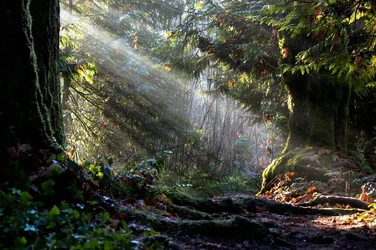
I edited it yet again and put the iso, exposure and F-stops in. quick question though, currently I am shooting in large quality Jpeg. format, should I be shooting in in Raw image format? and if this has already been discused somewhere would someone be able to point me where to find that information thanks
This will depend on if you have a RAW editing program such as Photoshop or Lightroom. I am sure there are lots of others out there and will reveal my ignorance to them. I started with the PS/Bridge combination and have never looked back. If you indeed do have the capacity to edit in RAW, then by all means shoot in RAW as you will record infinitely more data than in a .jpg regardless of the file size.
Your exposure data shows ISO 800. Was there so much movement in the leaves, limbs, etc that you couldn't shoot a longer exposure? If not, let's play a tit for tat exercise:
F-stop = 5.6
Exposure = 1/60
ISO= 800
(I tried to chart this in column form but the editor doesn't recognize it. sorry)
F:/8 gives you greater depth of field and would have opened up a little of your area past the big tree on the right. To be fair to what you shot, if you taketh away a unit of light, you must give one back, thus the 1/30 (half as much light, twice as much exposure to compensate).
F:/8 @ 1/60 takes away a unit of light but doesn't give anything back, which in this case is good because you already had an extra unit of light (in the form of an aperture point) you didn't need. The tit for tat formula works.
F:/8 @ 1/30 gives more time so to compensate, I lose a stop of light by dropping my ISO to 400. Could I have made the same compensation by increasing the DoF to 11? Yes, I could, but I am not sure I want that much extra depth of field since my main focus is on the light. Right now, I am merely losing noise. The T3i is right there with the D5100 and noise at 200 or even 400 should be minimal.
You can see how the rest of the compensation adjustment works. Think of exposure in terms of units of light. Each operation on the camera consists of units of light - Aperture, Shutter and ISO. Each number in the sequence is either half that which comes before it, or double that which comes after it. F:/8 is twice as much light as f:/11 but only half as much as F:/5.6. In either case, each represents a full unit of light. 100 is half of 200 and twice 50. ISO works the same way. The only one of these which affects depth of field is aperture, so know what it is exactly you want the viewer to see, set that aperture and work everything else around that number. The bigger the number, the greater the depth of field, the smaller the number, the shallower depth of field.
I wouldn't begin to tell anyone how to shoot, but I found (and still do) bracketing my exposures a great help in understanding what happens with exposure. Sometime when you have a free day, set your camera on a tripod in your backyard (safe from the elements) and shoot one particularly artsy area. Switch off the VR and use a remote shutter release, set your Lens to its sweet spot - for most f:/8 is going to be pretty close - and set your ISO to 100. Focus, then Meter to where you think the light is just perfect, Expose and then do 4, 1/2 stop exposures on the plus side of the meter and four on the minus side. Do this exercise at 7-ish, 10-ish, 1-ish, 4-ish and then open the images in bridge and compare them side by side. the ish's are for folks living in the far far north where the sun rises at 8 and sets at 4. Sunrise to sunset is a good range, two to three hours between shots.
[Some folks might argue for a full stop, +3/-3 but I find many of the T3i/D3100, 5100 class of cameras have some factory EV issues and I can narrow down in 1/2 stop increments quicker than in wholes and make an in-camera adjustment, generally in the +1/3 or - 1/3 EV range.]
Change your metering format and do the same exercise the next day. What you'll eventually discover is that some times of the day need more compensation than other times, some images require more exposure because of highly reflective surfaces nearby - or require fill light as a measure of compensation, that early morning and late afternoon will require more exposure, while high noon, much less. Some images work better in a matrix mode, some centerweighted and some spot. Figuring everything out takes a long time.
What you are going to rapidly discover is we don't live in a tit for tat world because we have other factors which affect the quality of the light we are trying to shoot: wide open expanses of concrete, sand, snow, sky add lots of reflective or refractive light, very little, low, flash compensation, movement, etc., and they have to be compensated for, but you have this great array of tools sitting in front of you that make this task exceedingly easier than it was with a simple 35mm film camera. Someone on here, or another forum pointed something out which I think everyone should ascribe to: know what it is that you want from the image before raising the camera to your eye. Make the proper adjustments in camera, shoot and do minimal PP work more as clean up than reworking the entire image. If the shot's not there, wait another day. If you can't wait another day, do the best you can but the better part of valor is not to make the shot at all (not a theory to which I've learned to ascribe to...ahso). There's another one tomorrow. Always.
*** Disclaimer: everything above is meant as an exercise in learning how your camera works. It isn't a detailed account of what I would do with his image, but should serve only to show how light, aperture and shutter have to work in concert with one another to get a proper exposure. I dont know what lens he used, if there was any wind (there wasn't of course as noted by the lack of blur in the foreground leaves - blur that 1/60 wouldn't begin to compensate for), the time of day - lots of unknowns. The most important bit of information is this: You have to know your camera and understand light before you can make exceptional photographs. My edit should have been what came out of the camera to start with. Oh, I should live so long.