What's new

Night, Tree, Stars, Flash - Help

  • Thread Starter 🔹
  • Moderator 🛠️
  • #16
Like all other above have said a remote shutter is a must. now what i would do different if i were shooting this picture is i would skip using the flash. instead i would use my cellphone torch or a led light to draw the tree in while capturing on a bulp mode for about 40 seconds. or you could bump up the iso and shoot at shorter time 20- 25 perhaps.

I tried a few with my cell phone and they were ok.

Guess I am buying a remote trigger!
 
  • Thread Starter 🔹
  • Moderator 🛠️
  • #17
$sky2.webp

Some same shot different settings

f/3.5
15sec
ISO-2500
Stronger flash.

I guess even if it is a bit windy I can't seem to get even the base of the tree to be sharp.
 
Like all other above have said a remote shutter is a must. now what i would do different if i were shooting this picture is i would skip using the flash. instead i would use my cellphone torch or a led light to draw the tree in while capturing on a bulp mode for about 40 seconds. or you could bump up the iso and shoot at shorter time 20- 25 perhaps.
I agree with this, except the bit about the 40 seconds – such a long exposure would likely give you startrails, the length of which being determined by your focal length (the longer the focal length, the less exposure time required for the trails to show).

When shooting the night sky, you really want to go with the largest aperture you can afford. Although not ideal (I'd say f/2.8 or faster would be), f/3.5 could still get the job done depending on the circumstances. f/5 is definitely too slow unless it's a bright night. Set your focus at infinity (or slightly less), and set your ISO at the largest tolerable number (what's tolerable varies by camera and by person). When shooting the night sky I start by setting my camera at f/2.8, ISO 800 and 30 seconds (at 14mm on full frame). If f/3.5 was the fastest I could go, then I'd set my starting ISO at 1250 or 1600, and stick with the 30 seconds. I usually take a couple test shots with those settings and then I make adjustments as needed – if I need more light, I increase the ISO; if I need less light, I stop the aperture down.

I never use flash – if I need to light something in the foreground, I use a flashlight to lightpaint. The problems with using the flash are reach and also that it will likely light something that you may not want to be lit (in this case, the snow close to the camera).

Do you have any photos of this scene shot without the flash (i.e., the tree being just an outline against the sky?).

 
Like all other above have said a remote shutter is a must. now what i would do different if i were shooting this picture is i would skip using the flash. instead i would use my cellphone torch or a led light to draw the tree in while capturing on a bulp mode for about 40 seconds. or you could bump up the iso and shoot at shorter time 20- 25 perhaps.
I agree with this, except the bit about the 40 seconds – such a long exposure would likely give you startrails, the length of which being determined by your focal length (the longer the focal length, the less exposure time required for the trails to show).

When shooting the night sky, you really want to go with the largest aperture you can afford. Although not ideal (I'd say f/2.8 or faster would be), f/3.5 could still get the job done depending on the circumstances. f/5 is definitely too slow unless it's a bright night. Set your focus at infinity (or slightly less), and set your ISO at the largest tolerable number (what's tolerable varies by camera and by person). When shooting the night sky I start by setting my camera at f/2.8, ISO 800 and 30 seconds (at 14mm on full frame). If f/3.5 was the fastest I could go, then I'd set my starting ISO at 1250 or 1600, and stick with the 30 seconds. I usually take a couple test shots with those settings and then I make adjustments as needed – if I need more light, I increase the ISO; if I need less light, I stop the aperture down.

I never use flash – if I need to light something in the foreground, I use a flashlight to lightpaint. The problems with using the flash are reach and also that it will likely light something that you may not want to be lit (in this case, the snow close to the camera).

Do you have any photos of this scene shot without the flash (i.e., the tree being just an outline against the sky?).

That is right You will get startrails. i have seen that on my own, And i totally agree on the f/2.8 or faster. the most wonderful Northern lights pics i have seen are captured on 2.8
 
Like all other above have said a remote shutter is a must. now what i would do different if i were shooting this picture is i would skip using the flash. instead i would use my cellphone torch or a led light to draw the tree in while capturing on a bulp mode for about 40 seconds. or you could bump up the iso and shoot at shorter time 20- 25 perhaps.

I tried a few with my cell phone and they were ok.

Guess I am buying a remote trigger!

I cant wait to see more of your night shots, when you get your hand on one trigger, I hope you don't mind me showing you a pic a friend of mine did, He is teaching me by the way about the northern light capturing :)
on this picture he used his sell phone on the boat. https://fbcdn-sphotos-f-a.akamaihd.net/hphotos-ak-prn1/798187_101184793398389_1127482690_o.jpg
 
  • Thread Starter 🔹
  • Moderator 🛠️
  • #21
Like all other above have said a remote shutter is a must. now what i would do different if i were shooting this picture is i would skip using the flash. instead i would use my cellphone torch or a led light to draw the tree in while capturing on a bulp mode for about 40 seconds. or you could bump up the iso and shoot at shorter time 20- 25 perhaps.
I agree with this, except the bit about the 40 seconds – such a long exposure would likely give you startrails, the length of which being determined by your focal length (the longer the focal length, the less exposure time required for the trails to show).

When shooting the night sky, you really want to go with the largest aperture you can afford. Although not ideal (I'd say f/2.8 or faster would be), f/3.5 could still get the job done depending on the circumstances. f/5 is definitely too slow unless it's a bright night. Set your focus at infinity (or slightly less), and set your ISO at the largest tolerable number (what's tolerable varies by camera and by person). When shooting the night sky I start by setting my camera at f/2.8, ISO 800 and 30 seconds (at 14mm on full frame). If f/3.5 was the fastest I could go, then I'd set my starting ISO at 1250 or 1600, and stick with the 30 seconds. I usually take a couple test shots with those settings and then I make adjustments as needed – if I need more light, I increase the ISO; if I need less light, I stop the aperture down.

I never use flash – if I need to light something in the foreground, I use a flashlight to lightpaint. The problems with using the flash are reach and also that it will likely light something that you may not want to be lit (in this case, the snow close to the camera).

Do you have any photos of this scene shot without the flash (i.e., the tree being just an outline against the sky?).
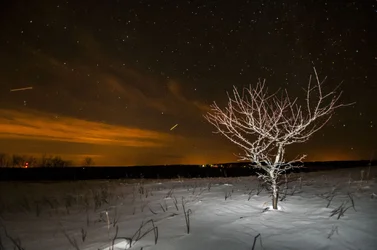
Sorry I only did this scene with the flash. Next time I will try it again.

I've tried shooting with my 1.8 wide open and at varying ISO I just think I am running into the limits of my camera.
 
  • Thread Starter 🔹
  • Moderator 🛠️
  • #24
Hi All, I'm new to Astrophotography and have read many of the tips, but similar to OP, my pictures the stars are blurry. I'm using a tripod and remote timer so I assume its just my camera settings?

I have a Canon T2i and generally used the following settings to get the attached pictures:
M mode, Bulb (for remote timer), F5.6, 3200 ISO. Manual focus, focused as far as possible). What should I try to change?
imgur: the simple image sharer

Also, for my first attempt at star trails, also attached, I just tried a 5 minute total exopsure (not nearly long enough I know, but I was testing and also noticed the stars were blurry):
Exposure 30 seconds, 32 second interval, 10 shots (for the composite with trails) I know this isnt nearly long enough, just tetsing this out.
imgur: the simple image sharer

What can I do?

Thanks you so much!!!
icon_smile.gif
JD
$small1.webp
 

Create an account or login to comment

You must be a member in order to leave a comment

Create account

Create an account on our community. It's easy!

Log in

Already have an account? Log in here.

New Topics

Back
Top Bottom