- Thread Starter 🔹
- #16
No, that's not right. The far object appears to have one fourth of the area of the near object, so the sensor receives one fourth as much light from it than from the near object. The two objects appear to be the same brightness because the ratio of light being received by the sensor from the object to the apparent size of the object is constant regardless of distance (ignoring the normally negligible light loss due to contaminants in the air etc).
If what you are saying were true, mountains would look black far away, or blindingly bright up close. That is obviously not the case.
I'm not saying anything, yet. That was a question. -- I don't think inverse square law is about apparent size, but about drop of intensity, like this:
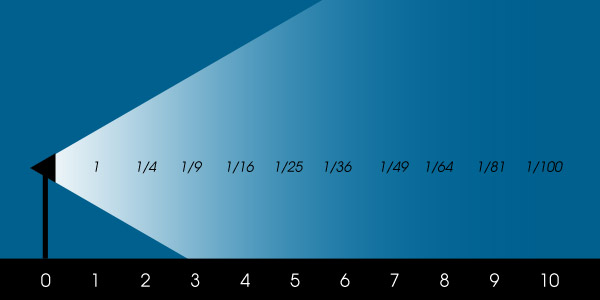
Also, TCampbell seems to have agreed that my picture is basically correct. So what now, which is it?
I do not want to talk about stars until we sort out the basics first.
Besides, this part of the experiment is easy enough to test by yourself. Use fixed settings in your camera and take several shots of a constantly-lit object or light source, varying only the distance between your camera and subject. It would probably be best to move the camera rather than the subject to avoid inadvertently changing the lighting conditions.
I would, but I'm not photographer, I do not have a camera where I can set exposure time and aperture size manually. Could you perhaps snap such photo for us?



![[No title]](/data/xfmg/thumbnail/37/37602-1ef8dbb1c2d0e4ff347ee65d328c3603.jpg?1734170730)