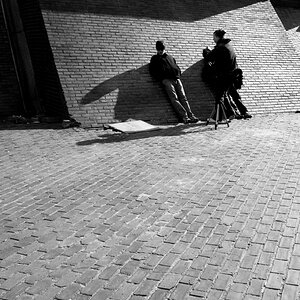
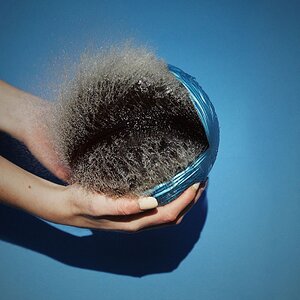
This is basically how I started out in professional photography. I was an apprentice (at a young age) for a professional photographer and while I had lots of tasks, holding the "side light" was one of them (probably the main thing that I did).
We used a light slave to trigger the off-camera flash (a Norman flash ... though this was more than 30 years ago, they still make these things:
Battery Portable Systems - Complete Kits ) - VERY powerful and very very fast re-cycle times (but not cheap). We mounted it on the top of a monopod which was hand-held by the assistant (me). If we wanted to soften it, we'd fire it through a shoot-through umbrella (though a softbox is generally better... a shoot-through umbrella is much more portable when moving through a crowded event because you can quickly fold & unfold an umbrella. I hand-held the umbrella in front of the flash.
These days I use an on-camera speedlight as fill light and an off-camera speedlight as the key light. I have a small 30x30" soft-box designed for use with speedlights (the mounting bracket is outside the soft-box... there's a hole in the back and you mount the flash so it fires through the hole into the softbox.)
You get much better lighting.
Here's a sample ...
View attachment 148402
But what's interesting (and bad) about this image is that the reflections in his glasses are my flashes and you can see the on-camera flash reflected in the lens on the left (his right eye) and you can see the softbox in the lens on the right (his left eye). The softbox is roughly at a 45º angle to the subject.
I *think* I used my 30x30" box (I also have a 24x24" box). But the closer the softbox is to your subject, softer the light. You can see a slight shadow under his chin (the softbox is too high to wash that out) and that could have been softened by using a light modifier on the on-camera flash. Often I use my Rogue Flashbender (large size) which turns out to be my favorite bounce-card style light modifier (after testing LOT of light modifiers for the on-camera flash) but this being outside, I don't think I used it (had I been inside it would have been on the flash.)
I generally always use a flash when doing outdoor portraits (this was a test shot to check my lighting as the day was beginning) because if in full-sun it helps reduce or eliminate the shadows and if a subject is in shade (especially if part of the background is in sun) it balances the light.
BTW there is no "overkill". When it comes to good photographic lighting... no matter how many lights you have, you can always think of a reason to have one more. ;-)



![[No title]](/data/xfmg/thumbnail/32/32153-05f63098d8752b05df53dfa6ae8d6e7d.jpg?1734161045)