What's new

rembrandt van rijn REMBRANDT van RIjN

The_Traveler

Completely Counter-dependent
Joined
Dec 11, 2006
Messages
18,743
Reaction score
8,049
Location
Mid-Atlantic US
Can others edit my Photos
Photos NOT OK to edit
p749568316-5.jpg
 
Quite hilarious ! Real ? Or photoshop trickery ?
 
  • Thread Starter 🔹
  • Banned
  • #4
Real, made at West Wing National Gallery this afternoon.
Slightly softened using color blob filter.

l did manipulate colors a bit to match the picture tones
 
Interesting; I wouldn't have thought that they would allow someone to take up that much floor space, but I think it's very cool that they do!
 
Me thinks the painter is missing some of Mr. Rembrandt's use of the dark lower portions to set up the stage for the face. But then, we re-crop other members' photos all the time to "improve" them. I admire the painter's skill.
 
  • Thread Starter 🔹
  • Banned
  • #8
I talked for a minute or so with the painter (a very nice personable man) He can only get 6 hours per week to paint in the museum; I imagine there are lots of people and the pressure to allow artists in is huge.

He had some photos of the Rembrandt for detail and we talked about white balance a bit. I noticed that he would make strokes above the canvas with his brush not touching and I asked if he made a plan on how to get certain effects. He said that, in some places, he couldn't figure out our Rembrandt had gotten the effects he did.

vtrCQ9.jpg


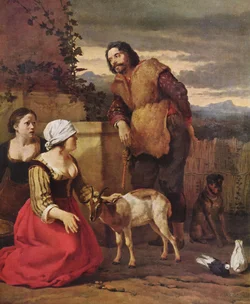
This led to me asking a docent a question which led to an really interesting, to me, answer. I love the Dutch painters of the 17th century, their 'Golden Age' and I was always fascinated by their ability to produce amazingly life-like detail in fabrics, feather, animals hair, etc and yet their rendition of human and animal faces was much less skilled. The docent told me that many of these painters worked, not from life, but from pattern books of animal faces and quick sketches of their subjects, perhaps done by others. So they could have swatches of fabric (velvet, brocade, etc) and pose them in the exact light they wanted to copy the effects but they had only sketches of the faces to go by.

"Karel Dujardin 001" by Karel Dujardin - The Yorck Project: 10.000 Meisterwerke der Malerei. DVD-ROM, 2002. ISBN 3936122202. Distributed by DIRECTMEDIA Publishing GmbH.. Licensed under Public domain via Wikimedia Commons - File:Karel Dujardin 001.jpg - Wikimedia Commons
$Karel_Dujardin_001.webp

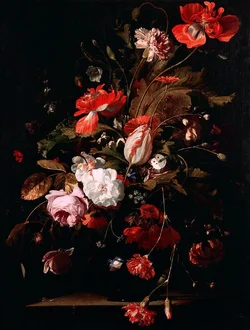
"Willem van Aelst - Bloementuil" by Willem van Aelst (1627–after 1682) - Unknown. Licensed under Public domain via Wikimedia Commons - File:Willem van Aelst - Bloementuil.jpg - Wikimedia Commons

$Willem_van_Aelst_-_Bloementuil.webp
 
I like the addition of those two shots. I'm not the biggest fan of taking pictures of other's art, but I like these documentary style ones, and I like the effect/play on the photo of the first.
 
This led to me asking a docent a question which led to an really interesting, to me, answer. I love the Dutch painters of the 17th century, their 'Golden Age' and I was always fascinated by their ability to produce amazingly life-like detail in fabrics, feather, animals hair, etc and yet their rendition of human and animal faces was much less skilled. The docent told me that many of these painters worked, not from life, but from pattern books of animal faces and quick sketches of their subjects, perhaps done by others. So they could have swatches of fabric (velvet, brocade, etc) and pose them in the exact light they wanted to copy the effects but they had only sketches of the faces to go by.

"Karel Dujardin 001" by Karel Dujardin - The Yorck Project: 10.000 Meisterwerke der Malerei. DVD-ROM, 2002. ISBN 3936122202. Distributed by DIRECTMEDIA Publishing GmbH.. Licensed under Public domain via Wikimedia Commons - File:Karel Dujardin 001.jpg - Wikimedia Commons
View attachment 82053

"Willem van Aelst - Bloementuil" by Willem van Aelst (1627–after 1682) - Unknown. Licensed under Public domain via Wikimedia Commons - File:Willem van Aelst - Bloementuil.jpg - Wikimedia Commons

View attachment 82054

Have you seen David Hockney's documentary about how the "painters" of that era used camera obscura setups and lenses to paint exceedingly life-like paintings??? He is one of the best artists of the 20th century, and his dissection of hundreds of paintings leaves little doubt that the "true" photographic perspective present in many paintings of long ago is the result of painting sone by a LENS projection system, and the equivalent of "multi-image stitching".

His proofs and examples are exceedingly convincing. The above idea of "pattern books" is preposterous and has no academic proof, just anecdotal BS, passed along over decades. LOOK at the paintings, then see how they were done. Hockney's examples of incredible highlight and shadow mapping and amazing patterns are pretty much all a thinking person needs to understand that the "masters" of long ago used tools in secret, and Hockney's own re-creating of their tools is astounding.

The amazing photo-realistic painting style of the Dutch master Vermeer has pretty much been proven to have been done using a lens-based method of rendering scenes. Vermeer?s Secret Tool: Testing Whether The Artist Used Mirrors and Lenses to Create His Realistic Images | Vanity Fair

Watch David Hockney's "Secret Knowledge" and just LOOKM at his timeline of hundreds and hundreds of paintings; as if flipping a switch, people SUDDENLY began to paint with ASTOUNDING realism--at least to the un-trained eye; Hockey's amazing abilities as an artist reveal the secrets of lens-based perspective anomalies that many people in the art world seem utterly clueless about. This is some of the first real new, and genuine, scholarship and use of scientifically-grounded research that has been applied to paintings in many decades.
 
'Preposterous' is a strong word.
Some of the paintings are certainly possible done with set scenes and a lens arrangements but many of them are of scenes that wouldn't be amenable to posing such as those with animals and cherubs or large groups of people set against an open meadow. Certainly the fine issues of textures and hair aren't plausibly conveyed with relatively dim lens arrangements and the unrealistic details of many animals certainly argue for a less precise source.

I don't mind a differing opinion or reason pleasantly expressed but stamping hard on someone's else's opinion just because it doesn't fit that acquired from your own reading is, well, rude.
 
Last edited:
watching the doc right now, very interesting.
 

Create an account or login to comment

You must be a member in order to leave a comment

Create account

Create an account on our community. It's easy!

Log in

Already have an account? Log in here.

Back
Top Bottom