What's new

Shooting JPEG in color for Black and White Images

Thanks for your replies. However, maybe I missed the answer to my question.....when your goal is to make black and white images using jpeg, will the images come out better if shot in color and then converted to black and white? Or will shooting jpeg using the cameras black and white mode give the same results as shooting in color first?
Thanks
 
Thanks for your replies. However, maybe I missed the answer to my question.....when your goal is to make black and white images using jpeg, will the images come out better if shot in color and then converted to black and white? Or will shooting jpeg using the cameras black and white mode give the same results as shooting in color first?
Thanks

Shoot in color and then convert to B&W and the images will come out better; yes.

Joe
 
it depends on how you convert it.

simple desaturation will provide similar results.
 
Ok, here is the last thing. I took a picture of a scene with a simple compact camera in color and then took the same scene using the black and white mode. (same camera) When I looked at the properties of both pics, the file size was just about the same. So I am a little confused as to how that could be since less info is recorded for a black and white photo than for a color photo. What am I thinking wrong?

Thanks again
Keith
 
Sorry, but it's been a long day and I'm feeling a bit testy.

....data in the primary colors only (red, yellow, blue) while RAW has the additional ability to save in the secondary colors (orange, green, purple). .......

Technically, our primary colors are red, green and blue. The 'secondary', or complimentary colors, are cyan, magenta and yellow.

If by "our primary colors" you mean the colors recorded by a digital sensor (with its 1-1-2 Bayer mask pattern), you are correct. I was referring to the common color wheel (Color Wheel, Color Circle, & Color Relationships), in which the primary colors are those pigments which cannot be made by mixing other colors - red, yellow, blue.

........ Or is it that, to complete this analogy, saving the in-camera six-shade B&W as a jpeg would then knock those six shades down to three anyway and the net effect is the same?

It's hard to explain easily, but reducing an image to only six shades of gray means you're reducing it to a 3-bit image....... far far less than an 8-bit JPEG.

Oh, I understand bit counts. I was admittedly over simplifying for the sake of analogy. My 3 shades of jpeg color and 6 shades of RAW color of the initial premise are also far, far less than their 8-bit and 12-bit analogs.

Keith, sorry for hijacking your thread - poor form, especially to do it to a fellow M@$$hole. I'll sign off of this thread and return it to its original path.

Because of taking classes that only taught about color, I feel compelled to respond. There are three color wheels, additive, subtractive and traditional. The traditional (red, blue, and yellow) refers to paint, the additive (RGB) to light, and subtractive (cyan, magenta and yellow) is used for ink. So for photos you only need to worry about RGB unless you are printing for a newspaper, magazine etc.
 
Ok, here is the last thing. I took a picture of a scene with a simple compact camera in color and then took the same scene using the black and white mode. (same camera) When I looked at the properties of both pics, the file size was just about the same. So I am a little confused as to how that could be since less info is recorded for a black and white photo than for a color photo. What am I thinking wrong?

Thanks again
Keith

All shades of gray still need equal amounts of Red, Green and Blue. So while red is 255:0:0, grey would still need three color channels. Middle gray would be 128:128:128.

So it takes the same amount of computer memory to record all three color channels, even if they are the same number.
 
Because of taking classes that only taught about color, I feel compelled to respond. There are three color wheels, additive, subtractive and traditional. The traditional (red, blue, and yellow) refers to paint, the additive (RGB) to light, and subtractive (cyan, magenta and yellow) is used for ink. So for photos you only need to worry about RGB unless you are printing for a newspaper, magazine etc.

"Traditional" is a bogus color system that doesn't really apply in the real world, and is based on tradition, not on physics. It's an approximation to CMY, and has a significantly limited gamut. For all intensive purposes, this color system should be ignored.
 
The only way the traditional wheel is helpful is if you are mixing paint. This was the only medium way back when, so hence the "traditional wheel".
 
theoretically, paint in CMY primaries would behave similarly to RBY and would be more reliable.
 
The pigments in ink andante are different so CMY wouldn't work for paint just as RGY wouldn't work for ink. For photos you should use RGB because you are dealing with light.
 
I've heard this argument before, and it just doesn't make any sense to me. Are you really suggesting that Cerulean Blue (cyan) and Quinacridone Magenta ink would mix up just fine, but the same pigment suspended in acrylic or oil won't?

I think this argument originates from artists expecting CMY and RBY to respond exactly the same.
 
Same color but not pigment. Ink and paint do not mix the same way.
 
... waiting for my crude example to dry.

---

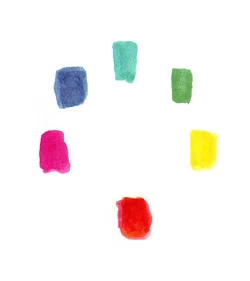
I'll admit that these scanned in more punchy than they actually are ... but you should get the idea. Below is a crude CMY color wheel created using pigment ink with a polymer base: Yellow Medium Azo, Quinacridone Magenta, Cerulean Blue. I mixed them exactly as you would paint, on a pallet with a brush.

$img004.webp

As you can see, these inks behave pretty much like you'd expect. They are pigment inks, the pigment falls out of emulsion and must be agitated before use.

Are you telling me that if I mix these inks into acrylic medium or gum arabic, that they'll somehow behave differently? Please don't tell me that is what you're saying, because I have both mediums and I don't really feel like demonstrating that, in fact, the medium does not matter.
 
Last edited:
The secondary colors for the traditional color wheel are not CMY. They are orange, violet and green. R+B=V, R+Y=O, and B+Y=G.
 
The difference doesn't really matter with the primaries and secondaries though. It's more about the analogous and tertiary colors.
 

Create an account or login to comment

You must be a member in order to leave a comment

Create account

Create an account on our community. It's easy!

Log in

Already have an account? Log in here.

New Topics

Back
Top Bottom