

- Joined
- Dec 16, 2003
- Messages
- 33,896
- Reaction score
- 1,853
- Location
- Edmonton
- Can others edit my Photos
- Photos NOT OK to edit
- Moderator 🛠️
- #16
Lighting for portraits is a big topic unto it's own. The site that Andrew linked to, has a lot of really good tips & lessons.Mike, can you give us a quick run-down on the whole broad/short lighting dynamic? You posted something similar in my thread the other day and I've been curious since. I bought a few books last night on portrait lighting, which I'm sure will go into it but I'm more interested on your interpretation and how you utilize/manipulate it. I'm pretty sure Andrew wouldn't mind hijacking his thread for a couple of posts as he was curious too when I mentioned your comments to him. Thanks.
~Tom
I can quickly touch on the question of short & broad lighting though.
Broad lighting is when you light the side of the face that is toward the camera. So for example, if your main light is on your right (subject's left) and the subject is facing a little to their right (your left)...then you will be lighting the closer side of the face. This is broad lighting. Another way to think of it, is that you are lighting the close (or visible) ear.
Broad lighting tends to light the whole head, and as such, can make your subject look bigger. Sometimes you want bigger (more important), but often, you don't want to make your subjects look any bigger.
Short lighting is the opposite. You are lighting the side of the face that is away from the camera...or you could say that there is light on the far (hidden) ear.
With short lighting, you are essentially lighting the 'front' or 'mask' of the face, rather than the whole head. This can work to make the subject smaller or thinner, which is often desirable.
With any portrait lighting style or pattern...a key aspect is where the light transitions into shadow. Further to that, the hardness (or softness) of the light will determine how that transition works.
So what I mentioned before about switching from broad to short...that can be done, sometimes accidentally, if you move your camera position from one side of the model's face to the other. Remember that broad & short is determined by which side of the face is closes (or toward) the camera. So if the camera moves, the lighting style/name may change as well....even though the light and the subject haven't moved at all.
Here is my wife in short lighting.

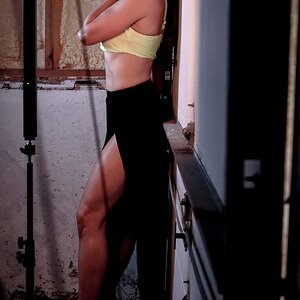
Here is a model in broad lighting.



![[No title]](/data/xfmg/thumbnail/34/34593-f9e16dc135ec1fcde87624f30e703802.jpg?1734165595)
![[No title]](/data/xfmg/thumbnail/36/36421-843e629a8c32ff091e337e6880f0c323.jpg?1734168831)
![[No title]](/data/xfmg/thumbnail/39/39429-cfa441056f1e6a1995539dc87c794876.jpg?1734173523)