lambertpix
No longer a newbie, moving up!
- Joined
- Sep 27, 2013
- Messages
- 938
- Reaction score
- 371
- Location
- Columbus, OH
- Can others edit my Photos
- Photos OK to edit
No I think your brain DOES recognize the difference. And it is very actively correcting in photos. But it simply calibrates itself to expect the proportions that "go with" the estimated distance to the subject, in the eye's typical focal length(s). This makes problems when you shoot at any focal length other than about 65mm. So when you see a picture with plenty of trees and context all around, it goes "hm, okay I must be about 10 or more feet away, because that's how far I'd be at 65mm to see all those trees around the person" but then you get the huge noses and stuff that you're only used to seeing a foot away, and the mismatch is a problem.It's true that our brains don't recognize distortion of a face as we get close to it, but I'm not sure that (alone) is helpful for us.
The brain has to resolve the conflict somehow, and the weaker of the two assumptions is the facial proportions -- because everything you look at ever reinforces the distance assumption, whereas only faces reinforce the face proportion assumptions, AND you know that people can be disfigured, etc. in real life. So it is a better guess to the brain to assume that the proportions really ARE weird on the person, not that it guessed distance incorrectly.
Thus the brain resolves the conflict not by changing its mind about distance, but by maintaining the distance assumption and instead interpreting the person as simply a weird ugly person with a big nose.
Barrel distortion is a separate issue entirely.not the barrel distortion pattern I'd expect to see if I shot the same grid with a wide-angle lens.
BOTH barrel distortion (if/when it exists) AND simply the mathematics of perspective when near something = bigger noses. But probably 95-99% of the effect of big noses you see is from perspective, not imperfect lenses.
In other words, a 14mm lens from 6 inches away, even if it was optically perfect and crafted by the very gods themselves, would still show big noses, about as big as our lenses do.
If your nose WEREN'T big in a wide angle shot from close up, then THAT would be the evidence of a major lens distortion / flaw in your glass.
I thought I'd pretty carefully qualified my observations as things that I see when I look at portraits taken with a wide-angle lens, but clearly, I didn't take quite enough care; I'll try again.
I've seen several examples of portraits at multiple focal lengths in which the same subject was shot from wide-angle to telephoto focal lengths. Here's an example, but there are quite a few others out there:
Untitled Document
I understand that the distance to the subject has to change in order to maintain the same framing from shot to shot. I also am aware that framing in my "normal" 3D world isn't quite the same as framing in a camera, due in part to my eyes constantly darting around. As it turns out, for the purposes of this exercise, I don't care.
When I scroll to the right of the strip of images in the example above, I perceive a noticeable difference between the shot at 19mm and the shot at 350mm. Careful analysis of a sufficient number of images might show actual differences in number of pixels occupied by noses, eyes, ears, and so on from very wide focal length-framing combinations to telephoto focal length-framing combinations, but I haven't done any such analysis. Nevertheless, I perceive a difference. I have no idea if anyone else sees a difference as well, but I suspect that I'm not alone.
Now, then, just because I perceive a difference, it may or may not be important. I choose to believe it is, based on the facts that (1) some of the photos in the example above are more attractive to me than others, and (2) I've seen a number of people claiming to have isolated "beauty formulas" or other such hooey based on measurements of the human face. I'm aware that there might very well be factors other than the focal length-framing combination contributing to factor #1, but I've seen this exercise repeated a number of times, and it turns out that I typically like head shots somewhere in the 70-135mm range, and I really don't like head shots at wide focal lengths very much at all when compared to similar photos at normal to near-tele lengths. Again -- that's just me. Moving on to factor #2, I recognize that the very idea of a "beauty formula" seems subject to extreme skepticism, and I personally tend to believe that a single universal formula for beauty is probably hogwash. Despite this, I think there is an underlying hard-wiring in my brain that causes me to be more sensitive to size and proportion when I view a human face than I would, for instance, when viewing a cantaloupe. I may not always be able to tell you why I prefer (a) to (b) given any two options, but I know which one I like. My optometrist, for what it's worth, seems fond of the same technique for evaluating my optical preferences, even after measuring objective facets of my vision.
So, when I view photos, I see a difference between wide and telephoto (given similar framing), and when it comes to portraits, I prefer some over others.
Moving on to people I see in real 3D living color, I simply don't perceive the same change as they move nearer or further away. Speaking only for myself, I just don't see it. Again, I personally believe that my 3D vision accounts for at least some of this, based only on hunch and the one-eye-covered grid experiment, and again, even though "why" is of some interest to me, the mere fact that I don't perceive this effect in real life is sufficient for me for these purposes.
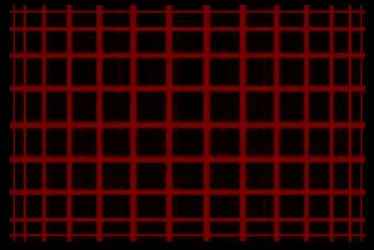
Re: barrel distortion, the "barrel distortion pattern" I mentioned (I checked to make sure that I really referred to it as a "pattern", and I did) was meant to describe my perception of distortion, whether through perspective or through lens distortion. On the off chance you're not familiar with the pattern, this is what I'm talking about:
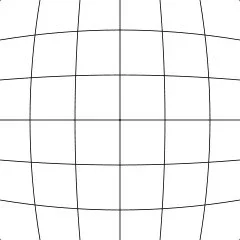
Forgive my earlier lack of precision re: the pattern. In any event, I stand these observations: when I move a grid close to my eyes, I perceive very little distortion. When I move a person close to my eyes, I perceive very little distortion. When I see a portrait shot up close at a wide focal length, it usually looks pretty odd to me.
I understand there's no proximity-induced subject shape-shifting going on as the focal length of my lens varies, and while I've got a passing interest in understanding how my brain's RAW processing works (again, this is a metaphor), my intent was mainly to support Ron.I've found that an uncorrected 2D representation of a portrait shot at close range using a wide-angle lens doesn't really seem to have the same proportions I perceived through my squishy-eyeball-lenses prior to mashing them up against the viewfinder.
Normally, I'd let that pass as "distortion" in a context like this (Ron, I knew what you meant).




![[No title]](/data/xfmg/thumbnail/30/30994-49c5521f7b5b417f49dcd43891cbec27.jpg?1734159066)
![[No title]](/data/xfmg/thumbnail/32/32929-22e23acc63d6ecb25e5ee941be87121f.jpg?1734162700)