What's new

Stars, Lenses, full frame senses ;)

Lexalotacus

TPF Noob!
Joined
Sep 21, 2011
Messages
3
Reaction score
0
Location
denver
Hey everyone, hope im posting this in the right area...

I'm looking for a lens to do some wide-er angle star photos (i want sharp, clean, bright stars and no star trails or smeary looking stars). I have a Zeiss 50mm 1.4 but it's not quite wide enough.

The problem is, I need something that's really REALLY good for stars, wider than 50mm, and no more than $1,000.00. I'm shooting with a Canon 5D mark ii. I want to avoid lenses made for crop-sensor cameras if possible...

Does anyone have any advice on this?
thanks in advance!
 
Adapt a Nikon 24mm f/1.4G. You might be able to swing a Nikon 28mm f/1.8G, but I have no idea how it does with coma in the peripheral.

Otherwise you can pretty much forget about it. Canon wide angle lenses suck balls compared to the Nikkor's.

Considering what you're looking for, I can check with my bank manager at Nigerian Leprechaun to see if I can make a loan to buy a unicorn.
 
Yep, and the new Ford Fiesta is just like an Aston Martin!!! see!!!!!


webopt-db9-04.jpg


Ford-Fiesta-2014.jpg


That 1.0L 3-banger's sure got a lotta pep in it!!


seriously...The Sigma 20, 24, and 28mm f/1.8's are just about the worst lenses in that range...you can't really do worse...At least the Samyang 24mm is better than that.
 
I dont believe you... It's usually the snotty know-it-alls that are wrong.
 
You should save yourself alot of money by getting the right tool the first time..

You're going to hate that lens too..At first you'll think it's alright. That's natural, you're just trying to justify your purchase, you'll think "wow! look at all the money I saved!" Than you'll go out at night and try to take a picture of the stars with the aperture wide open, and you'll see how crappy this thing really is, how nasty the field curvature is, and how only the very very very center is the only thing that's in focus in your exposure.

I'm not even kidding when I say you could not have chosen a worse current prime wide angle lens to put on your camera than one of those three sigmas.


Photozone seems to get a real kick out of it, 1.5-out-of-5 stars!!

Just like its slightly longer sister lens, the Sigma AF 24mm f/1.8 EX DG leaves us with a mixed impression. The center resolution of the lens is nothing to complain about, at least when stopped down, while the borders and corners disappoint especially at large apertures. Vignetting is quite pronounced wide open. CAs are a somewhat pronounced while distortion is well under control for a wide-angle lens. t
he bokeh is somewhat nervous at large apertures, but improves considerably when stopped down a little.The build quality is a bit of a negative surprise because of the wobbling inner lens tube. So, just like the EX 28/1.8, it's not an attractive choice for landscape shooters
 
Nikon 20 2.8 af-d
$DSC_9754.webp
Taken with a Nikon d700, 222sec exposure, This was on an equatorial tracker to keep match the rotation of the earth so now trails are present ( that is why the trees appear to move)
 
This is an non-tracked photo using a 5D II with the EF 14mm f/2.8L II lens.

It's 40 seconds at f/2.8 and ISO 1600. I didn't *quite* nail the focus (if I zoom in I can see the stars are softer than they should be.)

This was taken at the "Great Lakes Star Gaze" event in Michigan (about a 4 hour drive for me.)


Milky Way by Tim Campbell1, on Flickr
 
I dont believe you... It's usually the snotty know-it-alls that are wrong.

No. He is someone with experience trying to steer you in the right direction. He is just giving you an answer to the question you asked.

You asked for sharp, no star trails, or smeary stars. Well in order to achieve this you either need a super sharp lens at very wide apertures or a tripod with an equatorial tracker. Neither are cheap.
 
This is an non-tracked photo using a 5D II with the EF 14mm f/2.8L II lens.

It's 40 seconds at f/2.8 and ISO 1600. I didn't *quite* nail the focus (if I zoom in I can see the stars are softer than they should be.)

This was taken at the "Great Lakes Star Gaze" event in Michigan (about a 4 hour drive for me.)


Milky Way by Tim Campbell1, on Flickr

I see a bit of star trails too but this isn't good enough for the OP he wants better with much cheaper lens than your cannon 14mm f2.8.
 
Lenses for Astrophotography

The main point here is that astro imaging is a true test to a lens quality and many don't live up to expecations
 
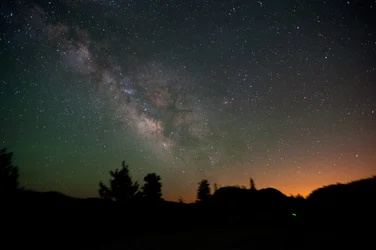
This is why you need f/1.4:

6832502343_82fde737f6_b.jpg
 
That's pretty awesome Switch. Can you give me an idea of your settings to achieve this? I live in the Middle East and we are coming into "clear skies" time of year so I want to take full advantage.

Many thanks in advance.
 
It was something like 24mm, f/1.4, ISO 6400 and 30 seconds or so.
 

Create an account or login to comment

You must be a member in order to leave a comment

Create account

Create an account on our community. It's easy!

Log in

Already have an account? Log in here.

New Topics

Back
Top Bottom