What's new

The Rule of Thirds. C and C Please

The "rule" of thirds is basically nonsense. A large portion of the great images in photography don't adhere to it, so I don't see how it helps anyone...
The "rule" of thirds is a compositional guideline which is a compositional guideline almost as old as art itself. It most certainly is not applicable to every image, but it is relevant here because the OP has asked about it.

So, I'm not entitled to express my opinion on something the OP asked about?

As for ROT itself, it's not even mentioned in several books on composition in art that I've read. It seems to be a big thing among photographers, but if you look at a lot of images of any kind that are hanging in museums it is difficult to see how many of them follow it. At any rate I don't see why it's forbidden to express an opinion on it.
 
The "rule" of thirds is basically nonsense. A large portion of the great images in photography don't adhere to it, so I don't see how it helps anyone...
The "rule" of thirds is a compositional guideline which is a compositional guideline almost as old as art itself. It most certainly is not applicable to every image, but it is relevant here because the OP has asked about it.

So, I'm not entitled to express my opinion on something the OP asked about?

As for ROT itself, it's not even mentioned in several books on composition in art that I've read. It seems to be a big thing among photographers, but if you look at a lot of images of any kind that are hanging in museums it is difficult to see how many of them follow it. At any rate I don't see why it's forbidden to express an opinion on it.

By all means, say what you want. I do find it funny, though, that your avatar is a variation of ROT. :)
 
Last edited:
The "rule" of thirds is basically nonsense. A large portion of the great images in photography don't adhere to it, so I don't see how it helps anyone...
The "rule" of thirds is a compositional guideline which is a compositional guideline almost as old as art itself. It most certainly is not applicable to every image, but it is relevant here because the OP has asked about it.

So, I'm not entitled to express my opinion on something the OP asked about?

As for ROT itself, it's not even mentioned in several books on composition in art that I've read. It seems to be a big thing among photographers, but if you look at a lot of images of any kind that are hanging in museums it is difficult to see how many of them follow it. At any rate I don't see why it's forbidden to express an opinion on it.
You're absolutely entitle to express your opinion on pretty much anything you want, but you didn't express an opinion, you made a statement. "In my opinion, the rule of thirds..."

Take a look at the work of the old masters (except for single-person portraits where it really doesn't apply), and you will see a very definite application of the ROT in many of them. It's an established fact that most people find an off-centre composition more pleasing than a centred one.
 
As for ROT itself, it's not even mentioned in several books on composition in art that I've read. It seems to be a big thing among photographers, but if you look at a lot of images of any kind that are hanging in museums it is difficult to see how many of them follow it. At any rate I don't see why it's forbidden to express an opinion on it.
You might be right about "ROT" being more popular among photographers for the simple reason that in photography one doesn't always get the chance to re-arrange components for better composition. We often see a scene and capture it just as it is, then we crop to make it better.

There are plenty of other compositional attributes that photographers do not address, or very rarely, that painters for example just put where they need to be.
 
To me, the "rule of third" guideline is a subset of a larger guideline called "balance". Balance is difficult to describe, since there is so many ways it can be expressed, whereas the rule-of-thirds is quite easy to state. Yet in the end, one is looking for a composition that is coherent, where the various elements support each other, where the image "makes sense". This applies whether one is doing an abstract, or a street scene.

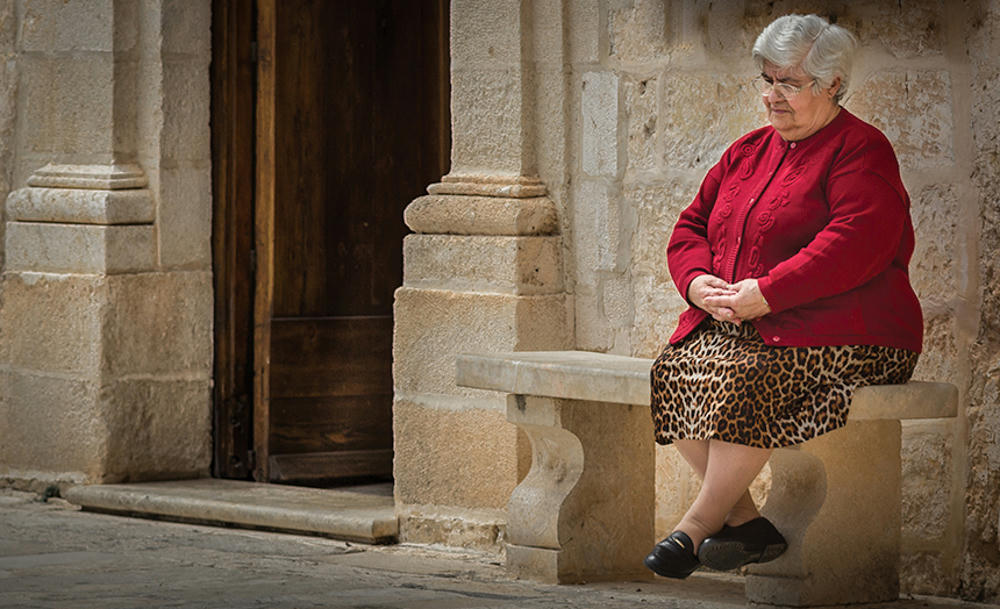
In the case of this photo, it feels (to me) to be cropped a bit too tight. I'd have liked to see a bit more space above her head, and a bit less space to the right. I like the detail you've captured, both of your subject and the wall. The announcement box above her head looks like it is somewhat intrusive if the subject is the woman, yet on the other hand, it's part of a darker vertical block (woman + announcement box) that kinda balances the other dark vertical block (the door). The invisible eyes (that Lew pointed out) don't bother me, as her posture seems to be almost meditative. However, there's something in the framing that just doesn't feel balanced to my eye. I'll need to stare at it some more to see if I can come up with a more coherent critique.
 
Thank you guys. This is very informative. This is the second edit:
43aq9l4rw9iga47zg.jpg
 

Create an account or login to comment

You must be a member in order to leave a comment

Create account

Create an account on our community. It's easy!

Log in

Already have an account? Log in here.

New Topics

Back
Top Bottom