What's new

Why are exposure times so long if light travels so fast?

.........
Say, we've got a scene (hipothetically) with NOTHING moving in it and no more or less light entering it, it's stagnant. How would it make a difference in the final picture if I left the shutter open for 1/1000 of a second or 30 seconds??.......


Take a 5-gallon bucket and put a hose in it. Turn the water on. How long did it take to fill the bucket?

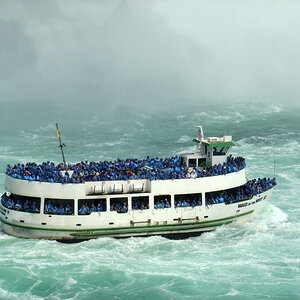
Now, take the same 5-gallon bucket and stand at the bottom of Niagara Falls. Fills up a lot faster, didn't it?


Niagara Falls has a LOT MORE water traversing the same space as your dinky little hose did. It may be moving at the same speed, it's just there MORE OF IT.


In a dark scene, there's not many photons (drop of water) striking the sensor (your 5-gallon bucket), so it takes more time to fill up those photo-wells. That's the same as your hose. In a bright scene, there a lot more photons headed toward the camera, so the photo-wells get filled up faster. That's Niagara Falls.
 
Say, we've got a scene (hipothetically) with NOTHING moving in it and no more or less light entering it, it's stagnant. How would it make a difference in the final picture if I left the shutter open for 1/1000 of a second or 30 seconds??

No light. No picture it doesn't matter the exposure time. Photographers have used this to their benefit for years. Filming lightning or fireworks on a dark night you can open the shutter, wait for the flash, then close the shutter.

I mean why the heck would a sensor need a whole 30 seconds to capture an image??
You need to learn a bit about the exposure triangle. This is all about tradeoffs and choices on the part of the photographer and artistic vision. Things look different under different shutter speeds.

I really don't get it. I mean if I wanna take a picture of a blue mailbox, why would I want to leave the shutter open for 30 seconds instead of just snapping the same exact image in 1/1000 of a second?

Again artistic vision an choices on the part of the photographer. It will not be the same image. Maybe there is so much noise when the ISO is raised image quality suffers. Maybe the photographer wants to stop down the lens more to get a greater depth of field. These choices become even more interesting when you think about moving subjects especially moving water.

Also, during a whole 30 seconds, what's going on with the camera's sensor? What info is being saved and where? Is that entire 30 seconds getting written to a file on the SD Card and isn't the stuff that happened in the first 10 seconds being overwritten anyway?
No. To oversimplify: Pretend there is a turnstile on each pixel and it counts the number of photons entering. 0=black depending on the camera something like 16384=white. It's adding, not taking separate images.
Adjusting the ISO adjusts the levels for black and white. There is rarely pure darkness on the earth unless you go spelunking.

For example, what if I press the shutter and it's set to 30 seonds and a lightning bolt strikes in the first second. What happens to that lightning bolt image? If it's not recorded in the final image then what's the point of having the shutter open for a whole 30 seconds?
Good example. It depends on how much extra ambient light is reaching the sensor. If it's dark, you will only get the lightning, assuming that you have sufficient sensitivity

This is confusing. I can't find any info on the web to read up on it either. All the article just repeat the whole birds eye view of the process, so that it all remains a mystery, but I really want to understand it.
Maybe a video.
 
You do not fill the cup in the first 1/1000 of a second.

Ok, but then how do people take great pictures at 1/1000 or greater speeds? Is it simply that the light is more abundant so they don't need as long?

If a sensor takes 30 seconds though to capture all the light it needs from an image in my opinion it must be pretty darned slow. I just can't understand anything digital or electronic needing longer than a fraction of a second to gathering all the "info" it would need for making an image from light, but I guess I'm off base somewhere here.

How come when we look at a scene we humans capture all the light within a split second to percieve the scene, but a modern digital camera may require 30 seconds to gather that info? I don't get this.

P.S. When would I need to use an shutter speed longer than a second in real life?
 
Ok, but then how do people take great pictures at 1/1000 or greater speeds? Is it simply that the light is more abundant so they don't need as long?

Artistic vision. Sometimes things look cooler under slow shutter speeds. Some crazy people, myself included, strap filters to reduce light on our cameras to take slow shutter speed shots ( from a tripod ) when the light is bright.


If a sensor takes 30 seconds though to capture all the light it needs from an image in my opinion it must be pretty darned slow. I just can't understand anything digital or electronic needing longer than a fraction of a second to gathering all the "info" it would need for making an image from light, but I guess I'm off base somewhere here.

Star trails? Here's a 267 second exposure.

DSC_9404.webp


How come when we look at a scene we humans capture all the light within a split second to percieve the scene, but a modern digital camera may require 30 seconds to gather that info? I don't get this.

P.S. When would I need to use an shutter speed longer than a second in real life?

Human perception is not how your camera captures. Human vision has higher dynamic range and is interpreted by your brain.
 
It's not necessarily a slow sensor, maybe there just isn't a lot of light (say at night, for instance).

Sensors are not eyes.
 
Ok, but then how do people take great pictures at 1/1000 or greater speeds? Is it simply that the light is more abundant so they don't need as long?

If a sensor takes 30 seconds though to capture all the light it needs from an image in my opinion it must be pretty darned slow. I just can't understand anything digital or electronic needing longer than a fraction of a second to gathering all the "info" it would need for making an image from light, but I guess I'm off base somewhere here.

How come when we look at a scene we humans capture all the light within a split second to percieve the scene, but a modern digital camera may require 30 seconds to gather that info? I don't get this.

P.S. When would I need to use an shutter speed longer than a second in real life?


Why does it take your entire lifetime to earn all that money?

Why can't I just get paid $5,000,000 on my first paycheck and be done with it?
 
How come when we look at a scene we humans capture all the light within a split second to percieve the scene, but a modern digital camera may require 30 seconds to gather that info? I don't get this.

I have never been able to look up into the night sky and see the Milky Way galaxy in a split second. It doesn't work even after staring at the sky for 30 seconds. :D
 
You do not fill the cup in the first 1/1000 of a second.

Ok, but then how do people take great pictures at 1/1000 or greater speeds? Is it simply that the light is more abundant so they don't need as long?

Imagine a tap that came off and the water is pouring out of the pipe at a very high pressure. How long does it takes to fill the cup ?

Look, it is all very easy, just use your common sense.
 
Some very informative and funny info here.
 
So Cal is not always 75 degrees, warm beach, and fake boobs. :D We have huge national forests that are completely untouched. My home studio is a short 15 mins drive to San Bernardino National forest. I go deer hunting there every year, 2am in the morning pitch black sitting on my tree standk, looking up to the beautiful sky with no major towns within 30 miles. I've never been able to see the Milky Way the way that my camera does. Maybe my eye sight is not as good as some of you... :o
 
Last edited:

Create an account or login to comment

You must be a member in order to leave a comment

Create account

Create an account on our community. It's easy!

Log in

Already have an account? Log in here.

New Topics

Back
Top Bottom