What's new

Why are exposure times so long if light travels so fast?

Who cares? Just go outside and take good pictures. That's all that matter.

...and make sure to get paid for it. Else, it's going to be expensive. :D
 
stick a fork in it, turn it over, it's done!
 
Ok, so if the sensor is collecting photons from the blue mailbox for 30 seconds what will be the end result in final image form from say a 1000 of a second exposure. Just a brighter picture?

Would someone need to use a 30 seconds exposure normally in broad daylight, for example? What would be the end result if I was at say 100 ISO and took a picture at 30 seconds shutter speed on a beautiful sunny day outside? My guess that the picture would be very "white" . Am I off base?

So are underexposed pixels black and over exposed white in a final image? Everything in between is a color other than black or white?

How am I doing? Am I a pro photographer yet? LOL
 
.........Would someone need to use a 30 seconds exposure normally in broad daylight, for example? .......

Yes. Commonly done to get that silky-smooth effect when shooting moving water such as waterfalls.

BaringCreek_4203post.jpg
 
I've done long exposure in bright day light before... with a 10 stops ND filter :o
 
I'm still having trouble with understanding the "blur" thing, but I guess I'm gonna have to do some research. I don't get how "movement" can be captured into a final image if a camera captures something at an instant in time. Obviously a "blur" shows movement.

For example, a person running across the image and then the final image has him or her in 4 different places at once (as various blurs of course). I don't get how that can happen really. It's boggling my mind!
 
I'm still having trouble with understanding the "blur" thing, but I guess I'm gonna have to do some research. I don't get how "movement" can be captured into a final image if a camera captures something at an instant in time. Obviously a "blur" shows movement.......!

Put some wet paint on your finger, press said finger against a canvas, then move your finger around.

The paint smears, doesn't it? Because your finger moved over time.

A subject reflecting light toward a camera is the same thing. The subject is your finger, the light is your paint and the camera is your canvas.
 
I'm still having trouble with understanding the "blur" thing, but I guess I'm gonna have to do some research. I don't get how "movement" can be captured into a final image if a camera captures something at an instant in time. Obviously a "blur" shows movement.......!

Put some wet paint on your finger, press said finger against a canvas, then move your finger around.

The paint smears, doesn't it? Because your finger moved over time.

A subject reflecting light toward a camera is the same thing. The subject is your finger, the light is your paint and the camera is your canvas.

Thanks, I think I might be getting it now!

That helped! :)
 
I'm still having trouble with understanding the "blur" thing, but I guess I'm gonna have to do some research. I don't get how "movement" can be captured into a final image if a camera captures something at an instant in time. Obviously a "blur" shows movement.

For example, a person running across the image and then the final image has him or her in 4 different places at once (as various blurs of course). I don't get how that can happen really. It's boggling my mind!

Define "instant." Your own example of a 30-second exposure is not exactly instantaneous, is it? The camera does not choose one particular instant of time during that 30 seconds and record that instant. It captures everything it sees during that time, so there is no "instant."

The sensor captures everything it sees in that time, but obviously not as motion.

Exercise to illustrate motion blur: extend your arm out to its full length in front of you, on a bright day, with your hand in front of a dark surface. A wall, the fridge, your car, the Black Forest, whatever. Enough contrast that your hand is brighter than what's behind it.

Raise your index finger like you're counting to ONE.

Now shake your hand back and forth sideways as rapidly as you can.

While it's moving, does your eye see your finger sharply defined, or do you see "through" a wide stretched-out distorted view of your finger.

If a camera takes a picture of that movement with a shutter speed of 1/8000 of a second, the camera will capture a sharp image of your hand and finger. If instead you run the shutter at 1/2 of a second, the camera will not be able to resolve the finger, but will have that streak of finger-color in the space your finger moved through. The camera looked at the scene long enough to see the motion, which it recorded as the blur you saw in the exercise above.

 
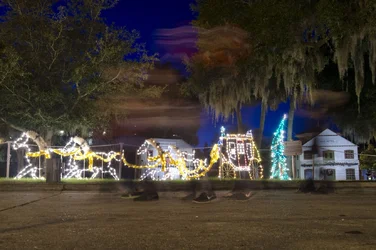
Here's a little exercise that can help you. Set your mode to shutter priority. Set your shutter speed to (say) 1/10 sec. Now, take a picture of people walking in a plaza. You'll might get the image of a person walking past you. If the timing is right, you'll see the person's foot "frozen" on the ground, and an increasing blur as you look up the person. That's because the foot hasn't moved in the 1/10 sec, whereas the rest of the body is moving. The leg will be almost completely sharp at the ankle, and probably quite blurred by the hip. This illustrates one of the various ways that using the shutter speed can improve your artistic vision.
 
^^^^^ Hahaha! Something I actually did a couple of weeks ago at a local city park! 2 seconds exposure.
 

Attachments

  • DSC_2460sm.webp
    DSC_2460sm.webp
    269.2 KB · Views: 137
I'm still having trouble with understanding the "blur" thing, but I guess I'm gonna have to do some research. I don't get how "movement" can be captured into a final image if a camera captures something at an instant in time. Obviously a "blur" shows movement.
For example, a person running across the image and then the final image has him or her in 4 different places at once (as various blurs of course). I don't get how that can happen really. It's boggling my mind!


The camera only catches an "instant" if you set your shutter speed to an "instant".

Let's assume that an "instant" is 1/1000th of a second:

If you shoot a bird flying at 50 miles per hour at a shutter speed of 1/1000th of a second. In the time it takes your shutter to open and close again the bird has only travelled 0.02 metres (or 2 centimetres):

50mph = 22.35 metres per second

22.35200 divided by 1000 = 0.022 (2 centimetres) - you catch that 2 centimetres of movement with a shutter speed of 1/1000th of second.

2 centimetres is more or less imperceptible if the bird is any distance away due to the parallax effect (a WHOLE different topic!) so you get a solid, sharp image of a bird in flight.

NOW:

Try the same shot with a 5 second shutter speed:

50mph = 22.35200 metres per second x 5 seconds = 111.76 metres.

So, in the time it has taken your shutter to open and close again, the bird has travelled over a hundred metres. Because your shutter was open for that whole 111 metres, it captures all the motion from the start of that 5 seconds to the end, and because you've captured a whole 5 seconds and not an "instant", you can see that full 111 movement across the sensor.
 
Last edited:
For example, a person running across the image and then the final image has him or her in 4 different places at once (as various blurs of course). I don't get how that can happen really. It's boggling my mind!

This is about as confusing as dipping your paint brush in paint, then dragging it across your canvas and wondering how a line was captured.
 

Create an account or login to comment

You must be a member in order to leave a comment

Create account

Create an account on our community. It's easy!

Log in

Already have an account? Log in here.

New Topics

Back
Top Bottom