fjrabon said:
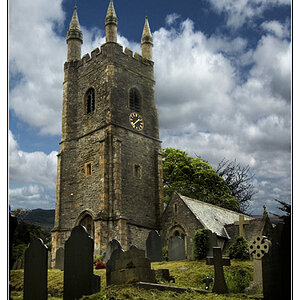
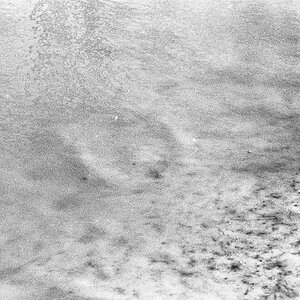
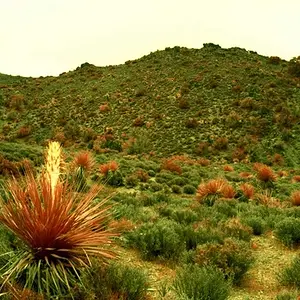
As you can see, the 'blob' gets bigger, as the light gets dimmer.
What this doesn't mean was that if I was to look at the lamp directly that the actual lamp itself would appear dimmer. It's that the total light falling on my eye would be less, because it's coming from a smaller part of my visual frame, due to how our eyes focus. Once you take focus out of the equation, further light sources are actually in some sense bigger the further they are.
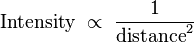
Sources of light that radiate photons radially, such as point or a spherical light source, without lens would imprint bigger blob on a photo as distance increases, and the brightness of the pixel in the center of that blob would become less bright proportionally to the square of the distance. Ok?
Consider what Isaac said:
- "If you have a spherical light source (like one of those oriental paper lanterns), it still follows the inverse square law no matter how close you are to it. You can think of this as a quirk peculiar to spheres."
Does what he said not mean if we photograph such spherical light source it will produce less bright blob on the image proportionally to the square of the distance, as if it was a point light source?
No, because you're optically altering the light due to having a lens in front of it. You're taking all that dispersed light and then recombining it into a smaller light, of equal brightness. Which is why we kept telling you all along that you can represent the falloff as the light sources being dimmer, or smaller, BUT NOT BOTH.
As light source gets further away its projected blob without lens gets bigger, so even when there is a lens lots of light would just fly around it and miss the lens, so should we therefore not expect that brightness would fall off with the distance even when there is a lens because lens would proportionally receive less light as the distance increases?
You seem to be confusing light fields and points of light as resolved by a lens or an eye.
Lenses take light from a source that is hitting your eye, all across retina, and focuses it into a coherent image. When you look at a candle, the light from that candle isn't hitting a small part of your eye, its hitting your whole eye, your whole body, the whole room. Your eye focuses it. Whatever size the flame looks like is based upon your distance to it, as the further you move away, the smaller part of your visual frame it takes up. However, because your eye (or camera) focused the diffuse light back into a coherent image, you no longer get the dimming effect. Your eye sees the candle as brightly as it would see it a few feet away.
So, if you focus the light you get the smaller effect, but not the dimmer effect. If you were not to focus the light (essentially what holding a sheet of paper over the light does) you would get the dimming effect, but a corresponding increase in the 'spread' of the light (which is the whole reason the inverse square law works to begin with).
This is why we kept telling you that you could represent stars as dimming, or getting smaller, but not both.
The reason why stars appear to get dimmer the further they get is because they are too far away for our eyes to focus on them. We can only focus at an arbitrarily far point into space, and after that, things just look equally small. Because we can't really focus on the objects in space, as they get further away, they simply look dimmer. If, however, you had a telescope accurate enough to focus on them, they would look just as bright as anything else, even if they were very tiny.
Now, measuring the amount of light falling on an area from a light is a totally different matter. If you're in a dark room and you have a light meter, as you move a flash light closer to the light meter, it will register more light. As you move it away, it will register less. However, if you took pictures of the same flashlight, the actual flashlight would seem equally as bright no matter the distance. However, in the further picture it would be taking up less space in the visual frame. What that means is that if you were to calculate the value the sensor read for the flashlight and multiply it by the area it took up in the frame, the flashlight that was further away would follow the rules of the inverse square law, because the less light is being illustrated by the light taking up less space in the frame.
again, indicating that you can illustrate the inverse square law as lights being dimmer, or lights being smaller, but not both. Which was your original problem.