What's new

around & about shooting raw

So this 1/focal length is a myth? I do play with it, and I noticed when I am on A that the shutter speed is not always 1/focal length.. so that's another reason I am confused about this 'rule' or guideline when the camera does not even follow this when left to make it's own decision. I will definitely be taking your advice though.
 
Many new photographers feel like they need to shoot everything at 100 ISO, so they don't get noise.

Ha! That was totally me.

So this 1/focal length is a myth? I do play with it, and I noticed when I am on A that the shutter speed is not always 1/focal length.. so that's another reason I am confused about this 'rule' or guideline when the camera does not even follow this when left to make it's own decision. I will definitely be taking your advice though.

I did not read most of the other posts, so I assume you mean the rule for reducing camera shake? If you have a lens that it becomes more critical ( like a long telephoto ) then you shoot in Shutter Priority. Aperture does not matter at that point if you can't get a crisp shot anyway.

Sounds to me like you need to learn two things ( more so than diving head first into full manual ). You need to learn to read your histogram, and you need to learn to use exposure compensation if you are in a mode other than full manual. That way if you look at a shot and its a bit too dark and the histogram is stacked to the left you dial up some exposure comp. That way if you are in, lets say, aperture priority for DOF, the exposure comp will change the shutter speed and not harm your DOF setting. This is a quick and easy way to shoot on the fly. Shooting RAW also gives you the ability to boost that exposure in post processing within reason. It all boils down to you paying attention as you are shooting though. If you just fire blindly and wait til you get home to find out you have a card full of crap, then shame on you.

Also, in terms of shooting full manual, here is a helpful article. It doesn't address things like strobe use, but its a nice easy to understand article to help build a foundation for choosing an exposure. Sunny 16: An Old Rule for a New Age « Seeing The Light
 
Thanks, I definitely don't just fire away. I try to work with the settings but admittedly never even looked at the histogram once. I just think about my surroundings, and how the exposure triangle works and then adjust my camera to fit my surroundings but obviously I am not trained well enough to just be able to do that by eye.
 
I just think about my surroundings, and how the exposure triangle works and then adjust my camera to fit my surroundings but obviously I am not trained well enough to just be able to do that by eye.
Thats what the article I posted is all about. Read it a few times in a row. ( It does require you to understand fstops,shutter speed and ISO though )
 
So this 1/focal length is a myth?
No, but it's only a guideline. I can usually shoot at less than 1/focal length. But, from expereince I know ways to make that work. Inexperienced shooter that don't have good camera handeling technique may need to use 1.5 /focal length as their guideline.

As far as flash stopping motion, flash can do that because the flash of light has a short duration. At full power most hot shoe flash units have a flash duration of about 1/1000 second.

One of the benefits from using flash is that the motion stopping capablity of the flash lets you adjust the shutter speed to control the ambient light exposure.

Most of your problems are stemming from the fact you don't yet have a technical understanding of how the camera, lens, flash, and a digital photograph work.
 
True, I don't. The technical side is hard for me. The creative/artistic side is not. My brain just doesn't work that way.
 
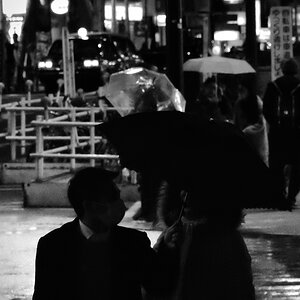
Just thought I'd say I find #2 to be an pleasant shot to rest my eyes on. You captured really nice light. You might try to rotate it a degree or two clockwise to get the vertical of the rail post straighter.

Okay thank you, do you think it looks underexposed?

I looked at the histogram and it looks almost spot on... well within acceptable range. Either direction up or down could be made based on artistic decision and it wouldn't be bad. It could go up maybe 1/3 stop, but it's fine as it is.
 
True, I don't. The technical side is hard for me. The creative/artistic side is not. My brain just doesn't work that way.
Sure it does.

Because you tell yourself it doesn't, you set yourself up with a handy excuse for not making the effort needed to gain the technical understanding required to support and make your artistic vision a reality.

For a long time I had myself convinced I had no artistic ability, because I was a technical type. But, I made the effort to learn about the visual arts, and learned I did have some artistic ability. I didn't become famous, but I did make a boatload of money.

Believe me, the great artists had/have a very good grounding in the technical aspects of their work.
 
That's not true KmH. I try very hard to learn the technical side. My brain doesn't work that way, but that doesn't mean I simply don't try. It will click eventually though and then you'll be surprised at how well I understand and handle a camera from that POV. It's been like this my whole life, in any area and don't ever underestimate my effort again. It's why I am even here asking for help. If I wanted an excuse I'd put it on auto and not even bother trying.

Example. I didn't know how to read until 3rd grade. My brain could not figure it out. I was put into a special ed class for reading. One day it just CLICKED. Suddenly I could read at an 8th grade level and I was reading books my classmates wouldn't dare read, the same kids who teased me for being retarded since Kindergarden.

Just because you learn a certain way doesn't men that we all do so please don't be so quick to judge. I appreciate your valuable input but sometimes you come off very condescending and I don't think you intend to. Just realize that if I didn't want help I would not be here.
 
.. so that's another reason I am confused about this 'rule' or guideline when the camera does not even follow this when left to make it's own decision. I will definitely be taking your advice though.

That's because the camera doesn't know the rule. It looks at the light, the ISO you've selected and the f stop you've selected and tells you what ss you need for proper exposure. It's up to you to look at the ss and use the rule of thumb to determine if it's fast enough or not. If it's not, it's up to you to adjust aperture and/or ISO to make it suitable.

As Keith stated, with practice you can become rather skilled at shooting below 1/fl, but your results will be more consistent if you stay at or above 1/fl.
 
Ok, this post is so crazy, that I have to respond further.

Generally speaking, a flash will freeze action so you need not worry about that. If your photos are blurry with flash, you may have missed focus in the dim light since many auto-focus systems fail without good light and contrast.... or you had camera movement..
Flash only freezes movement when the manual is set correctly. End of story. If the poster missed his focus, or had "bad light" , or had "camera movement, it is only an excuse. He does NOT know what he/she is doing.

"most photographers don't know how to shoot manual"
What the hell! EVERY working photographers knows how to shoot in manual mode.. This is perhaps the most inform statement I've ever seen IN MY LIFE.

The rest is the poster prattering on about what LITTLE HE/SHE KNOWS about auto settings.

Goodness... Somebody didn't get a hug today....

I can see that you're probably young, a bit touchy and delight in misreading/misunderstanding what you read.. I'll put my 50 years behind a camera up to your few weddings and say that I may know a few things about the subject although perhaps not as much as I would like...

I see that you have also misquoted comments to try to prove your own point.. I'll stand by what I said in the context I offered it.

If you meter carefully with a good meter at several different spots, measure to your subject to know your focal distance, calculate your DOF and then set your camera manually to the best settings for the subject and available light; you are shooting "manually". If all you do is look in the viewfinder and you're setting to what the camera indicates, you may be setting the camera manually but you are far from "shooting manually". I don't think that this philosophy disparages any "working photographer" who likely adjusts settings using the cameras meter readings and experience. There are many others that I've seen who just line up the needle and tell themselves that they are shooting manually. I don't know which group you are in, nor will I guess..

Perhaps you can serve the Poster better by offering helpful advice and recommendations rather than engaging in inflammatory rhetoric that doesn't seem to say anything different than was posted..

 
At full power most hot shoe flash units have a flash duration of about 1/1000 second.
Much less at less than full power.

If you truly need motion stopping flash, the lowest power you can get away with will give you the shortest duration (which will freeze motion the best).

edit
For your kid playing soccer, the difference probably doesn't matter. For a hummingbird in flight, it does.
 
Last edited:
At full power most hot shoe flash units have a flash duration of about 1/1000 second.
Much less at less than full power.

If you truly need motion stopping flash, the lowest power you can get away with will give you the shortest duration (which will freeze motion the best).

edit
For your kid playing soccer, the difference probably doesn't matter. For a hummingbird in flight, it does.

Dude, you just answered a question that's been in the back of my head. I figured that a flash would easily stop hummingbird wings but when I took this shot, it had me scratching my head.

6066200747_ebffcdedea_z.jpg


To fight the mid morning sun dappling through the background, I had to fire through my softbox at full power from about two feet away, maybe less. So now I know that if I wanted to stop the wings, I would have to shoot at less power, or get a bigger light, or lose the diffusion. So if I go from full power to half power, does that cut the light emission time in half as well or is it non-linear?
 
Hey Larry,
Yeah, I probably could have made my point with less snark. :-) Sometimes however, some posts here are a lesson in exasperation.

So I'm young again, a kid? Yay!!!! I'll take a do over in life!

And just for grins, why do you think I've shot "a few weddings"? Everything you would ever want to know about me is a click away on my siggy.

Anyhoo, I've seen your work and it is very nice indeed. I'm also not in the mood for a pi$$ing contest. We will just have to agree to disagree on this one.

Peace out! (or whatever a teenager would say.....my kids are in their mid twenties so I wouldn't know). ;)
 

Create an account or login to comment

You must be a member in order to leave a comment

Create account

Create an account on our community. It's easy!

Log in

Already have an account? Log in here.

New Topics

Back
Top Bottom