What's new

Basics of photographing sunsets on my D3200?

snapsnap1973

TPF Noob!
Joined
Jan 18, 2013
Messages
147
Reaction score
4
Location
Portland, Maine
Can others edit my Photos
Photos NOT OK to edit
Hi.

I know absolutely nothing about photographing sunsets. Well, of course the pictures never come out looking like what I see at the time. I used AUTO and nothing matched up, then I went to MANUAL and set various things to bring the EXPOSUER meter in the viewfinder in the center and still it came out nothing like I saw.

I set the WB to shade, don't know if that was what it shoud've been at. So what are the basics of photographing sunsets? Basic "ballpark" settings maybe? Should I be at F11, F4? Does it all change depending on everything else? What exposure speed should I be at?
 
It would help if you could post an example (or a link to it). We don't know what sort of result you actually got.

Normally for landscape you want a high focal ratio (f/11, f/16) to provide a larger focused area (so everything appears nicely focused.)
The low ISO setting will eliminate any "noise" in the image. All that remains is the shutter speed... and if it's sunny then that'll be 1/100th.

The slightly more complex way is to meter the shadows and highlights in your scene separately and find an exposure in the middle so that your highlights and shadows won't be clipped.
 
The camera cannot make photos that look like what you saw.
Because the camera doesn't work like your eyes do.

How far away your focus point is has a lot to do with what lens aperture you will want to use.
IMO the often given advice to use f/11 to f/16 for landscape shots is bad advice.
The lens focal length is also a factor. Landscapes shots are usually made using a short focal length.
If the focus point is more than 100 feet away you don't need a small lens opening like f/11 or f/16 to have a deep depth-of-field.
A short focal length of the lens means even the less need for a small lens aperture like f/11 or f/16.

You need to learn about dynamic range, depth-of-field and the hyperfocus distance.
When using a small lens opening like f/11 or f/16 you need to make sure the lens you're using won't lose focus sharpness because of diffraction.
 
Sunsets are almost always overexposed (relative to what you'd like to see) by the camera's metering. Take a meter reading, then go to manual and set it a stop or two darker, through faster shutter or smaller aperture.

Bracket your exposures. Take one at "correctly" metered, then one darker, and one lighter. Many cameras can be set to do this automatically.

The other problem with sunsets is that the bright areas and dark areas are MUCH farther apart exposure-wise than the camera is capable of recording. That is the dynamic range mentioned before, and digital cameras are astonishingly bad in that regard. Worse than we'd all like, that's for sure! If the sun itself is in the picture, it will be blown out. Shadowy spaces in the foreground will be black. Your eye doesn't see that, because as you look at the shadow, your eye adjusts for it. As you look back at the brighter sky, your eye adjusts again. You're asking the camera to take all that in, all at once, without adjusting. All you can do is compromise.
 
BTW - when you see very dramatic sunset shots... realize that the photographer may have been using something called a "gradient neutral density" (GND) filter... or even a "reverse gradient neutral density" (Reverse GND) filter (Reverse GND's are a bit more specific to sunsets.)

These filters are usually rectangular (not round) and they slide into a holder. They are clear on one half... and tinted on the other half. There are some specifically designed for sunsets which are clear on the bottom, have their strongest tinting in the middle, and then weaken the tint toward the top (that way the block the most light near the horizon line where the sun is located.)

What these filters are REALLY doing is helping to bring the scene under some control so that the light levels will all fall within the "dynamic range" of the camera sensor.

Here's a link to ND Grads: Neutral Density Graduated Filters (ND Grads), and ND Standards in Resin and ProGlass from LEE Filters
Here's a link to a reverse ND grad: Daryl Benson Strip FiltersAvailable in Neutral, Orange & Pink Densities | Singh-Ray Filters

Casual photographers typically won't own these. But serious landscape photographers will own them. The point being... when you see these dramatic landscape shots and you wonder why YOU can't get the shots THEY can get... it may be because they're using filters that you aren't using.
 
Most all of the sunset photos you see that are good are done in HDR. Our eyes see a wide dynamic range but a camera sees a range less wide. So, people take multiple pictures of the same thing with different settings. Each shot has a part of the dynamic range of the scene. Those photos are then put together with computer software to make a single photo with most of the dynamic range of the scene. Some HDR photos have just a couple of photos but some have 5, 10, 15, 20 or more shots merged together.
 
Most all of the sunset photos you see that are good are done in HDR. Our eyes see a wide dynamic range but a camera sees a range less wide. So, people take multiple pictures of the same thing with different settings. Each shot has a part of the dynamic range of the scene. Those photos are then put together with computer software to make a single photo with most of the dynamic range of the scene. Some HDR photos have just a couple of photos but some have 5, 10, 15, 20 or more shots merged together.


I would say most sunset photos we see which are dramatic have been done in HDR through digital manipulation. However, good sunset photos were being take long before the switch to digital techniques and the use of computerized programs to bring an image to a printed final result. Since the op is trying to learn about the camera techniques used in sunset photos, possibly a bit of reading on the basic subject is in line. While digital and analog handle the high dynamic range of sunsets differently, the basics are still the foundation upon which every photographer must start IMO. But certainly, a quick entry into a search engine should get the op more than a few suggestions for how to use a digital camera in this situation.


I do see the op asking a lot of questions related to, "what settings do I use for X situation?" Particularly when dealing with sunsets, there are no absolutes to be given in terms of numbers. Yes, you can begin with a basic landscape approach but one issue with sunsets is the rapidly changing light and the changes required in the camera to compensate for those changes. It's quite likely that from moment to moment the same settings on the camera will not provide similar results in the image.

I would, as suggested by TCampbell, say one of the keys to good sunset shots though is the filter used. They go a long way to balancing the information coming into the camera. Whether filters are something the op is ready to address is another issue. As with every other topic in photography, filters and their proper use can be a year's long study.
 
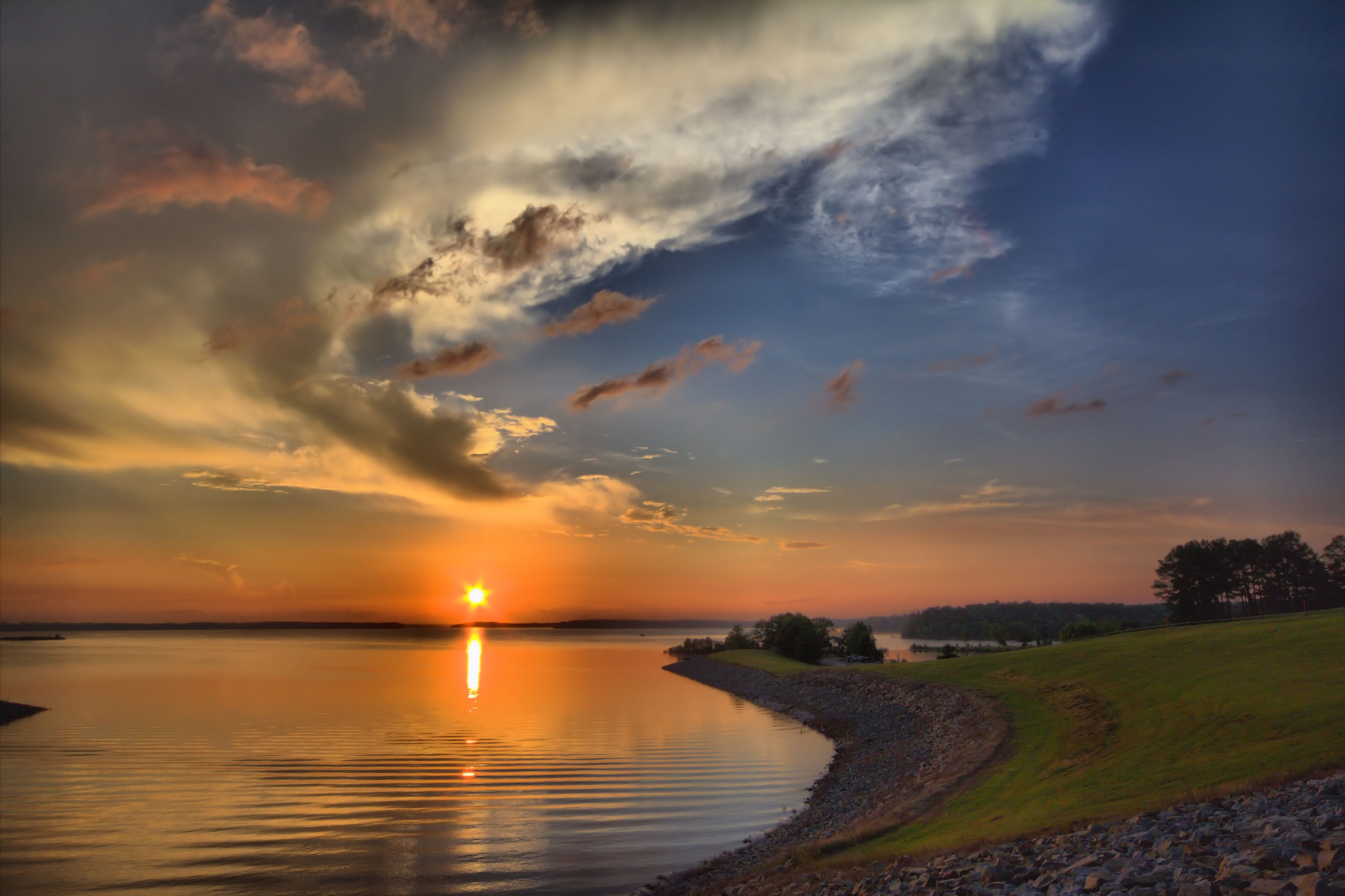
Your eyes adjust to highlights and shadows very quickly, and thus you can look at a sunset and see a lot of great detail in the bright areas and the dark, and during sunset there's plenty of both. One of the easiest ways to overcome this is to shoot at least three images, one correct overall exposure, one two stops under exposed, and one two stops over exposed. If you shoot 5 total shots, shoot another one 4 stops underexposed, and then another 4 stops over exposed, and so on. Then you can combine them into an HDR shot that will look more like what your eyes and your brain saw. If it's a fast moving sunset you can take one shot, and then brighten it by two stops, save as a new file, then darken the original by two stops and save as a new file and do what's called a one shot HDR. It doesn't usually work as well as bracketing your shots, but if you don't have a tripod or the clouds move too fast it works. That's how I got this shot:
LOTP%20SUNSET%20HDR%203.jpg
 
While some of the better sunset photographs may be done by combining 3 or more exposures to make an HDR, I would suggest that most good sunset shots are made with a single exposure and/or are made with a graduated filter on the lens.
Some may be made as a composite of 2 images - 1 exposed for the land and 1 exposed for the sky.

I think it is safe to assume that some amount of post process editing is usually done to make a good sunset photograph even better.
 
^^ what they all said. It can also be important to get your camera on a tripod so you can keep your camera steady while increasing the exposure time and keep a low ISO and use mirror lockup.

Of course there are no hard and fast rules about photography, but for landscape shots I'd be expecting to use all or most of the list below:

An appropriate metering system
Hyperfocal distance
the "sweet spot" of your lens
Polarising filter
ND/GND filters
A tripod
Remote shutter release
Mirror Lockup
Low ISO
Bracketed exposures if you are blowing shadows and/or highlights
 

Create an account or login to comment

You must be a member in order to leave a comment

Create account

Create an account on our community. It's easy!

Log in

Already have an account? Log in here.

Back
Top Bottom