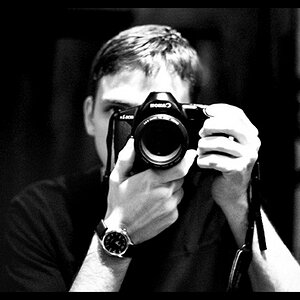
Back to your original question... at the Canon website you can get "refurbished" cameras at a fairly decent discount and that typically is about the best price you'll find. A "refurb" isn't technically "new" because you're not the first consumer to open the box... but usually these are camera that were returned for whatever reason (usually the buyer changed their mind) and didn't have anything wrong with them at all. Regardless, everything sold as a refurbished camera is fully check out, repacked, and includes the same warranty that "new" cameras get. Mostly that just means you get a better price.
Here's the link to the refurbished section:
Canon Refurbished EOS Digital SLR Cameras | Canon Online Store
As for the cameras.
A "full frame" body naturally has a wider angle of view when using the same lens but this changes some dynamics about how far away you'll stand from a subject to compose a shot, etc. and it has a noticeable impact on things such as the depth of field. It's easier to create a blurred background with a full frame camera than it is with a crop-frame camera (assuming the same lens is used).
The APS-C sensor cameras have a 1.6x crop factor. That means if you take the diagonal measure of the full frame sensor and divide by the diagonal measure of the crop frame camera you'll notice that it divides in 1.6 times. It turns out that math carries through into the focal ratios. If you compose a shot of a subject at f/4 using a full frame camera and compose the same shot with the same lens and the same cropping using an APS-C camera you'll find that to get the blur to work out, the crop camera would need to shoot with a focal ratio which is 1.6x lower than the full-frame camera (you would need to be able to shoot at f/2.5 to get an equivalent looking shot).
Full-frame cameras tend to be preferred for portraits and also there's a side-effect to sensor technology that also tends to mean that full frame sensors exhibit less noise when shooting at high ISO (assuming both cameras are using sensors with similar technology).
The 6D is designed to be an "entry level" full frame body camera. Full frame cameras tend to be expensive... almost always $2500 or more. The 6D provides a much lower-cost entry into the market, but the camera is simpler in other ways. It uses a rather simple 11 point focus system and it doesn't have a particularly fast shutter speed. This makes the camera less desirable for "action" photography.
The 80D is a newer generation of camera (so it has that on it's side) and it's especially well-suited to video. But it has a noticeably better focus system and a faster shutter speed. It's intended to be a mid-tier camera... a bit above the entry-level category but not quite into the pro category. The 7D Mk II, on the other hand, is really more of a pro-level camera with emphasis on use ability for action photography and use in the field. It's physically larger and heavier. It has a magnesium alloy (lightweight metal) body instead of polycarbonate (plastic). It has weather sealing. It has a substantially better focusing system. The list of benefits goes on... but mostly it's features tend to be optimized toward action photography.