What's new

Birds of the Philippines


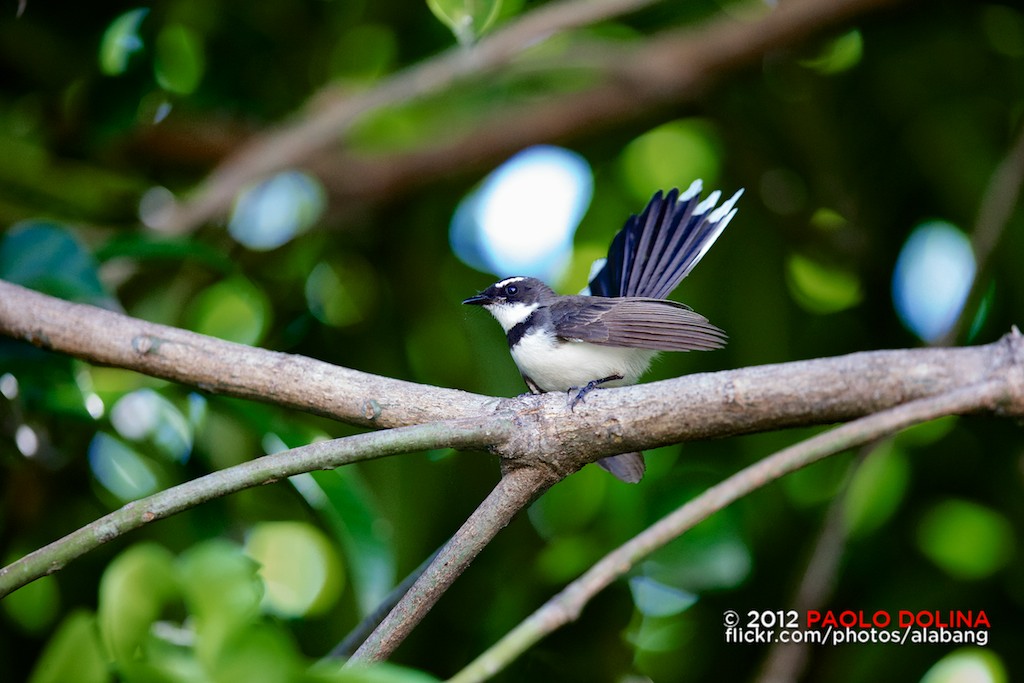
Pied Fantail (Rhipidura javanica) by alabang, on Flickr

Pied Fantails are named for their habit of fanning out their beautiful long tails. It has been suggested that by revealing the white tips of the tail, insects are startled into movement.

Pied Fantails eat mainly insects. Unlike their relatives the flycatchers, Fantails forage close to the ground in the dark understorey, perching on a root or low branch, teetering at the ready to launch into flight. They catch their prey on the wing and rarely miss. Their broad bill is ringed with spines (rictal bristles) which may help them catch insects even in the dim light of the understorey.

They move actively in the undergrowth, lurching from perch to perch; dashing in acrobatic flights. They make short flights from one cover to the next. They are generally quite inquisitive and not shy. They hunt alone or in pairs.

Source: pied fantail (rhipidura javanica): info fact sheet, photos

Take at Muntinlupa City, Philippines

Settings: 1/2000 ƒ/4.5 ISO10000 600mm
 
Fantastic photos. I also enjoyed the info on each bird.
 
Thanks Propilot.


Indigo-banded Kingfisher (Alcedo cyanopectus) by alabang, on Flickr

The Indigo-banded Kingfisher (Alcedo cyanopectus) is a species of bird in the Alcedinidae family. It is endemic to the Philippines, where it is a generally uncommon but locally common resident of the northern and central islands. There are two subspecies, the nominate race, which occurs on Luzon, Polillo, Mindoro, Sibuyan and Ticao, and A. c. nigriostris, which is found in Panay, Negros and Cebu. It forms a superspecies with the Silvery Kingfisher of the southern Philippines.[1]

The Indigo-banded Kingfisher feeds on fish and aquatic insects. It perches on rocks and overhanging branches and foliage and dives steeply into the water to catch its prey. Once caught, it returns the prey to the perch where it is beaten and swallowed. Little is known about its breeding behaviour, although it is known to nest in tunnels dug into the banks of streams and rivers.[1]

Its natural habitats are subtropical or tropical dry forests and subtropical or tropical mangrove forests.

Source: Indigo-banded Kingfisher - Wikipedia, the free encyclopedia

Taken at Villa Escudero | Attractions Amenities and Activities

Settings: 1/320 ƒ/4.0 ISO5,000 600mm
 

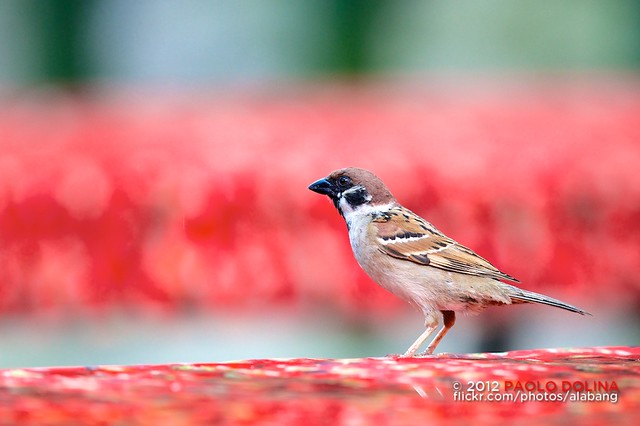
Eurasian Tree Sparrow (Passer montanus) by alabang, on Flickr

The Old World sparrow genus Passer is a group of small passerine birds that is believed to have originated in Africa, and which contains 15–25 species depending on the authority.[10] Its members are typically found in open, lightly wooded, habitats, although several species, notably the House Sparrow (P. domesticus) have adapted to human habitations. Most species in the genus are typically 10–20 cm (4–8 in) long, predominantly brown or greyish birds with short square tails and stubby conical beaks. They are primarily ground-feeding seed-eaters, although they also consume invertebrates, especially when breeding.[11] Genetic studies show that the Eurasian Tree Sparrow diverged from the other Eurasian members of its genus relatively early, before the speciation of the House, Pegu and Spanish Sparrows.[12][13] The Eurasian species is not closely related to the American Tree Sparrow (Spizella arborea), which is an American sparrow.[14]

The Eurasian Tree Sparrow's binomial name is derived from two Latin words: passer, "sparrow", and montanus, "of the mountains" (from mons "mountain").[3] The Eurasian Tree Sparrow was first described by Carl Linnaeus in his 1758 Systema Naturae as Fringilla montana,[15] but, along with the House Sparrow, it was soon moved from the finches (family Fringillidae) into the new genus Passer created by French zoologist Mathurin Jacques Brisson in 1760.[16] The Eurasian Tree Sparrow's common name is given because of its preference of tree holes for nesting. This name, and the scientific name montanus, do not appropriately describe this species's habitat preferences: the German name Feldsperling ("field sparrow") comes closer to doing so.[17]

Source: Eurasian Tree Sparrow - Wikipedia, the free encyclopedia

Taken at Villa Escudero | Attractions Amenities and Activities

Settings: 1/200 ƒ/4.5 ISO1,000 600mm
 

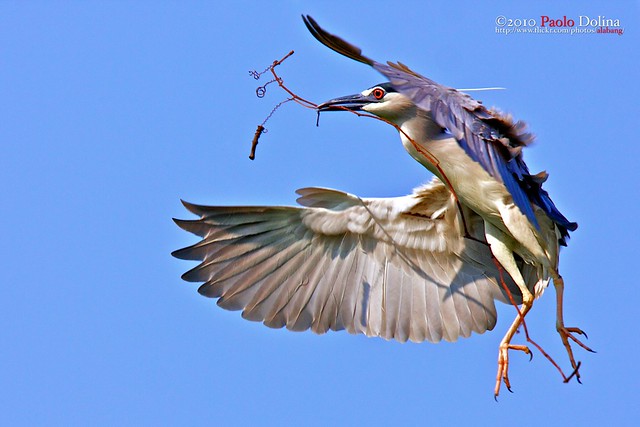
Black-crowned Night Heron (Nycticorax nycticorax) by alabang, on Flickr

The scientific name, Nycticorax, means "night raven", and refers to this species' nocturnal habits and harsh crow-like call.

In the Falkland Islands, the bird is called "quark", which is an onomatopoeia similar to its name in many other languages, like "kwak" in Dutch and Frisian, "kvakoš noční" in Czech, "квак" in Ukrainian, "кваква" in Russian, "Vạc" in Vietnamese, "Kowak-malam" in Indonesian, and "Waqwa" in Quechua.

Source: Black-crowned Night Heron - Wikipedia, the free encyclopedia

Taken at Villa Encarnation II, Valenzuela City, Philippines

Settings: 1/1600 ƒ/6.3 ISO400 420mm
 
THanks HL45.


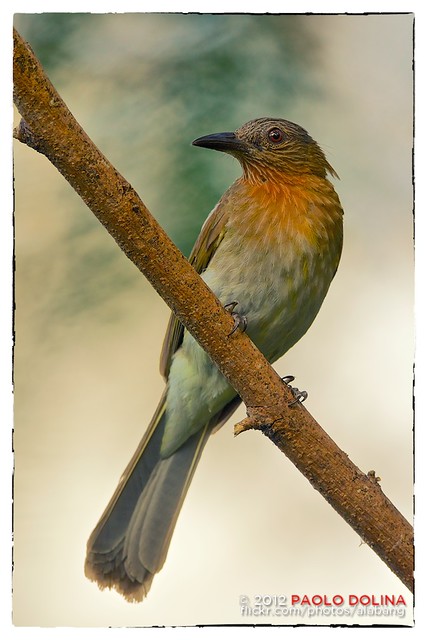
Philippine Bulbul (Hypsipetes philippinus) by alabang, on Flickr

The Philippine Bulbul (Hypsipetes philippinus) is a songbird species in the bulbul family (Pycnonotidae). It is often placed in the genus Ixos, but is better retained in Hypsipetes as long as this is not entirely merged into Ixos, as it is quite closely related to the type species of Hypsipetes, the Black Bulbul (H. leucocephalus).[1]

It is endemic to the Philippines. Its natural habitats are subtropical or tropical moist lowland forests and subtropical or tropical moist montane forests; on Mount Kitanglad on Mindanao for example it is abundant in any kind of primary forest at least between 500 and 2,250 m ASL.[2]

Fledglings of the Philippine Bulbul were recorded on Mindanao in late April, but the breeding season seems to be prolonged as females with ripe ovarian follicles were still found in April and May. Territorial songs are heard at lower altitudes as late as May, while further upslope the birds are silent at that time of year and presumably engaged in breeding activity. The Besra (Accipiter virgatus) has been recorded as a predator of young Philippine Bulbuls, and this or other goshawks might also catch adult birds.[3]

A common and adaptable bird as long as sufficient forest remains, it is not considered a threatened species by the IUCN.[4]

Source: Philippine Bulbul - Wikipedia, the free encyclopedia

Taken: Ternate, Cavite - Wikipedia, the free encyclopedia

Settings: 1/80 ƒ/5.6 ISO160 800mm
 

Create an account or login to comment

You must be a member in order to leave a comment

Create account

Create an account on our community. It's easy!

Log in

Already have an account? Log in here.

New Topics

Back
Top Bottom