Black and white is my personal favorite, but that's simply because where I live vibrant colors seem to hide in lack of sun we have 6 days a week.
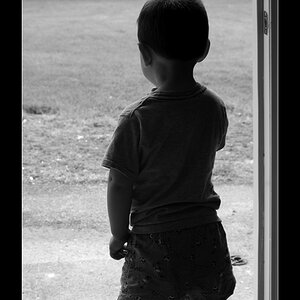
A black and white photo requires contrast. Heavy contrast. You could have a photo with shades of gray inbetween, but the photos with the whiter whites and the blacker blacks tend to not only look better but have the best artistic value.
This is a gallery I digged up on google in less than 3 seconds:
http://www.pbase.com/sheila/bw
Note how the powerful pictures in there work because of the sharp contrast. I can't emphasize this enough- even I forget sometimes to look for a shot with that contrast.
Black and white film tends to be sharper- digital black and white shots can be compressed to different sizes for sharper images than do their color counterparts. Because of this, don't be afraid to go for an extremely detailed (yet not distracting) image.
Finally, watch your clouds. A pale, dull, empty sky will show NOTHING when taken with black and white- just an offwhite or pale grey empty area. Be it in photoshop or the lab later, shots like these will NEED clouds or to be cropped out. Try to avoid taking pictures that include a noticeable amount of the sky if the sky is empty. I've taken architecture shots in B&W that mad the skyoverhead, which came out to a large portion of gray space I needed to crop out, thus lowering the resolution of my photo (this was film).
Hope this jumbled mess of words help. Send me some pics when you're done if you want more help.





![[No title]](/data/xfmg/thumbnail/37/37604-7ad625e983f92f880eb65a264eeef5e4.jpg?1734170732)