Derrel
Mr. Rain Cloud
- Joined
- Jul 23, 2009
- Messages
- 48,211
- Reaction score
- 18,936
- Location
- USA
- Can others edit my Photos
- Photos OK to edit
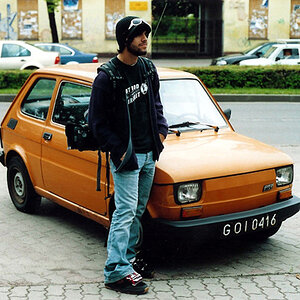
Much model work will be done between 7 feet to 25 feet away. Getting closer than 7 feet tends to cause unwanted perspective distortion on the nose, and any limbs that extend away from the body. Standing back a little ways, 7 feet to 10,11,12,13,14,15 feet, ensures that the nose, arms, shoulders, legs, and feet are rendered without unusual or unpleasant distortion of the relative size of the various body parts.
When the camera is placed closer than around 7 feet, the NOSE, especially, starts to be rendered a bit larger than it should be; by five feet, the nose looks weird; by three feet, the nose has grown significantly in size, and will look "funny"; from 10 inches or so with an ultra-wide-angle, the nose will be rendered comically huge, the face very small and oddly shaped. At distances closer than 7 feet, the arms and shoulders will begin to appear unnaturally larger than they should; if an arm is extended toward the camera, it will appear notably larger than in "real life". Yes, this can be used creatively, sure, but it can also ruin shots if the distorted limbs or body parts begin to look exaggerated when a natural,elegant look was desired.
On the other end, beyond about 20 feet, and certainly at 30 feet, the background becomes more and more difficult to render out of focus. As the camera-to-subject distance on an APS-C sized sensor approaches the 30 foot distance, even with a telephoto lens, at normal outdoor apertures of say f/5.6, the background is fairly recognizable. On full-length photos with a 100mm lens on a 1.6x body, the camera MUST BE 37.5 feet distant, in order to frame a six foot tall person within an 8.44 foot field of view with the camera turned to portrait orientation. Here is a screen capture I made of my calculations.
.

Field of View Calculator - Rectilinear and Fisheye lenses - Bob Atkins Photography
When the camera is placed closer than around 7 feet, the NOSE, especially, starts to be rendered a bit larger than it should be; by five feet, the nose looks weird; by three feet, the nose has grown significantly in size, and will look "funny"; from 10 inches or so with an ultra-wide-angle, the nose will be rendered comically huge, the face very small and oddly shaped. At distances closer than 7 feet, the arms and shoulders will begin to appear unnaturally larger than they should; if an arm is extended toward the camera, it will appear notably larger than in "real life". Yes, this can be used creatively, sure, but it can also ruin shots if the distorted limbs or body parts begin to look exaggerated when a natural,elegant look was desired.
On the other end, beyond about 20 feet, and certainly at 30 feet, the background becomes more and more difficult to render out of focus. As the camera-to-subject distance on an APS-C sized sensor approaches the 30 foot distance, even with a telephoto lens, at normal outdoor apertures of say f/5.6, the background is fairly recognizable. On full-length photos with a 100mm lens on a 1.6x body, the camera MUST BE 37.5 feet distant, in order to frame a six foot tall person within an 8.44 foot field of view with the camera turned to portrait orientation. Here is a screen capture I made of my calculations.
.
Field of View Calculator - Rectilinear and Fisheye lenses - Bob Atkins Photography


![[No title]](/data/xfmg/thumbnail/39/39438-1eb8b5f82b59d9d0c72ae9025778ed4c.jpg?1734173528)

![[No title]](/data/xfmg/thumbnail/35/35665-6506470fd930bd101375a007d572615a.jpg?1734167295)