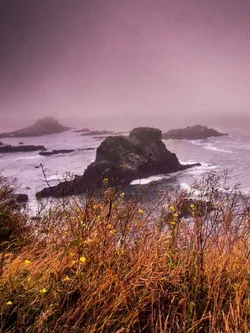
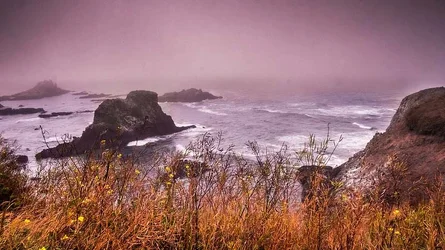
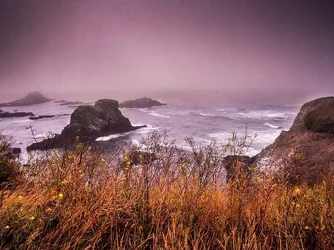
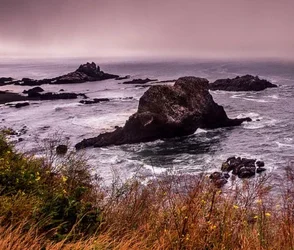
Lots of open, empty sky space, and not a lot of "engagement" with the background. I find these types of scenes tricky to shoot. The near/far relationship and the SIZE of the background rocks is difficult to capture with a wide-angle lens. I've been to that spot. The grandeur of it is hard to capture right from the bluff side like this, since it's fairly far to the rocks, and the wider angle view makes a non-panorama shot require a wide-angle, which makes the rocks seem farther away, smaller, and less-signficant in relation to the foreground brush. That's why so many shots of the Oregon coast are done from farther back, with longer lenses; it gives you literally a BIGGER, and more-magnified BACKGROUND to use to fill up frame space. A multi-shot pano here would have been sweet, and would have allowed you to shoot this a different way.
The issue you run into is the one I see all the time; landscapes that show a wide angle of a scene, but in creating the wide angle of view by using a short focal length lens, the photographers [plural] almost always mentally engage with the beauty of the scene, and end up showing us, the viewers, this large foreground, and then showing us a ton of boring, non-engaging background "stuff" that is very small, meaning actually measured with a ruler small, compared to the foreground stuff, be it shrubbery, or meadow flowers, or whatnot.
Effective composition involves effectively using the entire compositional space; in painting, the space can be manipulated out of thin air, and near/far size relationships are constructed using the artist's abilities with perspective, vanishing point, overlapping points, aerial haze, and so on. With a camera, one must fill the space based on the way a LENS draws.
Your photo would look better,better meaning more-engaging on the rocks and sea aspects, had it been say, shot from a ladder and 40 feet farther away with a lens that was 30% LONGER in focal length, to literally magnify, to make larger, the background rocks. In your composition, the shrubbery at the forefront is the star of the show, and the rocks and ocean are small by comparison. The short lens ALSO, when stopped down like that, can "see" the filter's water spots; a longer lens does not do that to such a degree, since it has less depth of field, and even at f/22, a longer lens does not "start to see" crap that's on the filter front.
I only go into this business about lenses because a lot of books on composition are written from the POV of a painter or traditional "fine arts artist", and many of them are ignorant [or kinda' fuzzy on] of the way a LENS renders distance and the way each focal length of lens renders its size/spatial relationships, so they might very well not touch upon the way FOCAL LENGTH selection plays a positively HUGE part in how one can actually make a landscape composition with a camera.









![[No title]](/data/xfmg/thumbnail/32/32721-63e870bb6055043e46744e5ac505d9bf.jpg?1734162372)

![[No title]](/data/xfmg/thumbnail/30/30992-773558233723ab0d28c307a97a1a2427.jpg?1734159059)
![[No title]](/data/xfmg/thumbnail/30/30994-49c5521f7b5b417f49dcd43891cbec27.jpg?1734159066)
![[No title]](/data/xfmg/thumbnail/32/32782-7f10503454a2a8eeff8b554e3b081c86.jpg?1734162474)