* There's no such thing as color infrared... its more like "false" color. Color (as we see it) is not within the spectrum.
* White balance is not an issue. What we see as "red" in the initial capture is because the high pass infrared filter begins at the red end of the spectrum into the near infrared.
* What is important is the "infrared" information that we cannot see but an image sensor does see. Certain cameras are more sensitive to infrared than others. You can increase a camera's sensitivity to infrared by removing the IR cut filter on sensor which people to refer to as "conversion". IMO, not completely accurate as the sensor itself is still designed for and optimized for visible light. Due to this, you will still see a certain "grain" to the final image. To my understanding this is due of the heavy use of red photo-sites with little to no information gathered by the green and blue.
* The KEY reason to increase the sensitivity of a camera to infrared is to obtain more reasonable (possibly hand holdable) exposures. In general, you will need a tripod and remote shutter.
* There is a focus shift between visible and infrared. You will need to rely on DOF and manual focus. Because infrared filter blocks most of the visible light spectrum, you will have a difficult time focusing TTL while filter is attached.
* In the digital world, Infrared photos rely heavily on Post process (photoshop etc...) to "manipulate" color and white balance. There's no way around it.
* There are two types of conversions; Clear optical glass and IR high pass filter. Clear allows the camera for dual use; use a IR cut filter for normal photography and IR high pass for infrared. The disadvantage is that the infrared filter makes for difficult focusing. IR high pass filter conversion allows for easy TTL focusing and composition BUT the camera will be permanently IR only... you won't be able to shoot normal visible light because of the IR high pass filter right on the sensor.
I recommend trying it out first using appropriate filter and long exposures. I found it fun to do. Unlike traditional photography that avoids the harsh high noon light, IR photography seems to excel at this times. If you find yourself really liking the experience, then decide if the cost of conversion is necessary.
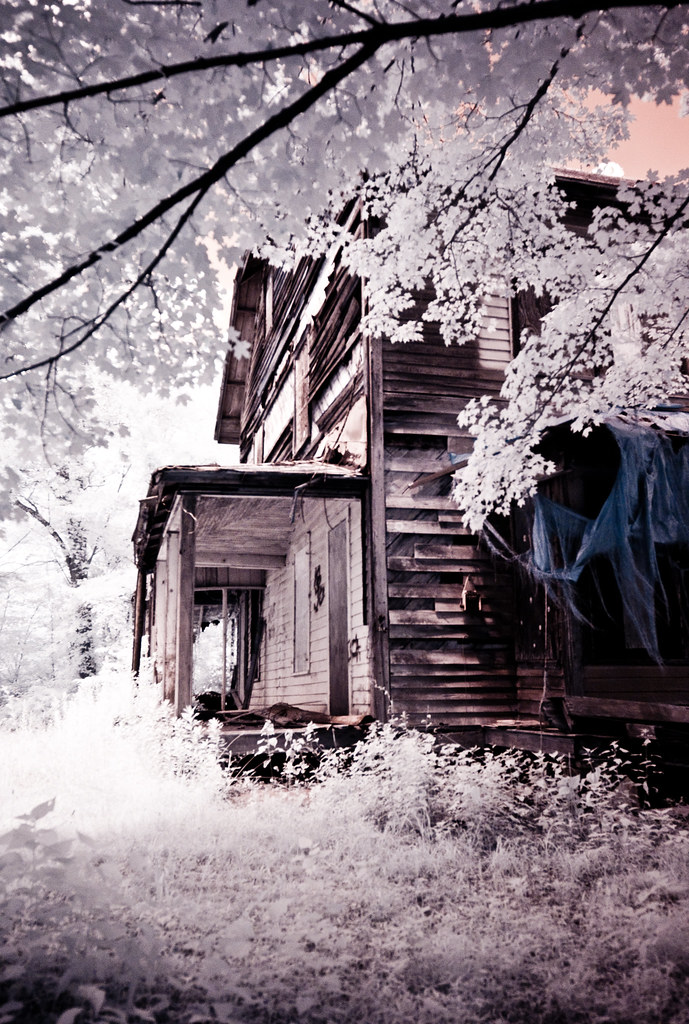
I am enjoying my time shooting IR... have not (and probably not) pursue a camera conversion. One of my first attempts shot handheld in bright sun:
I am still learning/experimenting with post process of these images..... there's a lot of information available on various websites. My experience is each camera is slightly different.