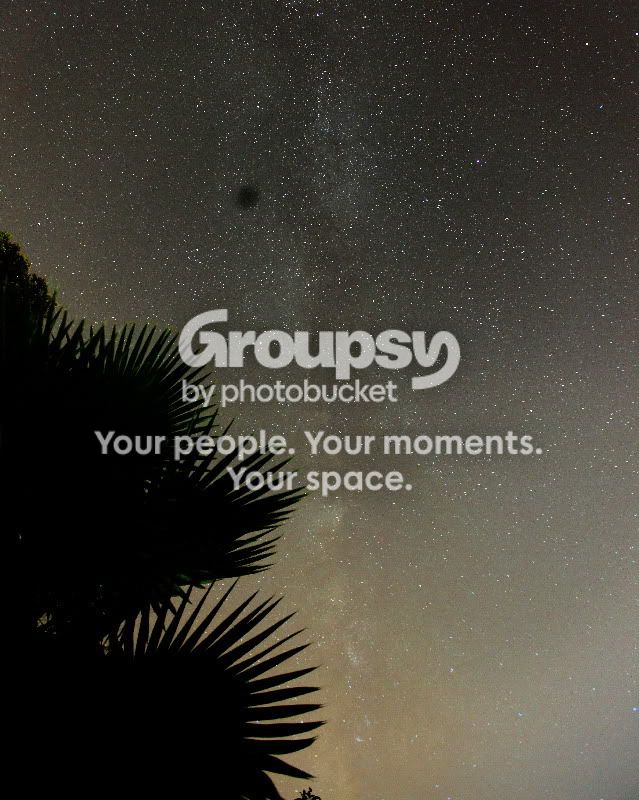
Im struggling with this one and am wondering what is going to be the best ISO and f stop combonation for the milky way. Am I assuming correctly that the f stop should be with the lense wide open or is that going to help creat noise with high ISO's?
I did find that a long exposure looks blurry because the stars are moving accross the sky hense my ISO confusion.
Any help would be great.
I did some playing last weekend, 10 seconds, ISO 1600, f/3.5, 28mm and they did OK with nice points of light. Focusing is the first problem, so find a nice bright start for that. Since the subject can be a variety of light years away, I don't think depth of field is very important.
The above was a total guess, based on past memories. Honestly I still like film better for star photos, but here we are in the digital age, might as well get along with it.
No wind helps, or sand bag the tripod, throw an old anvil on it, or hang anything you have over the cross supports on the bottom.
Remote release is good, but using the self timer will let things settle down after you push the button. One way or another, you need something beyond your finger, so you don't get "jiggles".

I'm sure that some people use the mirror lock up, I don't bother. But I'm just playing. Shooting with a telescope it can be an issue.
The reason I was trying different settings was for the space station which can traverse in about 3 minutes or less, and I wanted the streak, but also wanted the stars. I don't want it blown out, but at the same time, to get a proper exposure for that long, if it's stopped down, then you don't get the stars or the trails.
It's always a balancing act, give and take.
My suggestion as usual, beyond reading EXIF data, is go out and shoot at different speeds and openings and TAKE NOTES! Sure you can read the data on the files, but the notes (aka analog documentation) makes it easier to page through the photos and see what you did and how it affects things. Second reason for notes, you can circle things that work and read them in the field or find a startng point when the situation comes up again in two years.

If it's of any interest, one hour of exposure will produce 15 degrees of arc in the stars. You can calculate how much motion you will expect with some simple math. Look at the above, and figure 15 degrees x 24 hours = 360 degrees. Hey, isn't that amazing?
Since everything is manual I have considered adapting an old 50mm 1.2 lens to the digital so I'd have a way to get more light to the sensor for less dollars.
Oh yes, above all... Have Fun!
Here's a good website for some better and more specific information.
http://www.danheller.com/star-trails.html






![[No title]](/data/xfmg/thumbnail/1/1592-cfae4a7ea791f96c6e2d03484be2e454.jpg?1734142210)