What's new

Damn it...Im Determined!

NikonNewbie

TPF Noob!
Joined
Nov 8, 2010
Messages
635
Reaction score
0
Location
Half past a monkeys ass
Can others edit my Photos
Photos OK to edit
So, I finally started shooting in Raw...thats one Major hurrdle...now for shooting in Manual.
I think Im on to it tho...
if there is low light use a slower shutter speed
if there is fast motion or to feeze motion use a high shutter speed..
then Ap..lower f #'s for a more shallow DOF and f/11 to f/22 for great DOF like landscapes?
but to combine them oi...
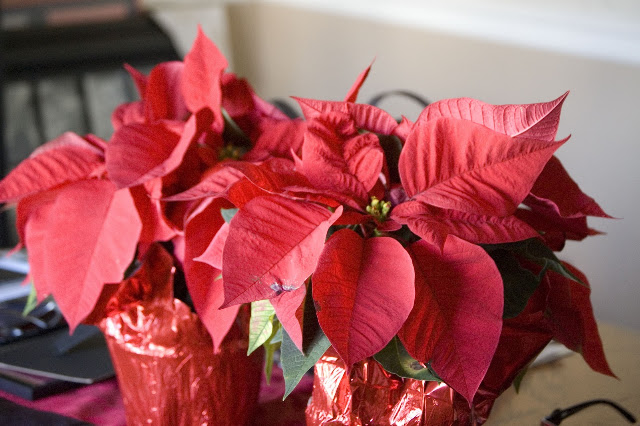
I took quite a few of the pointsettas on my dining room table.
I took them all at 1600, I played around with the shutter speeds, but kept them at f/4.2...the higher the shutter speed the darker they were...
but then....I changed the wb from Auto to Tung...and that made the pic more blue looking.
I dunno.
hmmm. :confused:

oh the reason it's at 1600 is because the room is mainly only lit by sunlight...it's pretty dark in here, when I took the pics I took them standing next to the window and pointed at the plants.
When I wanted to change the DOF to more open I changed the apateur to f/18 and it was too dark, so does the apateur change brightness to?
 
Aperture directly affects the amount of light reaching the sensor. As you mentioned, the larger the aperture (smaller f #s) the less DoF you have, and more out of focus area in the image. Each full stop (1.4, 2.8, 4, 5.6, 8, 11, 16, 22, 32) doubles or halves the amount of light reaching the sensor.

If you're shooting in RAW, then leave your WB in Auto, and correct, if need be, in post.
 
Yes, aperture controls how much light is getting it. So does shutter speed. :)
Aperture gives you creative control of DoF
Shutter gives you creative control of blur.
You put all these things together to get your exposure, they all relate.
You can't just change one, and expect the other two (ISO) to remain constant.

That's why you use your light meter. It is a guide to get you where you want to be.
Try it out.
Set your camera for an ideal exposure, then just change one of the 3 controls (ap, shutter, ISO) and see how it changes your light meter. If you change one, you can then change another to bring it back to center.

This is where you come into play. YOU are the creative photographer, and you have to decide what is important for any given shot.
Is very small DoF important? Then you will be playing with shutter speed and ISO to get the image.

Is stopping action most important? Then you will be changing your Ap and ISO.

You can't always have everything you want, and you will have to make concessions.
You may have to lose the Aperture (DoF) you wanted to be able to stop the action...
 
excellent...thats what I wanted to know!
did I need to change the wb for the situation every time...so the answer is ...if it's in RAW I'll be ok with leaving it on Auto...right?
 
Yes, auto is fine.

When you change it, you are pretty much changing it once per "shoot".
You change it when your light changes type.
 
Yes, aperture controls how much light is getting it. So does shutter speed. :)
Aperture gives you creative control of DoF
Shutter gives you creative control of blur.
You put all these things together to get your exposure, they all relate.
You can't just change one, and expect the other two (ISO) to remain constant.

That's why you use your light meter. It is a guide to get you where you want to be.
Try it out.
Set your camera for an ideal exposure, then just change one of the 3 controls (ap, shutter, ISO) and see how it changes your light meter. If you change one, you can then change another to bring it back to center.

This is where you come into play. YOU are the creative photographer, and you have to decide what is important for any given shot.
Is very small DoF important? Then you will be playing with shutter speed and ISO to get the image.

Is stopping action most important? Then you will be changing your Ap and ISO.

You can't always have everything you want, and you will have to make concessions.
You may have to lose the Aperture (DoF) you wanted to be able to stop the action...


Ok! I want to thank ya for that...however I dont have any thanks left :er:
I'll get cha later :D lol
 
I found the ideal setting for these here plants is 1/30 f/4.5
51unchanged.JPG

focus isn't so great I guess...but hell I wasn't trying to much to focus, I was really more interested in the lighting. :)
 
Think of it this way...
ISO represents how SENSITIVE the camera is to light. Low ISO is less sensitive Higher is more.

Shutter is TIME. So it's how much time you allow light to hit the sensor.

Aperture is QUANTITY. So it's how much light you allow to hit the sensor.

Let's say you have an exposure of: (I'm gonna simplify the numbers here for clarity.)
ISO 5
Apeture 5
Shutter 5

The exposure is a value of 15.

If you change the exposure to:
ISO 3
Apreture 5
Shutter 7

The exposure is still a value of 15, so its exactly the same.

Making the ISO number bigger will make your pictures more noisy. More grainy.

Making the Aperture wider will make DOF shallower, smaller will make DOF deeper. (Bigger numbers are smaller, smaller number are bigger, or more open apetures)

Slow shutter speeds show more time in your picture, so if the subject is moving they will blur more becacuse they moved more while the exposure took place. Shorter shutter speeds show less time and therefore tend to freeze movement.

The trick is to decide what exposure value you need then adjust the settings to get that exposure. In my example above I increased the shutter but decreased the ISO. Less sensitivity (ISO) in bright light, faster shutter to stop motion. Aperture is set to balance the other two and make my exposure value 15.

In the real world we use exposure values, generally measured in "stops." Decreasing the shutter by a click might be a half stop so to compensate you would open your aperture by a click, and so on. The amount of light decides what your exposure value is. You generally want to use the lowest ISO possible to get the shutter / aperture settings you want.

Of coures this can all get more complicated, but I tried to simplify it as much as I can...
 
Last edited:
The full range of manual adjustment choices you need to make, goes beyond the exposure triad.

They also include the in-camera metering mode, focus mode, and focus area mode.

In summary:
ISO sets the images sensors light sensitivity,
Aperture sets the volume of light being allowed to reach the image sensor (bucket fulls or shot glass fulls) and is one of the 4 factors that control DOF. (the other 3 that control DOF are - lens focal length, subject to image sensor distance, and subject to background distance).
Shutter speed is how motion blur is determined.

A key concept to understand is a 'stop'. a stop of ISO, or a stop of aperture, or a stop of shutter speed.

Tirediron touched on it when he mentioned "doubles or halves the amount of light" when he listed full stops of aperture (1.4, 2.8, 4, 5.6, 8, 11, 16, 22, 32.

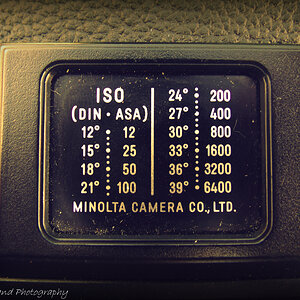
Full stops of ISO are - ISO 100, ISO 200, ISO 400, ISO 800, ISO 1600, etc.

Full stops of shutter speed are - 1/25, 1/50, 1/100, 1/200, 1/400, 1/800, 1/1600, 1/3200, etc.

If the on-camera light meter indicates a correct exposure is 1/250, f/4, ISO 200, then the same scene can be correctly exposed by changing shutter speed and aperture in 1 stop increments. As one increases by a stop, the other must be reduced by a stop. For example:

1/250, f/4, ISO 200
1/500, f/2.8, ISO 200
1/125, f/5.6, ISO 200
1/60, f/8, ISO 200
1/30, f/11, ISO 200
1/15, f/16, ISO 200
1/8, f/22, ISO 200

All yield the same exposure, but DOF will be different, because of the different lens apertures, and the way motion is rendered would differ, because of the different shutter speeds.

Or ISO and one of the other 2 exposure triad values could be changed in the same way. As ISO is increased making the image sensor more light sensitive, one of the other exposure triad values must be reduced to keep the exposure the same.
 
Don't know if its been mentioned yet, but don't forget about your flash when in low light either:thumbup: Its something alot of people seem to overlook.
 
I have nothing to help with the original question...was just keen to say how helpful I have found the replies you have been given. They all answered questions I also had (although some of them I didn't KNOW I had!).

Thanks all you helpful people.
 
Don't know if its been mentioned yet, but don't forget about your flash when in low light either:thumbup: Its something alot of people seem to overlook.
Introducing flash into the mix is for another thread alltogether.

This is beginner manual camera setting 101.

Small steps.
 
Don't know if its been mentioned yet, but don't forget about your flash when in low light either:thumbup: Its something alot of people seem to overlook.
Introducing flash into the mix is for another thread alltogether.

This is beginner manual camera setting 101.

Small steps.


Yea! I'm still a window licker here!!! :lol:
 
So, I finally started shooting in Raw...thats one Major hurrdle...now for shooting in Manual.

Don't shoot in full manual.

It sounds like you're using the internal light metering system that's built into your camera. And it sounds like you're trying to take basically normal photos (no special effects). If that's the case then using the camera in full manual mode is slower, less efficient and likely less accurate.

Take your poinsettia photo for example. You didn't know without the camera's meter that 1/30 sec at f/4.5 was a good exposure. With the camera on full manual you had to set either the shutter or f/stop and then adjust the other until the camera meter zeroed. If you put the camera in S mode and set the shutter speed to 1/30 sec. The same meter would read the same light the same way and come to the same conclusion and set the f/stop to 4.5. In fact it may have been slightly more accurate and set it to f/4.83 (depends on the camera). It's still your responsibility to monitor what the camera's doing, but that can be done in less time than it takes to set both shutter and aperture manually. That really great shot came and went in that time.

Do it the other way: Set your camera to A mode and set the f/stop to 4.5. The same meter will meter the same light the same way and set the camera's shutter to 1/30 sec. or maybe more accurately to 1/42 sec. Again you must monitor what the camera is doing and again no one can manually set both the shutter and f/stop is the same time that they can set one of those and then mentally check off the other.

Full manual only makes sense when you aren't going to use the camera's internal metering system. That means you know the camera's meter would be wrong. That's possible. That's also allowed for by good cameras and handled with a +/- exposure comp control. On my camera that control is directly under my right thumb and immediately active. Again it's faster than full manual.

When I use the internal meter in my camera I use S or A mode and the exposure comp control and I can arrive at the best exposure answer faster and more efficiently than any one using any camera in full manual. I do use my camera in full manual when I'm using my external light meter or strobes. That's when it makes sense.

You're using the internal meter in your camera? Then use it. You're smart enough to know when the meter will be wrong? Then use the exposure comp control.

Joe
 
Man you guys really know your stuff. Everytime I read a thread that is meant to teach sometine I learn something new. Props to all the people that actually help and not **** in someones cherrios when they need help!
blue
 

Create an account or login to comment

You must be a member in order to leave a comment

Create account

Create an account on our community. It's easy!

Log in

Already have an account? Log in here.

Back
Top Bottom