What's new

Distance Setting

FWIW the red 17 is the infrared light focus distance (17 feet).

The ∞ (infinity) symbol indicates infinity focus for that lens.
 
The distance meter has nothing to do with your depth of field and how large or small it will be.
Well... in so far as the greater the distance displayed, the greater the DoF will be it does.

OP: Have you looked at the image linked to in my post above?
OK. you got me there...
Let me re-state that...
The distance meter doesn't tell you what your DOF will be, but you can guess that it's going to be a lot larger if you are further from your subject with some basic knowledge of how DOF works.
 
Browsing through the Nikon USA website, it looks like most of the "G" primes have the DoF scale, including the 10.5 DX Fisheye; the 35/1.8 DX does not. It also appears a number of the "G" zooms have it, as well. Maybe it's only the kit and possibly the mid-priced lenses that lack the scale.
 
So if I'm a 3 feet, the DOF will be 1 meter? Please explain, Thanks!

Um, no. 3 feet and 1 meter is the same distance but in two different measuring systems. If you are more comfortable with the English system, use feet. If you like metric, use meters. But they are the same distance.

For DOF you also need to know focal length and aperture, which the image posted by MLeek does not show.

Prime lenses often show the DOF marks engraved on the barrel between the focusing distance scale and the aperture scale. When using primes, it is possible to quickly see the DOF effect of aperture at the distance being focused on. Zoom lenses don't have the DOF marks because DOF changes with both aperture and focal length.

1 meter and 3 feet are not the same distance, 1 meter is 85mm longer when shooting at F1.2 is a long way
 
1 meter and 3 feet are not the same distance

Well, close enough in terms of using the focusing ring as a distance indicator. But if you want to be more precise, 3 feet are 0.9144 meters. ;)
 
1 meter and 3 feet are not the same distance

Well, close enough in terms of using the focusing ring as a distance indicator. But if you want to be more precise, 3 feet are 0.9144 meters. ;)

I edited my post, it is a long way when shooting at F1.2, when i shoot on the streets i set my Lieca to F8 (check light for shutter speed) and focus distance to 10 feet and i'm go to shoot without focusing again all day
 
It's much easier to see this with an older camera, though all DSLR lenses do have a distance scale on the lens (or sometimes a window through which it appears -- but always on the lens), not all lenses have depth of field marks.

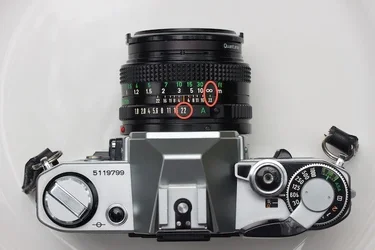
Here's an example:

$Hyper-Focal.webp

Click to zoom in on this.

The thing to notice here is that the lens is focused to about 12' away. The f-stop is set to f/22. If you look at the DoF scale on the lens, you can see a pair of "22"s ... one to the far left and the other to the far right. That means at f/22, everything from about 6' through to "infinity" will be in "acceptable" focus. If we were to open the f-stop up to f/4, that would drop considerably... and the DoF would only have acceptable focus from about 10' to about 14' (just left of the 15). You're looking for the pairings of f-stop marks on that scale... everything "between" the marks matching your current f-stop will be in acceptable focus.

Modern lenses seldom have DoF scales anymore. Some prime lenses... but generally never on a zoom. Also since the lenses are electronically focused rather than manually focused, the rotation of the focus ring doesn't offer as much fine tuning as the older lenses -- so whatever DoF scale exists (if there is one at all) is usually VERY narrow -- not nearly as wide as you see in this image.

 
The distance meter has nothing to do with your depth of field and how large or small it will be.
Well... in so far as the greater the distance displayed, the greater the DoF will be it does.

OP: Have you looked at the image linked to in my post above?
OK. you got me there...
Let me re-state that...
The distance meter doesn't tell you what your DOF will be, but you can guess that it's going to be a lot larger if you are further from your subject with some basic knowledge of how DOF works.

Woo-hoooooooo.... one for me! :mrgreen:
 
Woo-hoooooooo.... one for me! :mrgreen:

Um, John? You DO know that winning an arguement with a woman is... how shall we say this delicately? "Not" "wise"?

It has been nice knowing you.


:mrgreen:
 
Welcome to the world of the modern DSLR camera, where automation and design geared to causal shooters reigns supreme.

Not only have DoF and hyper focus scales gone away, distance scales are going too.
Today, you use a phone app for information like that.

A shooter without a cause is a terrible thing, Keith, a simply terrible thing!!!
 
1 meter and 3 feet are not the same distance, 1 meter is 85mm longer when shooting at F1.2 is a long way

Well, if you want to get technical, it's not f/1.2 either. It's f/1.19. Nor is it f/1.4, f/2.8, f/5.6 f/11 or f/22 as well. They're actually f/1.4142135624, f/2.282271247, f/5.6568542395, f/11.3137084990 and f/22.6274169980.
 
It's much easier to see this with an older camera, though all DSLR lenses do have a distance scale on the lens (or sometimes a window through which it appears -- but always on the lens), not all lenses have depth of field marks.

Here's an example:

View attachment 17855

Click to zoom in on this.

The thing to notice here is that the lens is focused to about 12' away. The f-stop is set to f/22. If you look at the DoF scale on the lens, you can see a pair of "22"s ... one to the far left and the other to the far right. That means at f/22, everything from about 6' through to "infinity" will be in "acceptable" focus. If we were to open the f-stop up to f/4, that would drop considerably... and the DoF would only have acceptable focus from about 10' to about 14' (just left of the 15). You're looking for the pairings of f-stop marks on that scale... everything "between" the marks matching your current f-stop will be in acceptable focus.

Modern lenses seldom have DoF scales anymore. Some prime lenses... but generally never on a zoom. Also since the lenses are electronically focused rather than manually focused, the rotation of the focus ring doesn't offer as much fine tuning as the older lenses -- so whatever DoF scale exists (if there is one at all) is usually VERY narrow -- not nearly as wide as you see in this image.

I'm glad you posted this. It was getting to the point where I figured I'd have to do it myself because nobody seemed to be really addressing this correctly. You did an excellent job of describing the distance scale and how it relates to dof at various apertures. If you grew up with 35mm film cameras and prime lenses as I did; and I'm sure you did, this information is very handy. But there are lots of photographers who don't even about this stuff.

Is that a top view of an AE-1 ? looks like my old Canon
 
Distance scales are still common on better lenses. Almost all of my glass is L glass and all have distance scales. DOF scales are not added anymore as they are not accurate any longer. With the multitude of sensor sizes and potential sensor sizes the DOF scale is not a one size fits all as is a distance scale.
 
Is that a top view of an AE-1 ? looks like my old Canon

In fact it IS a Canon AE-1 (well spotted!) This was my first 35mm SLR. I still have it and it still works great.
 
Some of the newer consumer grade DSLR lenses don't have a distance scale, of any kind.
 

Create an account or login to comment

You must be a member in order to leave a comment

Create account

Create an account on our community. It's easy!

Log in

Already have an account? Log in here.

New Topics

Back
Top Bottom