What's new

duck decoys? photo blinds?

Rick Mark

TPF Noob!
Joined
Mar 4, 2006
Messages
21
Reaction score
0
Hi, I moved this summer into this great house on a lake, and a variety of ducks have come in for autumn. I'm working on making a camouflage blind that I can set up on a boat dock to get closer to the critters. Wondering if anyone has any tips?

I bought some camo cloth at a local hunting-supply store and I noticed DUCK DECOYS! So I'm thinking I should get a couple of decoys too.

That's my main question. Anyone have any concerns about using duck decoys to bring my subjects in closer to my blind? I mean, I don't see why not, but I was wondering if anyone had any ethical or "wildlife management" issues with the idea?

Thanks
 
Oh, I'm making my own blind out of pvc pipe. It's designed to fit my dock, and I'll keep it in a nearby shed, so I don't have to cart it very far.

I've never heard of photographers using duck decoys, so I'm wondering if anyone had any insight.


There are lots of portable blinds available - Ameristep Gunner Blind (Camo)
though just about anything that hides you and the camera would likely be effective.

Decoys Flambeau Premium Magnum Mallard Duck Decoy
and a Primos Classic Wood Duck Call should help.
 
I don't see anything wrong with it, my concern would be that the decoys would somehow wind up in the shot and ruin it. Also consider a duck call!
 
Animal calls and lures are quite widely used in wildlife photography - pure tracking is hard enough without having to get a good photo as the end result. Provided that you don't abuse the use of lures or baiting methods most won't have any problem with them being used at all.

Abuse would be when you use them very frequently in a limited area and thus adversely affect the subject you're dealing with. Or if you start providing a regular source of food and then suddenly remove it (bird feeders through winter is a good example as once you've provided that daily food you have to keep it going as the birds shift from it being an extra to being dependant upon it as the winter sets in).

So provided that you use it with some thought and that the animal in question is not put into harm there isn't any worry at all.


Ps some of the most outspoken against using any lures/camera traps/laser trip wires etc... are not actually wildlife photographers only viewers who dislike the idea that anything but the pure approach is used.
 
Decoys? Duck blinds? You CLEARLY don't have a lot of experience dealing with ducks. Get yourself a lawn chair and a back of potato chips. Sit on the end of your dock eating the chips. Before long, every duck on the lake will be at your feet mooching for handouts.

Sometimes I kid on these posts, but this is one case where I'm being completely serious.
 
Decoys? Duck blinds? You CLEARLY don't have a lot of experience dealing with ducks. Get yourself a lawn chair and a back of potato chips. Sit on the end of your dock eating the chips. Before long, every duck on the lake will be at your feet mooching for handouts.

Sometimes I kid on these posts, but this is one case where I'm being completely serious.


Ha ... funny. Well, you might be right, but I have a feeling that your approach would help me with mallards and seagulls, but I'm not sure the grebes and mergansers and egrets would be interested in potato chips. Do you think???
 
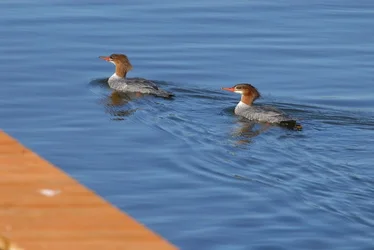
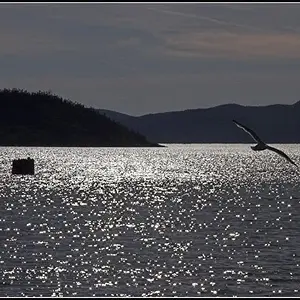
since my last message, I went out and grabbed this. 400mm manual lens. D200 - no cropping. No post-processing at all. That's my dock at the left; I was standing on the steps, about 50-60 feet away.

Pretty sure these are common mergansers in non-breeding plumage

$common-mergansers.webp
 
If you are shooting from the dock get down on your stomach on the dock. Most images are more pleasing when you are on or near the same level as your subject. YOu could also set your blind up on the shoreline. Leave the blind up so that it's not something new and the birds will get used to it, a short time after you enter the blind they will go back to their normal routine and ingnore the blind.
 
I've seen pictures of floating rigs that photographers use (usually with 400/600mm lenses) so that they can get right down to water level. I was looking for a link or photo to show you, but I couldn't find it. I did come across a site with (what looks like) a ton of good information, specifically for shooting birds
Secrets of Digital Bird Photography
 

Create an account or login to comment

You must be a member in order to leave a comment

Create account

Create an account on our community. It's easy!

Log in

Already have an account? Log in here.

New Topics

Back
Top Bottom