A few thoughts:
A) I'm concerned that you'd start a company whilst at the same time asking what are some very basic and elementary questions. Concerned because it might mean that you're unable to deliver the product you advertise to them which might well result in disagreements or conflicts. The last thing you want is to start a company and earn a bad reputation. A good reputation is hard to get but so easily lost.
B) You appear to have some solid editing skills; composition and general photography - although part of that might also be helped by shooting in good light. You have what I would consider a very solid foundation to build from.
I would thus advise possibly holding back on being a company and working and instead consider a few months of strict structured learning. With your current level I would guess you could pick up much of what you need pretty quickly - you can then start afresh from a stronger and more confident position.
1) Grainy - this is generally the result of two factors.
a) High ISO - a higher ISO value will increase the noise/grainyness of the photo*. This is unavoidable, but likewise there will be many times where you have to raise the ISO to get the shot you want in the light you're working in
b) Underexposure - if you underexpose a photo and then brighten it up in editing you will get more noise. Importantly if you underexpose and brighten you will get more noise than if you'd have raised the ISO at the time of shooting and exposed correctly and thus not had to brighten in editing.
As such whilst raising the ISO increase noise; if you need to raise it then do so.
Note noise is the opposite of sharpness when it comes to editing. You will want to invest time into learning effective noise removal/reduction coupled with sharpening methods. There's a lot of material out there on this so take some shots at high ISO and make some noisey shots to work with and practice on. Note much of the noise will vanish in web display or printing; but effective editing can make a vast difference**
2) Blurry - part of this is experience; although from mine I can say that 1/640sec is the slowest shutterspeed you can have for something like showjumping. At that speed you should get a sharp shot with most areas of detail and motion being sharp. 1/500sec and you'll start to see hooves and hair (mane/tail) blurring and any slower and you really will see blurring a lot more.
Any faster than 1/640sec is ideal; though of course you need the light for that.
3) Shallow depth of field is certainly the result of the aperture; but also distances come into play as well. In general though many horse events are hard to shoot because the background is often very close to the horse and rider. This means careful choosing of your shooting location - editing as you've done in shot 1 - and sometimes you just have to accept it.
4) Depth of field of horse and rider - in practical terms f2 is the widest I'd ever go with horse and rider in terms of aperture. Anywider and the thin depth of field will be very challenging to work with; especially with two focal points of interest (horse and rider). f2.8 to f5.6 is a practical working range for horses and riders. Often f2.8 when in low or challenging light conditions; you can sometimes find that the shoulder of the horse is better to aim for - easier to keep the focus tracking and somewhat in the middle between horse head and rider head - but depends a little on the angle you're shooting at and on the horse.
5) Ideally you want 100mm or longer for most equine photography; otherwise if you get too close for a portrait with a shorter focal length you can run the risk of perspective distortion where the closer parts are enlarged over those further away (you can see these in the extreme on those post/birthday cards with animals looking at the viewer with VAST noses all blown up compared to the rest of their head). Of course this assumes a portrait where the horse fills most of the frame; the further back you are the more you can get away with short focal length lenses - but in general 100mm or longer (and for most showjumping or similar you want to give them distance ot move anyway and not be crowding them).
6) A 70-200mm f2.8 can be a major workhorse [pun intended

] of this genre of photography. Able to work in portraits and posed shots as well as in the showring. Expensive, but honestly very well worth saving up for and purchasing. Canon has their own version in the MII which is very highly priced; whilst if you look second hand you might find older versions a bit cheaper.
7) If you plan to shoot showjumping in an indoor arena - or dressage or anything for that matter get ready for a big challenge. To prepare yourself
a) Shoot in an arena (obviously)
b) Set your camera to its high ISO setting (check the manual for how to enable "high" ISO setting that unlocks another stops worth of ISO) and get some shots
c) Practice with those shots with regard to noise removal.
I have been in cases where I've been at 1/500sec - f2.8 - ISO 125000 and still been underexposing. slowest sharp(ish) shutterspeed; widest aperture; highest ISO.
Remember most events won't let you use flash with horses and flash for such a large close-up animal and rider is not a simple matter of one on-camera flash anyway. So you've got to work with the light that the day gives you
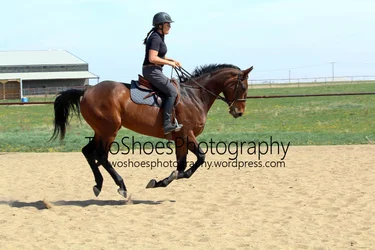
Finally with regard to your second photo try to avoid bum-shots. When the horse and rider move away from you at a jump generally avoid it - most people dislike that angle and it would only serve purpose in showing someone their method whilst riding. Otherwise its generally not something people want to see [and yes I've seen loads of bum-jump shots on peoples online portfolios - doens't mean they sell any of them)
*technically digital has "noise" whilst film has "grain" the appearance of both is different enough that they are different things and thus different terms. Although most today will know what you mean with grainy in a digital shot.



 [/URL][/IMG]


 ). I spent a little time looking through your facebook page, and to be honest, while you do have a couple of really, really nice shots (at least on screen), the vast majority of your work seems to lack refinement. Many images have exposure issues, off-level horizons, awkward crops, etc. I agree with Overread that you definitely have an eye for the moment, but your execution isn't quite there yet.


![[No title]](/data/xfmg/thumbnail/39/39499-b11b4321c0f029e3a5523ccab621b71c.jpg?1734173619)