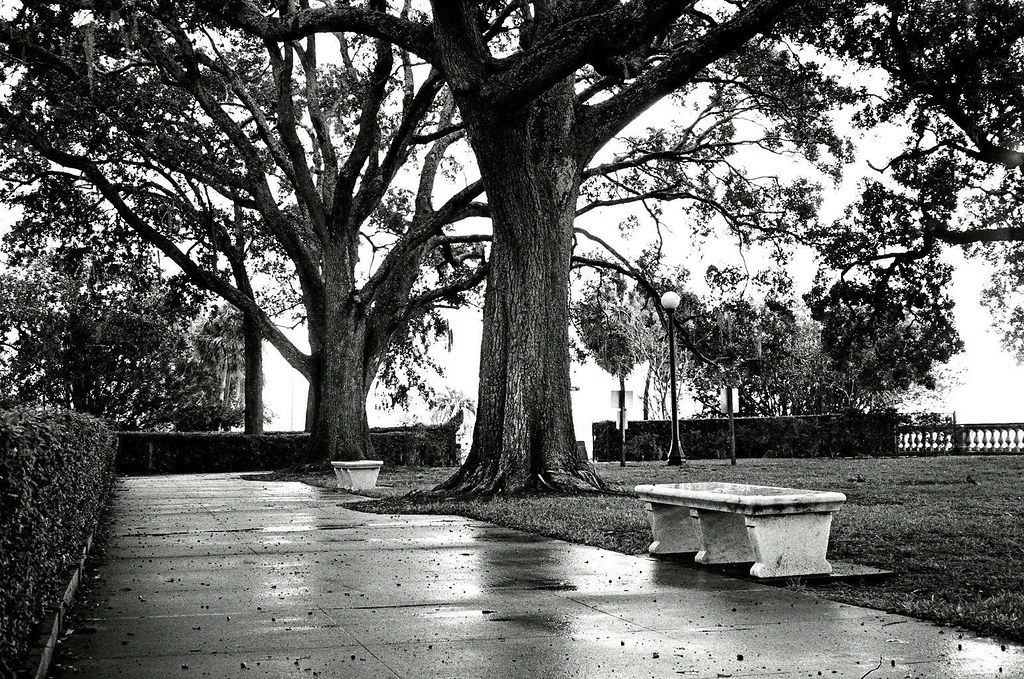
What do you guys think - would this scene be possible in a single exposure with digital?
Kodak TMAX 100, N-2
(scanned on an mid-end Epson flatbed)
Yes, based on my own mental image of the light that was present when that was shot, I think it would be possible to capture that scene in one exposure using a good, modern d-slr; especially one of the high-end ones that are testing out with the 13.9 EV dynamic range...a few years back, we had d-slrs that were at topping out at 10.9 EV at base ISO, rapidly dropping down to 9, then 8, then 7 EV at elevated ISO levels. It's hard to tell just how much of a contrast range was in that scene...is that sky the result of a filter over the lens (as it appears to be)? And what about the burned in sky at the top? The final image looks rather muddy to me...no offense intended, but the scene as-shown, on my monitor, over the WWW, is not much of a testament to B&W film...it just looks like the entire scene has been flattened and compressed. But then again, as compur pointed out, we're being shown an on-screen "digital image" whenever we look at images on the computer...so...
If you want to simulate -2 development, do you adjust your camera's Tone Curve setting to "low"? I know that is what I do. Also, the tonal response of "digital" varies quite a bit, across the entire spectrum of digital cameras. Some cameras have pretty amazing shadow recovery abilities...the Nikon D2x and Xs models for example, when they hit the market, were a huge step up in the amount of shadow detail that was recoverable and actually useful, compared with other cameras. Those two models made exposing to the right less-critical. The "new" Sony sensor in the D7000 and Pentax K-5...that sensor has amazing underexposure recovery potential...I do not know of any other sensor that can be shot with the in-camera ISO control menu set to ISO 200, and then an exposure made at an Exposure Index of 50,000, and then a BLACK raw file recovered to make a very good image...
I am mentioning these specific cameras because they span about a five year range in "advancements" in what a d-slr sensor can do...there is not clear set of capabilities associated with the word "digital".
And, with the B&W films, how do we describe the response and look of the DYE-based, chromogenic B&W films?





![[No title]](/data/xfmg/thumbnail/41/41902-e45a2db116295062060b22cde75818ed.jpg?1734176267)