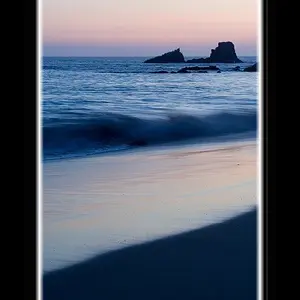
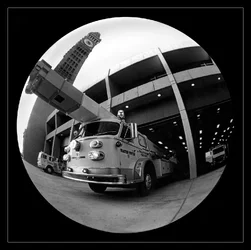
Over the years, I've shot with a couple of fisheyes. Back in my film days, it was Nikon's 8mm 180-degree circular fisheye. It was a lovely piece of glass. whose rearmost element extended almost to the film plane. To use it, the mirror had to be locked up and an accessory viewfinder used.
Here's one from those days:
Lately, I'm using Nikon's 10.5mm rectangular fisheye. It was designed for their cropped sensor cameras, but it appears that if I carefully remove the built-in plastic lens hood, it will become a circular fisheye on my full-frame cameras, since it has a 180-degree angle of view in all directions, except for the area masked by the hood. Haven't tried it yet, since trimming the hood will require a lot of precision.
A more recent fisheye shot, taken from about three feet behind the arch:
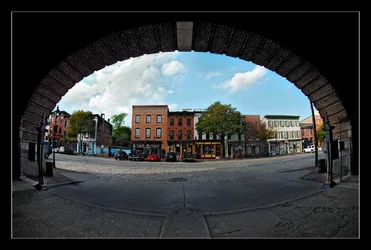
Many speak of "fisheye distortion," but in reality, a fisheye lens sees the world just as we do. It's a matter of viewing distance. If a fisheye image is viewed close enough, or printed large enough, when viewing it as close as possible (a few inches away, for instance), the 'distortion will disappear and the image will appear proper. Go figure.



![[No title]](/data/xfmg/thumbnail/34/34349-9e6dfcf7d5163c413329b9b4a5872791.jpg?1734164896)