What's new

Focal length vs magnification

Not when you double the distance between the camera & subject.

? Doubling the distance makes the subject size smaller. Keeping it same size with longer focal length is exactly magnification. Really, you know these things. :)
 
Not when you double the distance between the camera & subject.

? Doubling the distance makes the subject size smaller. Keeping it same size with longer focal length is exactly magnification. Really, you know these things. :)

Try reading the post again.

......For example, 50mm lens (with no extension tube) at a distance of 1 meter will have precisely the same magnification as a 100mm lens at a distance of 2 meters........
 
Not when you double the distance between the camera & subject.

? Doubling the distance makes the subject size smaller. Keeping it same size with longer focal length is exactly magnification. Really, you know these things. :)

Try reading the post again.

......For example, 50mm lens (with no extension tube) at a distance of 1 meter will have precisely the same magnification as a 100mm lens at a distance of 2 meters........


? Because he said it wrong does not make it meaningful. :)

The 50mm had the same IMAGE SIZE, only **BECAUSE** the 100mm at 2x distance also has 2x the magnification.

At the same distance, the 100mm would see 2x image size (magnification), because 2x focal length has 2x magnification.


Read Magnification - Wikipedia, the free encyclopedia
 
? Because he said it wrong does not make it meaningful. :)

The 50mm had the same IMAGE SIZE, only **BECAUSE** the 100mm at 2x distance also has 2x the magnification.

At the same distance, the 100mm would see 2x image size (magnification), because 2x focal length has 2x magnification.


Read Magnification - Wikipedia, the free encyclopedia

Once again...... read the post.

......For example, 50mm lens (with no extension tube) at a distance of 1 meter will have precisely the same magnification as a 100mm lens at a distance of 2 meters........


If you can't figure this out, I'm not going to try to correct you any more.
 
Focal length is exactly magnification. That is the only reason we use telephoto, to magnify the subject size.
This is simply incorrect. It's not magnification, and that's not the only (or even a very common) reason to use telephoto.
You primarily use telephoto not to magnify, but rather to get further away from the subject. Or conversely, to take photos of things you can't get close to.

If a human being is the subject of your photo takes up exactly one half the height of your frame in focus, then your magnification is the same, no matter which focal length you take that photo with. Longer focal lengths are useful though, because if you take it with 15mm lens, you have the same magnification, but the person will look weird since you're closer than you normally are to people. With 100mm lens, same magnification, it looks more normal, because you're 10-15 feet away.

Distance away from a subject =/= magnification.
Magnification = how big a thing is on your sensor compared to how big it is in real life.

If you are 15 miles away from a ladybug, and take a photo of it that fills half of your frame using a lens the size of an apartment building, then your lens still has LESS magnification than if you are a foot away from the ladybug and take a photo where it fills the entire frame.

The problem here is just that you're using a colloquial definition of magnification where it is actually a pretty specific technical term in photography (and biology, etc. etc. same technical definition) where focal length is just one of two variables you need to solve the equation.


A number of years back, I shot 1:1 magnification images using my 60mm Micro-Nikkor and my Sigma 180 f/3.5 EX Macro...I got what appeared to me to be the same depth of field with the 180mm lens as I did with the 60mm, despite the 180mm lens being 3x farther away...it kind of made an impression on me...
Well yeah, the chart above seems to show that it becomes essentially indistinguishable as low as 0.05 magnification. So if you're shooting 1:1, the DOF will long past being affected, probably completely indistinguishable / sub-pixel differences kind of thing.

At 0.01 magnification and lower, though, it's a major difference. 0.01 = things about 70 inches tall filling the vertical on a full frame camera. In other words, something along the lines of a seated human portrait with plenty of space above the head.

 
Last edited:
Focal length is exactly magnification. That is the only reason we use telephoto, to magnify the subject size.
This is simply incorrect. It's not magnification, and that's not the only (or even a very common) reason to use telephoto.
You primarily use telephoto not to magnify, but rather to get further away from the subject. Or conversely, to take photos of things you can't get close to.


? Sorry, you are choosing your terms carelessly, not well at all. You are assigning new meanings of your own, and then imagining it must be fact. :)

You are using magnification to instead mean image size. Magnification is the math RATIO of ORIGINAL subject size to sensor image size.

The absolute fact is that if a 50mm and 100mm lens are at the SAME distance, the 50mm image size is HALF of the 100mm image size (obviously because 100mm magnifies 2x compared to 50mm). That is what focal length does. That is all it does.

The telephoto lens ONLY works because of its greater magnification, THAT is why we use it. The ONLY reason we can stand farther away is because the focal length magnifies to produce the same usable image size. How hard is that?

If you are 15 miles away from a ladybug, and take a photo of it that fills half of your frame using a lens the size of an apartment building, then your lens still has LESS magnification than if you are a foot away from the ladybug and take a photo where it fills the entire frame.

Your lady bug terms forget everything except image size. We can get image size different ways, long lens magnification, closeup subject distance, cropped sensor size, etc. It was the one foot distance that produced your larger image, it was not about lens magnification. It possibly could have been the same lens, with proper extension.

However, then macro does shift the definitions, and 1:1 is about reproduction ratio (compared only to sensor size), and it is not called lens magnification (it was instead about subject distance). Any focal length can produce 1:1 (with proper extension).
 
*Facepalm* Dude you just contradicted your own definition within a single post.

Magnification is the math RATIO of ORIGINAL subject size to sensor image size.
^
Your words. Which are correct.
A ladybug is a given physical size. The ladybug's size doesn't change when you switch lenses. And if you fill up your frame equally with a ladybug with two lenses, then the image size is ALSO the same.


So guess what? The ratio of the original subject size to the image size on the sensor is the SAME! X/Y = X/Y...
Thus the magnification is the same when you make an equally framed image of the same object.
A 50mm lens at 1 foot will make the ladybug the same size on the sensor as a 100mm lens at 2 feet.

Therefore, by your definition, since neither subject size nor image size are changing, the 50mm and the 100mm lens CAN have the same magnification. Therefore focal length =/= magnification.
100mm at 2 feet:
ladybug = quarter inch real life, let's say 1/16 inch on the sensor = 1:4 magnification
50mm at 1 foot: ladybug = quarter inch real life, let's say 1/16 inch on the sensor = 1:4 magnification

They CAN also not have the same magnification, under different circumstances, like the situation you are describing where they are at the same distance. But when you say things like "focal length = magnification" you are wrong, because that implies always. When in fact, it is only true in the specific and narrow situation of not changing your distance to the subject. It is false in every. other. instance. (infinitely more situations)

However, then macro does shift the definitions
Um, no. It doesn't. It's still the exact same definition. Ratio of object size to image size. It's called "Macro" when the ratio = 1. Simple as that. Just an arbitrary cutoff point somebody decided on. The fact that any focal length can provide 1:1 is in fact an example of why focal length does NOT = magnification. You provided your own counterexample to yourself. Thanks.
 
Last edited:
......For example, 50mm lens (with no extension tube) at a distance of 1 meter will have precisely the same magnification as a 100mm lens at a distance of 2 meters........

My objection was about the above careless statement. Confusing misuse of terms. It does not point newbies in the right direction.

The principle is this:

If both 50mm and 100mm lenses are at the SAME distance, the 50mm image is of course smaller, because 100mm is 2x relative magnification, due to focal length.

The magnification of the longer lens (2x focal length) allows us to stand back 2x as far, and still get the same image size, instead of half size.

That result is NOT the same magnification. It is merely the same image size, specifically due to different magnification.

We can change IMAGE SIZE with focal length magnification, or with closer subject distance, or by cropping sensor size.
 
There is absolutely nothing misleading or incorrect about my 50 / 100 statement.

There is, however, something incorrect about this statement:
The magnification of the longer lens (2x focal length) allows us to stand back 2x as far, and still get the same image size, instead of half size.
NO. No no no no. The magnification IS NOT 2x for the longer lens in that situation.

The magnification is precisely the same. I don't comprehend how you can continue to give the proper definition, and yet fail to even attempt to apply it.
Again, I will quote your own very words, which were correct, about the definition of magnification:
Magnification is the math RATIO of ORIGINAL subject size to sensor image size.

Do the math!
Magnification = sensor size / actual size
In the situation I described, the actual size is the same, obviously, since lens choice doesn't make objects bigger or smaller. Let's say it is X in both cases.
In the situation I described, the sensor size is ALSO the same since the object fills the same portion of the frame. Let's say it is Y in both cases.
Magnification = sensor size / actual size = Y/X. Y/X = Y/X Therefore, both lenses have the same magnification.


What you're doing is exactly like saying "Density = Mass / Volume" and then a paragraph later saying "A big piece of wood is denser than a small piece of wood, because the mass is larger"
 
......For example, 50mm lens (with no extension tube) at a distance of 1 meter will have precisely the same magnification as a 100mm lens at a distance of 2 meters........

My objection was about the above careless statement. Confusing misuse of terms. It does not point newbies in the right direction.

The principle is this:

If both 50mm and 100mm lenses are at the SAME distance, the 50mm image is of course smaller, because 100mm is 2x relative magnification, due to focal length.

The magnification of the longer lens (2x focal length) allows us to stand back 2x as far, and still get the same image size, instead of half size.

That result is NOT the same magnification. It is merely the same image size, specifically due to different magnification.

We can change IMAGE SIZE with focal length magnification, or with closer subject distance, or by cropping sensor size.

You are confused. Go back to the OP's original question where he asked about magnification and gave examples using the common photo form 1:1 or 1:4. The OP's question establishes the context and Gavs was precisely correct to answer the OP saying there is no correlation between FL and magnification. Look up the definition of correlation (nobody here would understand that better than Gavs). As Gavs pointed out you yourself verified the definition correctly: "Magnification is the math RATIO of ORIGINAL subject size to sensor image size."

In any two photos with the same image size of the subject recorded (regardless of the cropped size of the sensor -- you're wrong about that also) the magnification is the same.

In a photo where the magnification is 1:4, which of those two numerals is the lens focal length? The 1 or the 4?

Joe
 
$Gav_Wayne_cage match.webp

Luckily, I bought my ticket outside the arena from a guy who was having trouble unloading a set of three tickets and one single nose-bleed section seat...and I payed LESS than half of face value! Now, the fellow was asking TWICE (that's 2x!!!) face value, and I told him I'd give him HALF price...he blurted out "SOLD!" immediately.
 
NO. No no no no. The magnification IS NOT 2x for the longer lens in that situation.

Present company excepted, but anyone that does not realize long lenses magnify the subject (much like telescopes), has passed hopelessness.

Do the math!
Magnification = sensor size / actual size

Sensor size? So you did not mean magnification, you instead meant reproduction ratio? (except that is not about sensor size either).

Magnification is about Original subject size compared to the image size on the sensor. Not to the sensor size, but magnification compares image size. And a 100mm lens obviously magnifies 2x compared to a 50 mm. You have looked through different lenses on a SLR, right?

Read here: Magnification - Wikipedia, the free encyclopedia
 
"Sensor size" was shorthand for "size of the image on the sensor." I was not perfectly careful with my word choice since you already explained it yourself... Sorry, whatever.
The fact remains that in both situations, neither the size of the image on the sensor, nor the size of the object are changing, thus the magnification cannot change.

You continuing to just say "lol nope!" without addressing the math or the logic is not exactly convincing.


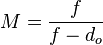
Don't mind if I do! According the wikipedia:
b9e88d2b8e7557506abd988c76f16dbe.png

f = focal length
do = distance lens to object

In other words, focal length is NOT equal to magnification. That would be "M = f" or "M = constant * f" neither of which as you can see, is the equation.
If you plug in my examples, you'll see once again that 50mm and 100mm lenses can both indeed have equal magnification:

50mm @1 foot (~300mm):
M = 50 / (50 - 300) = 1:5 magnification (the negative sign just means the image is flipped like in any focused camera)

100mm @2 feet (~600mm):
M 100 / (100-600) = 1:5 magnification.


Oh hey look the magnification is the same.
As in... not 2x higher in the 100mm lens. Imagine that.

Yes, it's possible to describe a situation where the 100mm has twice the magnification (when you stand in the same place). It's also equally possible to describe a situation where the 50mm has twice the magnification (if you stand 4x closer), or anything in between or whatever else you want. Saying that "100mm lenses have 2x the magnification, period" means "in every situation" which is not true. It is in fact only one situation, an infinitely small percentage. And no correlation.
 
Last edited:
I was not perfectly careful with my word choice

Yes, that has been my complaint.


b9e88d2b8e7557506abd988c76f16dbe.png

f = focal length
do = distance lens to object

There are factors of magnification... focal length is certainly one, and subject distance.

But to examine only the effect of the focal length -- If we compute for 50mm at 2 feet, and 100m at the same 2 feet,
clearly as everyone knows, long lenses obviously magnify the result we see (2x in that comparison).

As in... not 2x higher in the 100mm lens. Imagine that.

My objection is to your saying "no it doesn't", which is clearly nonsense.
 

Create an account or login to comment

You must be a member in order to leave a comment

Create account

Create an account on our community. It's easy!

Log in

Already have an account? Log in here.

Back
Top Bottom