What's new

Fotodiox extension tube question

No, the tubes. Not with Nikons. They always close down to minimum aperture by default. So if there's no mechanical linkage between the camera & lens, you'll be shooting at a minimum aperture all the time.

Hi sparky, I could not find what you were referring to on the tube, perhaps this is what you mean as in the youtube link I pasted, not sure.

http://m.youtube.com/watch?v=xI6EiZ848sE
 
No, the tubes. Not with Nikons. They always close down to minimum aperture by default. So if there's no mechanical linkage between the camera & lens, you'll be shooting at a minimum aperture all the time.

Hi sparky, I could not find what you were referring to on the tube, perhaps this is what you mean as in the youtube link I pasted, not sure.

http://m.youtube.com/watch?v=xI6EiZ848sE

Put the lens on the camera, with an extension tube behind it. Look through the viewfinder. Is it as light as normal, or is it dark as night?

If it's light, you have the linkage in the tubes. If it's dark, then you don't.

What the linkage does is maintain the mechanical connection that the camera uses to close down the lens for shooting.


ReversingMacro01.jpg
.

The red arrow shows the little lever in your camera that does this. If your tubes do not maintain this connection, the lens will be stopped down to minimum all the time when using the tubes.
 
Put the lens on the camera, with an extension tube behind it. Look through the viewfinder. Is it as light as normal, or is it dark as night? If it's light, you have the linkage in the tubes. If it's dark, then you don't. What the linkage does is maintain the mechanical connection that the camera uses to close down the lens for shooting. . The red arrow shows the little lever in your camera that does this. If your tubes do not maintain this connection, the lens will be stopped down to minimum all the time when using the tubes.

I connected the tubes and the lens and it's light. What can I do next to improve the blur factor? I notice if I move just a hair it blurs and when I click the shutter release. I stacked all three which are 7, 14 and 28 mm.
 
What lens are you using and how have you combined everything?

Nikon 18-55 and 55-300 lens with Fotodiox extension tubes all stacked 7, 14 and 28 mm
 
No, he's referring to the tube. Sounds like it's just using the widest aperture thus thinnest depth of field. Without being able to manually or electronically setting the f stop (aperture) you will always be working in the thinnest depth of field. What is the mm of the extension tube?

7,14 and 28 mm all stacked together.
 
Put the lens on the camera, with an extension tube behind it. Look through the viewfinder. Is it as light as normal, or is it dark as night? If it's light, you have the linkage in the tubes. If it's dark, then you don't. What the linkage does is maintain the mechanical connection that the camera uses to close down the lens for shooting. . The red arrow shows the little lever in your camera that does this. If your tubes do not maintain this connection, the lens will be stopped down to minimum all the time when using the tubes.

I connected the tubes and the lens and it's light. What can I do next to improve the blur factor? I notice if I move just a hair it blurs and when I click the shutter release. I stacked all three which are 7, 14 and 28 mm.
 
Can you post a link to the tubes your purchased?

My connection is too slow to go gallivanting around the interwebz looking for them.

I use Kenko tubes that allow for aperture control through electrical contacts G type lenses...
 
I connected the tubes and the lens and it's light. What can I do next to improve the blur factor? I notice if I move just a hair it blurs and when I click the shutter release. I stacked all three which are 7, 14 and 28 mm.


Welcome to the wonderful world of paper-thin DOF and extreme magnification.

Do deal with the DOF issue, you have a few choices. First, the cheapest, is to shoot with smaller apertures. Of course, this comes with the extreme light loss and possible diffraction. Shutter movement? A good, sturdy tripod will help, as will a remote release. Mirror-up is another option. This does everything except actuate the shutter, then you press the release again to take the shot. This allows you to remove the mirror movement from the equation.

If you still don't have enough DOF, you can either invest in a bellows system that has a tilt/shift mechanism, or learn how to do focus stacks.
 
Welcome to the wonderful world of paper-thin DOF and extreme magnification. Do deal with the DOF issue, you have a few choices. First, the cheapest, is to shoot with smaller apertures. Of course, this comes with the extreme light loss and possible diffraction. Shutter movement? A good, sturdy tripod will help, as will a remote release. Mirror-up is another option. This does everything except actuate the shutter, then you press the release again to take the shot. This allows you to remove the mirror movement from the equation. If you still don't have enough DOF, you can either invest in a bellows system that has a tilt/shift mechanism, or learn how to do focus stacks.

Thanks sparky for all your suggestions and help. Will look into all those options.
 
Can you post a link to the tubes your purchased? My connection is too slow to go gallivanting around the interwebz looking for them. I use Kenko tubes that allow for aperture control through electrical contacts G type lenses...

Thanks for your reply. As soon as I get the chance today will post the photo of the tube. Will also look into the kenko tubes. How much do they cost?
 
Can you post a link to the tubes your purchased? My connection is too slow to go gallivanting around the interwebz looking for them. I use Kenko tubes that allow for aperture control through electrical contacts G type lenses...

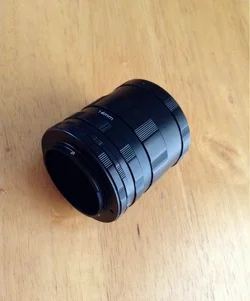
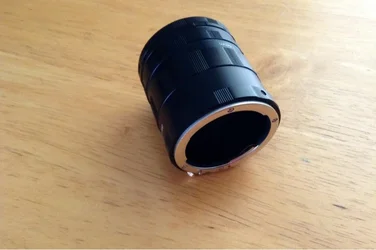
Here are my extension tube photos


$image-648198156.webp


$image-2583690267.webp
 
spanishgirleyes said:
7,14 and 28 mm all stacked together.

With that much extension, life is going to be a pain. Try using JUST the 14mm tube, or JUST the 28mm tube for most subjects. With a longer focal length, like say 150 to 300mm, there will not be a lot of need for a huge amount of extension.

Try to use as little extension as possible, and use lens focal lengths beginning around 45mm or 50mm, and longer. AVOID using short focal lengths with such long extension tubes as 7mm or 14 or 28mm; using even a 7mm tube with a short lens will cause the point of focus to move literally INSIDE of the lens barrel--and no, I am not kidding.
 
With that much extension, life is going to be a pain. Try using JUST the 14mm tube, or JUST the 28mm tube for most subjects. With a longer focal length, like say 150 to 300mm, there will not be a lot of need for a huge amount of extension. Try to use as little extension as possible, and use settings of from 50mm and longer.

Thanks Derrell I will definitely give it a try. I have the 18-55 and 55-300 lens. I guess I should use the 55-300 right ?
 

Create an account or login to comment

You must be a member in order to leave a comment

Create account

Create an account on our community. It's easy!

Log in

Already have an account? Log in here.

New Topics

Back
Top Bottom