Depth of field (DoF) isn't just about the lens aperture.
Indeed it's more about the point of focus distance (PoF), the focal length of the lens used, and the size of the image sensor in the camera.
Using the D60 and 50 mm lens @ f/1.8 and a PoF distance of 3 feet the total DoF is only 0.07 feet deep (about 7/8").
At f/3.5 (2 stops smaller aperture than f/1.8) & a 3 foot PoF distance the DoF would be 0.15 feet (1.8")
At f/5 (3 stops smaller aperture than f/1.8) & a 3 foot PoF distance the DoF would be 0.21 feet (2.5")
At the same aperture setting, as the PoF gets closer to the subject the DoF gets even shallower. At the same aperture setting, as the PoF gets further from the subject the DoF gets deeper.
Few 50 mm f/1.8 lenses deliver their sharpest focus when used wide open.
So the main benefit of stopping down 2 or more stops is getting the 50 mm f/1.8 lens into that part of the aperture range than delivers the sharpest focus.
Online Depth of Field Calculator
f-number - Wikipedia, the free encyclopedia
Online Depth of Field Calculator
Note too the distribution of the DoF changes as the lens aperture is stopped down.
At f/1.8 the DoF distribution is pretty much even with 50% of the 0.15 feet being in front of, and behind the PoF.
But at f/5 the distribution is 48%
in front of, and 52%
behind the PoF.
There are many ways to isolate your subject from the background. A shallow DoF is just one way, but it's also a way that requires an in-depth understanding of how to control the DoF.
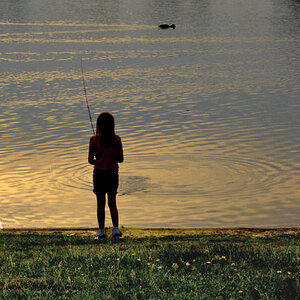
Frankly a better way to isolate the subject from the background is to do so using light.
The quality of the light in your shots leaves quite a bit to be desired, as does the white balance. But the light direction was OK.
Usually, light direction and quality are what separate OK photos from very good photos.



![[No title]](/data/xfmg/thumbnail/36/36673-19735e6d336c221f19091dde4a33c534.jpg?1734169173)
![[No title]](/data/xfmg/thumbnail/39/39440-bc17565eb7adee7f9859c53933e8543c.jpg?1734173530)
![[No title]](/data/xfmg/thumbnail/39/39446-903cfeac143cee6330a51546ecfdda92.jpg?1734173536)