What's new

Hand holding zoom lenses

I'm also an old timer at 70 years old.
I also typically shoot handheld with the same setup (Canon R5, RF 200-800mm lens).

I typically start at a shutter speed of 1/800 sec at 800mm on stationary subjects and then quickly
slower shutter speed and lower ISO.
This photo was from last week 1 /400sec, ISO400, wide open at F9, 800mm
R5__3303.webp


Another example from last week 1 /640 sec, ISO400, wide open at F9, 800mm.
I was shooting in manual, so the actual lighting was brighter than the photo.
redhead_sunrise.webp
 
Last edited:
Sometimes really slow shutter speeds with no tripod be effective.
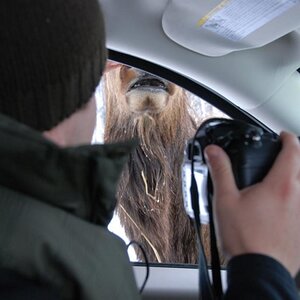
For example, same setup, 1/50th second resting the lens on my vehicle window.
febsnowstorm.webp
 
Whatever it is, your images prove it is an awesome lens.
To my mind it says more of the skill of the photographer. I very rarely manage any decent images with lenses beyond 500mm without a tripod. Often enough I can't even find the subject for framing without at least a monopod.

I would point out however that the holding issue is not to do with zoom lenses but instead long lenses. I have several zooms in the fisheye/ultra wide range which are generally easy to handhold even after the sun has set.
My MTO 1000mm f/11 on the other hand is a real challenge.
 
To my mind it says more of the skill of the photographer. I very rarely manage any decent images with lenses beyond 500mm without a tripod. Often enough I can't even find the subject for framing without at least a monopod.

I would point out however that the holding issue is not to do with zoom lenses but instead long lenses. I have several zooms in the fisheye/ultra wide range which are generally easy to handhold even after the sun has set.
My MTO 1000mm f/11 on the other hand is a real challenge.
Point taken.
 
Sometimes you just take the chance and try lower speeds to help the photo (ISO Specifically). You might be successful you might not be. I find especially with birds you often have just a few seconds before they are gone again out of sight. Problem is making an adjustment in time. If I am set up for a still bird but something starts to fly by no time to make a speed change you aim and shoot and hope for the best. The only downfall on the RF200-800 is its aperture forcing you into higher ISO then you would like especially on overcast days, especially if you after a BIF requiring high shutter speeds. But the challenge is part of the fun. You just know ahead of time not everything will work out but that's okay.

I remember watching a Jan Wegener video on BIF photography. He mentioned that he is pleased if 1 out of 1,000 shots is one he wants to keep. He explained that its a very difficult hit and miss scenario and often you just have to get lucky to catch that one shot you were after. He went on to say make the settings your friend ahead of time so at least you have done everything you could to prepare and then shoot and fire away multiple shots. It was interesting to note he rarely ever shoots below 800 ISO as speed is 2nd to none for this type of photography and a great ISO with a blurry photo due to insufficient speed isnt useful.
 
Sometimes you just take the chance and try lower speeds to help the photo (ISO Specifically). You might be successful you might not be. I find especially with birds you often have just a few seconds before they are gone again out of sight. Problem is making an adjustment in time. If I am set up for a still bird but something starts to fly by no time to make a speed change you aim and shoot and hope for the best. The only downfall on the RF200-800 is its aperture forcing you into higher ISO then you would like especially on overcast days, especially if you after a BIF requiring high shutter speeds. But the challenge is part of the fun. You just know ahead of time not everything will work out but that's okay.

I remember watching a Jan Wegener video on BIF photography. He mentioned that he is pleased if 1 out of 1,000 shots is one he wants to keep. He explained that its a very difficult hit and miss scenario and often you just have to get lucky to catch that one shot you were after. He went on to say make the settings your friend ahead of time so at least you have done everything you could to prepare and then shoot and fire away multiple shots. It was interesting to note he rarely ever shoots below 800 ISO as speed is 2nd to none for this type of photography and a great ISO with a blurry photo due to insufficient speed isnt useful.
Take a look at this: Emergency Action Button: The Secret Weapon for Wildlife & Bird Photography - Backcountry Gallery
 
Sometimes you just take the chance and try lower speeds to help the photo (ISO Specifically). You might be successful you might not be. I find especially with birds you often have just a few seconds before they are gone again out of sight. Problem is making an adjustment in time. If I am set up for a still bird but something starts to fly by no time to make a speed change you aim and shoot and hope for the best. The only downfall on the RF200-800 is its aperture forcing you into higher ISO then you would like especially on overcast days, especially if you after a BIF requiring high shutter speeds. But the challenge is part of the fun. You just know ahead of time not everything will work out but that's okay.

I remember watching a Jan Wegener video on BIF photography. He mentioned that he is pleased if 1 out of 1,000 shots is one he wants to keep. He explained that its a very difficult hit and miss scenario and often you just have to get lucky to catch that one shot you were after. He went on to say make the settings your friend ahead of time so at least you have done everything you could to prepare and then shoot and fire away multiple shots. It was interesting to note he rarely ever shoots below 800 ISO as speed is 2nd to none for this type of photography and a great ISO with a blurry photo due to insufficient speed isnt useful.
All my lenses longer than 500mm are manual focus. Where the action is predictable this isn't too much of an issue, I was shooting bike racing & had focused of the apex of the bend about 150m away where all the bikes went through. When one of them came off he crossed the track & so was a few meters closser. Easily enough to mess the focus, but I find I still like the result:
125 rider midtumble by Mike Kanssen, on Flickr
 

Create an account or login to comment

You must be a member in order to leave a comment

Create account

Create an account on our community. It's easy!

Log in

Already have an account? Log in here.

Back
Top Bottom