What's new

Help, I can't get Macro right...

Prleet

TPF Noob!
Joined
Jun 3, 2012
Messages
3
Reaction score
0
It will appear bigger if you crop a lot closer to the bug. See how close the picture was cropped to the fly? See if that doesn't help you.......... :)
 
Short answer is you won't get a photo quite like that (you'll get the quality, just not the same magnification) with your lens, since that fly shot you link to is taken at a higher magnification than 1:1. However you're not quite ready for that, you've got to master 1:1 first.


However before we can start on that you've got to do some ground work first. We need to know how you take your macro photos currently. What settings are you choosing (any why); what shooting mode are you using; what focusing mode; what additional (if any) lighting are you using?

This info is important as it helps us understand your process, once we understand how you are approaching macro we can see where the possible errors are and make some suggestions. Further some of these things come with practice - so we'll be able to take you so far, but you'll have to put the legwork in putting it from theory into practice.
 
Short answer is you won't get a photo quite like that (you'll get the quality, just not the same magnification) with your lens, since that fly shot you link to is taken at a higher magnification than 1:1. However you're not quite ready for that, you've got to master 1:1 first.


However before we can start on that you've got to do some ground work first. We need to know how you take your macro photos currently. What settings are you choosing (any why); what shooting mode are you using; what focusing mode; what additional (if any) lighting are you using?

This info is important as it helps us understand your process, once we understand how you are approaching macro we can see where the possible errors are and make some suggestions. Further some of these things come with practice - so we'll be able to take you so far, but you'll have to put the legwork in putting it from theory into practice.

Using Manual Focus, fstop veries from 8 to 16, today I got so mad, the fstops might be very high. I use the flash that comes with the camera, always for now doing macro. I know I need to get a diffuser or a o-ring flash. I try to use a tripod but the bugs move around so much or have to wait for the bugs to come to me. The first 5 pics are macros(MacroTest-3 | Flickr - Photo Sharing!) and as you can see they are all flowers. Maybe focus stacking would get rid of the non focus areas.
 
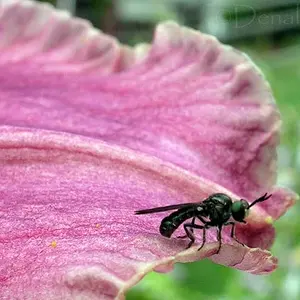
Here's your bug cropped closer, as I suggested:


Bug.jpg


See how it appears bigger. I don't know what resolution you're saving it at. Looks like it might be kinda low. Also looks like a good bit of noise in the picture. What ISO are you shooting at? Which camera are you using? A lower ISO will be less noise. Work on the things Overread said, along with lower ISO (if you can still get the shots), and the closer cropping. It's gonna take some practice too. I've recently got a macro lens, and started doing macros. But, I've not done bug macros yet. May get around to them later though. I'm practicing too...........
 
A lot of macro is lighting ( as is most other photography), but macro seriously needs good lighting. Without it, colors won't be true, diffraction is emphasized, and it is even difficult sometimes to get a sharp, clear shot. Diffused flash is good, as it bright diffused sunlight. The pop-up flash usually won't cut it, although it can be used somewhat succesfully if you diffuse it well, or bounce it.

The shot above has very bad diffraction... obviously a very small aperture was used, with inadequate lighting also.
 
Using Manual Focus, fstop veries from 8 to 16, today I got so mad, the fstops might be very high. I use the flash that comes with the camera, always for now doing macro. I know I need to get a diffuser or a o-ring flash. I try to use a tripod but the bugs move around so much or have to wait for the bugs to come to me. The first 5 pics are macros(MacroTest-3 | Flickr - Photo Sharing!) and as you can see they are all flowers. Maybe focus stacking would get rid of the non focus areas.

Ok a few starting points from what you've said:

1) settings wise I try to go for a low ISO, the fastest shutter speed I can with my flash and a small aperture. As a result the majority of lighting I tend to use is from the flash itself. As a result shooting in manual mode I set the settings of ISO 100, 1/200sec, f13. That is my "benchmark" starting point for macro - I might vary things a little depending on the scene and on how I want the shot to come out, but that is the rough starting point.

2) Lighting wise you can actually get some pretty good light from the cameras popup flash, however it can't give you the light in the right position (its way too far back on the camera). What you can do is use a "snoot" type controller. That is a tube with a white/reflective inside which carries the light from the popup flash to a point just above the end of the lens - you can then angle the light down a little with a tilt in the direction of the reflective material so that it shines out onto the subject.

3) Tripod macro is slow macro. As such you've got to have a situation where you've time to setup and the subject won't move off. Such situations could be:
a) Early in the morning when insects are cold after the night and very torpid

b) Soon after a sudden shower (rainfall) as many larger bugs will get caught out by the sudden temperature drop - again becoming torpid

c) At a feeding point - this could be a flower, a rotting bit of fruit, sugar water spread over a surface etc... (I tend to avoid using honey because honey from different hives will kill other bees - so sugar water is a safe, sweet drink for most bugs).

As you can see there are a few situations where you can get out and find bugs not willing to be moving around - at other times mobility and handheld shooting will come to the fore.

4) Don't try focus stacking, you've got to get good at taking a single keeper shot before you approach taking a whole series of shots for stacking. Get the basics down first before you start branching out. In a similar line of thought don't crop either. Work with the 1:1 magnification and work with those results - learn to use them and see what you get. Once you can get solid 1:1 magnification shots then you can start to consider experimenting in higher magnifications or cropping if you so choose.

 
I guess I was expecting good results too fast too early. Thanks for the pointers. I will keep trying. Will post when better results show up. again, thanks everyone.
 
That shot you linked to isn't 1:1, it's closer. Basically, it's beyond the limits of a normal macro lens.

Exif says 65mm and Canon, so I'm thinking it may be the MP-E 65...


Basically, you will never get anything like that with your lens... Sorry, but it's that simple.
 
I think its interesting that the pic of the fly at the link, the eyes on fly look like a speaker.
 
Basically, you will never get anything like that with your lens... Sorry, but it's that simple.

Maybe not by itself, but add a Bellows or a reverse mounted 35 or 28 on the end and you got some HIGH mag!
 
This is the most you can get after you crop the photo. If I crop it any closer, I will start seeing pixelation. Like Josh said, you need an MP-65. You probably need a flash and a macro tripod as well.
p794144435-4.jpg
 
Like Josh said, you need an MP-65. You probably need a flash and a macro tripod as well.

I don't understand why everyone thinks that the MPE-65 is the only option for high magnification macro.

All taken with a cheap 28mm Pentax lens reverse mounted on an off-brand 2x converter. No MPE-65 there:
Photos : ThomasShahan.com
 
do you have a picture of the setup ? I am seriously thinking about getting and MP-65. Less than $1000 I think is a pretty good price for what it can do.
 
do you have a picture of the setup ? I am seriously thinking about getting and MP-65. Less than $1000 I think is a pretty good price for what it can do.

Here's a video of him using it. @1:00 he tells the setup which in this video is just the reverse 28mm with extension tubes. He also describes the setup for specific photos @2:15

And here's a photo of another variation of his setup posted to his flickr: Macrophotography Setup | Flickr - Photo Sharing!
As stated in the description - "The majority of the time I just use the 28mm mounted to the teleconverter with no bellows".

Now the MPE-65 does give you the ability to focus at infinity, but if I were needing to do that, I wouldn't be using an MPE-65 either :lol:
 
Last edited by a moderator:

Create an account or login to comment

You must be a member in order to leave a comment

Create account

Create an account on our community. It's easy!

Log in

Already have an account? Log in here.

New Topics

Back
Top Bottom