What's new

Highest ISO during Star Photography?

I'm confused. Stacking images would require some mount that follows the earth's rotation, no? 80 30 seconds exposures would take 40 minutes, AT BEST, which means stuff mas moved pretty far.

Or am I missing something extremely obvious, here?
 
Ok...
There is no standard settings for shooting at night. Depending on ambient light you will need to adjust your exposure, F-stop, and ISO to meet the needs of the scene your trying to capture.

Long story short... you need to get out there and figure out what works for different scenarios.

High ISO, Wide Aperture, and Longer Exposure equal more light and more stars.
As mentioned in previous posts shooting an exposure longer then 30seconds (this fluxuate will depending on focal length) you will capture star movement. Also if you cant see the milky way with your own eyes.. you not going to get a good shot of it.


Here are a few examples of images I have taken.

30sec F2.8 11mm ISO3200

Light by Summit42, on Flickr

30sec f2.8 ISO6400

Uintas Camp 7.7.2010 by Summit42, on Flickr


30sec F5.6 ISO800

North Temple Wash 3.26.2010 by Summit42, on Flickr
 
McNugget those are fantastic landscapes, but quite in the realm of the second method I was talking about: Good Camera + Fast Glass.

Or am I missing something extremely obvious, here?

Yep, image processing. When I hit the big green go button in my stacking program the first two steps are 1) identifying stars, 2) aligning images :lmao:

Hence to make the image I posted earlier I had to stack twice with alignment on and off and combine in photoshop because I didn't want my foreground to be a rotational blur.
 
One more thought.... shooting at 10mm will allow you a longer shutter speed than my shots at 28, so you make up a little bit of the difference in aperture.

Can you please explain your thinking in this comment? How will focal legnth alter the exposure? The only thing I can think of is if you are not using a constant aperature zoom and zooming out give an extra stop?

It really doesn't effect the exposure. The wider you shoot the smaller the stars will be hence movement wont be as visible when shooting at 10mm compared to 200mm.
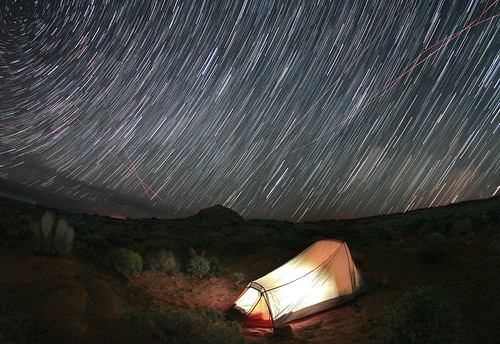
Another factor with star movement that had yet to be discuses is the position of the sky that your shooting. When shooting on the northern hemisphere stars in the south move faster then stars in the north. Here another example shot of mine taken with my 10mm fisheye with a 167° viewing angle. This is a series of stacked images to create the the star trails...this is NOT the same stacking method as mentioned in previous posts.
Anyways... notice the star movement is longer on the southern portion of the image. The cloudy area in the center right is the milky way moving across the sky in the during the 35min


Starry Night in Escalante by Summit42, on Flickr

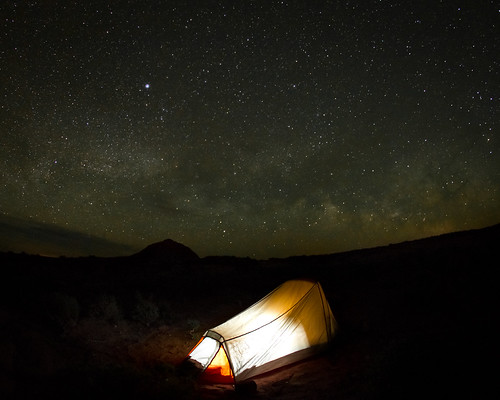
here is a single exposure form the above stack for comparison

Camp by Summit42, on Flickr
 

Create an account or login to comment

You must be a member in order to leave a comment

Create account

Create an account on our community. It's easy!

Log in

Already have an account? Log in here.

Back
Top Bottom