You'll be amazed how many times you can find something like dead bee and its not actually dead but just cold. The cold affects their metabolism and a sudden cold snap (say a rainstorm) can catch bees out and about unawares - suddenly their internal temperature drops and they basically shut down. Unable to move or react even if they wanted to.
Once the sun gets on them they warm up and return to life again. Thus after rainfall and early in the mornings are great times to get bugs in that torpid state of being too cold to move around.
Now to the photo:
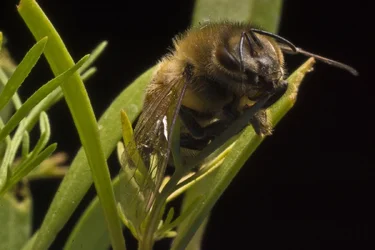
1) Lighting looks generally nice and soft, a bit of highlight on the wing, but that's a very tricky area to get perfect because of its highly reflective nature. Out of interest what kind of lighting were you using for this shot?
The lighting does look a bit underexposed though, a touch darker than ideal.
2) Background has gone to black which suggests the flash was dominant in the shot, and thus the fast fall-off meant the full background was too far to be lit. Some like the black background, others don't - its a personal taste thing really. If you want the background you can try using a slower shutter speed and a tripod to raise the ambient light component - ideal for a static shot in no wind, but of course not practical when there is even a light wind or a moving subject. The other option is to use a higher ISO, with good lighting you can raise the ambient with minimal effect to the noise in the shot (look up "expose to the right" theory).
3) Composition - feels a touch off.
To my eye you've got two areas of the shot. The first on the left is the grass stem curving to the left corner. It's not a hugely interesting point, but the way it curves and the nature of the other part of the shot makes it an "element". Yet I would say its a distracting element not necessarily needed in the shot.
The other part is the bee itself; and the bee feels squashed. The angle with the camera is good and you've got the eye, but the bee on its stem is giving you a neat leading line up toward the upper right; but the head of the bee is so close to the boarder that the viewers direction of following (we like to follow visual prompts like leading lines and the direction of focus of an animal/person) has no where to move into - it hits that boarder fast.
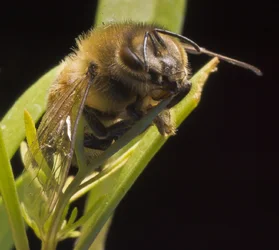
A nudge to the right with the framing when taking the shot would have helped - at this stage cropping the left off would, I think, help.





![[No title]](/data/xfmg/thumbnail/41/41893-f4e56dae79851bac6e79639bcf9e7473.jpg?1734176246)